Introduction
Whether you’re a dental student preparing for clinical practice, a dentist building your instrument tray, a supplier expanding your catalog, or simply a patient curious about what happens during a dental visit, understanding common dental instruments and uses can make dentistry far less intimidating.
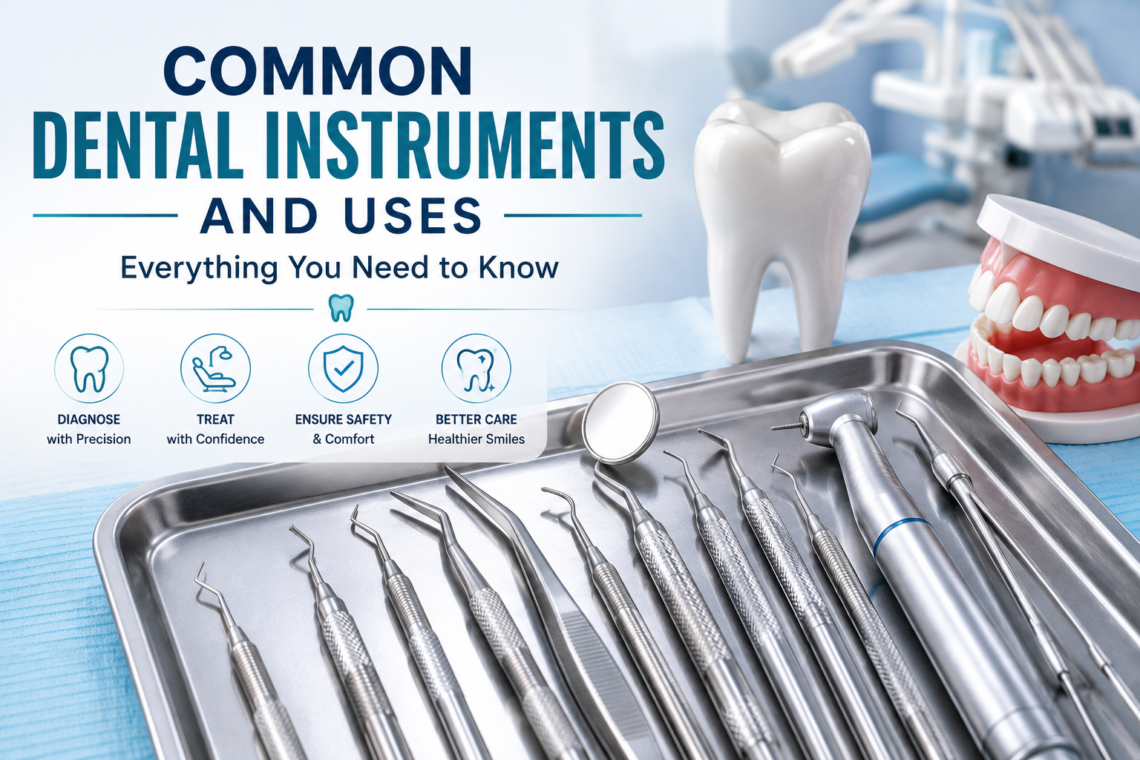
Every dental procedure—from a routine checkup to a complex tooth extraction—depends on specialized instruments designed for precision, safety, and patient comfort. Diagnostic instruments help identify oral diseases, periodontal tools support gum treatment, restorative instruments repair damaged teeth, and surgical instruments enable safe oral procedures. Recent guides also emphasize the importance of infection control, ergonomics, and instrument organization in delivering efficient patient care.
Types of Common Dental Instruments and Their Uses
Dental instruments are designed for specific clinical tasks. While there are hundreds of specialized tools used in dentistry, most fall into a few core categories. Understanding these categories helps dental professionals organize procedures efficiently and gives patients a better understanding of what happens during treatment.
Diagnostic Dental Instruments
Diagnostic instruments are the first tools a dentist uses during a routine examination. Their purpose is to detect cavities, gum disease, plaque buildup, fractures, and other oral health issues before treatment begins.
Mouth Mirror
The mouth mirror is one of the most recognizable dental instruments.
Uses:
- Provides indirect vision inside the mouth
- Retracts the cheeks and tongue
- Reflects light into difficult-to-see areas
- Improves visibility during treatment
Dental Explorer
Often called a “dental probe,” the explorer has a sharp, flexible tip.
Primary Uses
- Detecting tooth decay
- Identifying pits and fissures
- Checking defective fillings
- Locating calculus deposits
- Evaluating restoration margins
Periodontal Probe
Unlike the explorer, the periodontal probe contains millimeter markings.
It measures:
- Gum pocket depth
- Gum recession
- Attachment loss
- Signs of periodontal disease
Healthy gum pockets generally measure 1–3 mm, while deeper pockets may indicate gum disease requiring further treatment.
Cotton Pliers (College Tweezers)
Cotton pliers safely transfer small materials without contaminating them.
Common applications include:
- Holding cotton pellets
- Placing wedges
- Carrying small restorations
- Retrieving objects from the mouth
Periodontal Instruments
Periodontal instruments are designed to prevent, diagnose, and treat gum disease by removing plaque, tartar (calculus), and diseased tissue.
Dental Scalers
Scalers remove hardened tartar from tooth surfaces, especially above the gum line.
Common Types
- Sickle scaler
- Jacquette scaler
- Hoe scaler
For a closer comparison of scaling instruments & common dental instruments and uses, see Manual vs Ultrasonic Scalers: Which Should You Buy?
Curettes
Curettes are smoother and more rounded than scalers, allowing safe cleaning below the gum line.
Popular types include:
- Universal curettes
- Gracey curettes
Ultrasonic Scaler
Modern clinics frequently use ultrasonic scalers that vibrate at high frequencies while spraying water.
Advantages
- Faster cleaning
- Less operator fatigue
- Better patient comfort
- Efficient stain removal
- Reduced treatment time
Restorative Dental Instruments
Restorative instruments help repair damaged teeth after decay has been removed.
Dental Excavator
A dental excavator removes softened or decayed dentin before placing a filling.
Common Uses
- Removing carious dentin
- Cleaning cavity preparations
- Conserving healthy tooth structure
For more information about restorative treatment, see Organic Filling Solutions: Dental Health Alternatives Explained.
Composite Placement Instrument
These instruments shape and adapt composite filling material.
Functions include:
- Layering composite resin
- Contouring restorations
- Smoothing surfaces
- Preventing voids
Burnisher
Burnishers polish and contour restorative materials.
They improve:
- Marginal adaptation
- Restoration anatomy
- Surface smoothness
- Longevity of restorations
Condenser (Plugger)
Condensers compress restorative materials to eliminate air pockets and improve strength.
Commonly used with:
- Amalgam
- Temporary restorations
- Base materials
Rotary Dental Instruments
Rotary instruments are powered devices that cut, polish, shape, and finish teeth and restorations.
High-Speed Handpiece
Operating at up to 400,000 RPM, the high-speed handpiece is essential for:
- Removing tooth structure
- Crown preparation
- Cavity preparation
- Cutting enamel
It uses water spray to reduce heat and protect the tooth.
For proper maintenance and longer equipment performance, see Dental Handpiece Maintenance: The Complete Guide for Long-Lasting Performance.
Low-Speed Handpiece
The low-speed handpiece is used for more controlled procedures, including:
- Polishing teeth
- Finishing restorations
- Removing temporary cement
- Adjusting appliances
Dental Burs
Dental burs attach to handpieces and come in various shapes and materials.
Common materials:
- Diamond burs
- Carbide burs
- Steel burs
- Ceramic burs
Each type is selected based on the procedure and the material being cut.
Surgical, Endodontic, Orthodontic, and Infection Control Instruments
As dental treatments become more advanced, specialized instruments are required to perform procedures safely, efficiently, and with maximum precision. Whether extracting a tooth, performing a root canal, or placing braces, each instrument is carefully designed for a specific clinical purpose.
Surgical Dental Instruments
Surgical dental instruments are used during oral surgery, tooth extractions, implant procedures, and other surgical treatments. These tools are designed to minimize trauma to surrounding tissues while improving precision.
Dental Forceps
Dental forceps are among the most recognizable surgical instruments. They are designed to securely grasp and remove teeth after they have been loosened.
Common Uses
- Tooth extraction
- Removing retained roots
- Extracting damaged teeth
- Removing impacted teeth (in combination with elevators)
Dental Elevators
Before forceps are used, dentists often loosen the tooth with an elevator.
Functions
- Loosen periodontal ligament
- Expand the socket
- Lift retained roots
- Assist with impacted teeth
For another important restorative procedure, read Root Canal vs Tooth Extraction.
Surgical Curettes
These instruments remove infected tissue from extraction sockets.
They are commonly used for:
- Cleaning extraction sites
- Removing cystic tissue
- Eliminating infected debris
- Preparing implant sites
Surgical Scissors
Dental scissors cut soft tissue and surgical materials.
Applications include:
- Trimming tissue
- Cutting sutures
- Periodontal surgery
- Oral surgery
Needle Holder
A needle holder securely grips surgical needles during suturing.
Benefits include:
- Precise stitching
- Better wound closure
- Improved healing
- Reduced tissue trauma
Endodontic Instruments
Endodontic instruments are specifically designed for root canal therapy. Their purpose is to clean, shape, disinfect, and seal the root canal system while preserving the natural tooth.
Endodontic Files
Endodontic files clean and enlarge root canals.
Popular types include:
- K-Files
- H-Files
- Rotary NiTi Files
Endodontic Reamers
Reamers have fewer spirals than files and are mainly used to enlarge root canals.
Advantages include:
- Smooth canal preparation
- Efficient dentin removal
- Better irrigation access
Barbed Broach
Although used less frequently today, a barbed broach removes pulp tissue from the canal before cleaning and shaping.
Gutta-Percha Carrier
After cleaning the canal, dentists fill it with gutta-percha to prevent reinfection.
The carrier helps:
- Deliver filling material
- Seal canals completely
- Improve long-term success
Orthodontic Instruments
Orthodontic instruments are used during the placement, adjustment, and removal of braces and other orthodontic appliances.
Bracket Positioning Tweezer
Used to accurately place orthodontic brackets on teeth.
Ligature Cutter
This instrument cuts orthodontic wires after they have been placed.
Distal End Cutter
A distal end cutter trims excess wire while holding the cut piece to prevent it from falling into the patient’s mouth.
Band Removing Pliers
These pliers safely remove orthodontic bands without damaging the teeth.
Dental Isolation and Suction Equipment
Maintaining a dry, clean working area is essential for accurate and successful dental procedures.
Saliva Ejector
A saliva ejector continuously removes saliva during treatment.
Benefits
- Keeps the field dry
- Improves visibility
- Enhances patient comfort
For a deeper look at why saliva is important to oral health, read What Is the Role of Saliva in Dental Health?
High-Volume Evacuator (HVE)
The HVE removes:
- Water spray
- Blood
- Debris
- Aerosols
Rubber Dam
A rubber dam isolates the treatment area from moisture.
It is especially important for:
- Root canals
- Composite fillings
- Adhesive restorations
Sterilization and Infection Control Instruments
Infection prevention is one of the most critical aspects of modern dentistry. Every reusable instrument must be properly cleaned, disinfected, packaged, and sterilized before being used on another patient.
For a more detailed guide to dental infection prevention, see Best Practices for Infection Control in Dentistry.
Instrument Cassette
An instrument cassette organizes instruments for a specific procedure and reduces handling during cleaning and sterilization.
Sterilization Pouches
Sterilization pouches protect instruments during steam sterilization and help maintain sterility until use.
Autoclave
An autoclave sterilizes instruments using high-pressure steam to eliminate bacteria, viruses, fungi, and spores.
Advantages
- Highly effective
- Reliable
- Standard of care in dental clinics
- Suitable for most reusable instruments
Latest Trends in Dental Instruments
Dental technology continues to evolve, helping clinicians provide faster, safer, and more comfortable care.
1. Ergonomic Instrument Design
Manufacturers now produce lightweight instruments with wider, textured handles that reduce hand fatigue and improve grip during long procedures.
Benefits
- Better control
- Less muscle strain
- Improved clinician comfort
- Reduced risk of repetitive stress injuries
2. Digital Dentistry Integration
Digital workflows are transforming dental practices.
Examples include:
- Intraoral scanners replacing traditional impressions
- CAD/CAM systems for same-day restorations
- Digital treatment planning
- 3D printing of dental models and surgical guides
3. Advanced Rotary Systems
Modern nickel-titanium (NiTi) rotary systems offer greater flexibility and efficiency, especially in root canal treatments.
4. Improved Infection Control
Recent innovations include:
- Color-coded instrument cassettes
- Single-use disposable items for specific procedures
- Enhanced sterilization monitoring systems
- Instrument tracking with barcodes or RFID in larger clinics
5. Smart Materials
Dental instruments are increasingly paired with advanced restorative materials that improve bonding, durability, and esthetics.
Frequently Asked Questions (FAQs)
1. What are the most common dental instruments and uses during a routine examination?
A routine dental examination typically involves a mouth mirror, dental explorer, periodontal probe, and cotton pliers. These instruments help dentists inspect teeth, gums, and other oral tissues for signs of disease or damage.
2. Why is the mouth mirror important?
The mouth mirror improves visibility, reflects light into hard-to-see areas, retracts soft tissues, and allows dentists to examine surfaces that cannot be viewed directly.
3. What is the difference between a scaler and a curette?
A scaler is primarily used to remove plaque and tartar above the gum line, while a curette has a rounded tip designed to clean below the gum line during periodontal therapy.
4. Which instruments are used for tooth extractions?
Tooth extractions commonly require elevators to loosen the tooth and forceps to grasp and remove it. Additional surgical instruments may be used depending on the complexity of the procedure.
5. What are rotary dental instruments?
Rotary instruments include high-speed and low-speed handpieces, along with dental burs. They are used to cut, shape, polish, and finish teeth and restorative materials.
Conclusion
Understanding common dental instruments and uses is essential for dental professionals, students, suppliers, and even patients who want to better understand modern dental care. From basic diagnostic tools like the mouth mirror and periodontal probe to specialized surgical instruments, rotary systems, and endodontic files, each instrument has a specific purpose that supports accurate diagnosis, efficient treatment, and patient safety.
As dentistry continues to advance through digital technologies, ergonomic innovations, and improved infection-control practices, selecting high-quality instruments and maintaining them properly has become more important than ever. Whether you’re equipping a new dental practice, studying clinical procedures, or expanding a dental supply business, investing in reliable instruments and following best practices will contribute to better outcomes, greater efficiency, and long-term success.
Call to Action
Looking for reliable, high-quality dental instruments for your clinic, laboratory, or distribution business?
Explore our extensive selection of diagnostic, periodontal, restorative, surgical, endodontic, orthodontic, and rotary instruments designed to meet modern clinical standards. Our products are built for precision, durability, and dependable performance, helping dental professionals deliver exceptional patient care.