Choosing the right endodontic files is an important decision for any dental practice performing root canal treatment. These small precision instruments play a major role in cleaning, shaping, and preparing root canals for successful obturation. However, with different file types, materials, sizes, tapers, lengths, and motion systems available, selecting the right option can be confusing for beginners.
A suitable endodontic file should match the canal anatomy, treatment technique, clinician’s experience, and equipment available in the practice. Stainless-steel hand files may be ideal for canal exploration and glide-path preparation, while nickel-titanium rotary or reciprocating files can improve efficiency and flexibility during shaping.
This beginner’s buying guide explains the main types of endodontic files, how file sizes and tapers work, what materials to consider, and the most important factors to evaluate before purchasing.
What Are Endodontic Files?
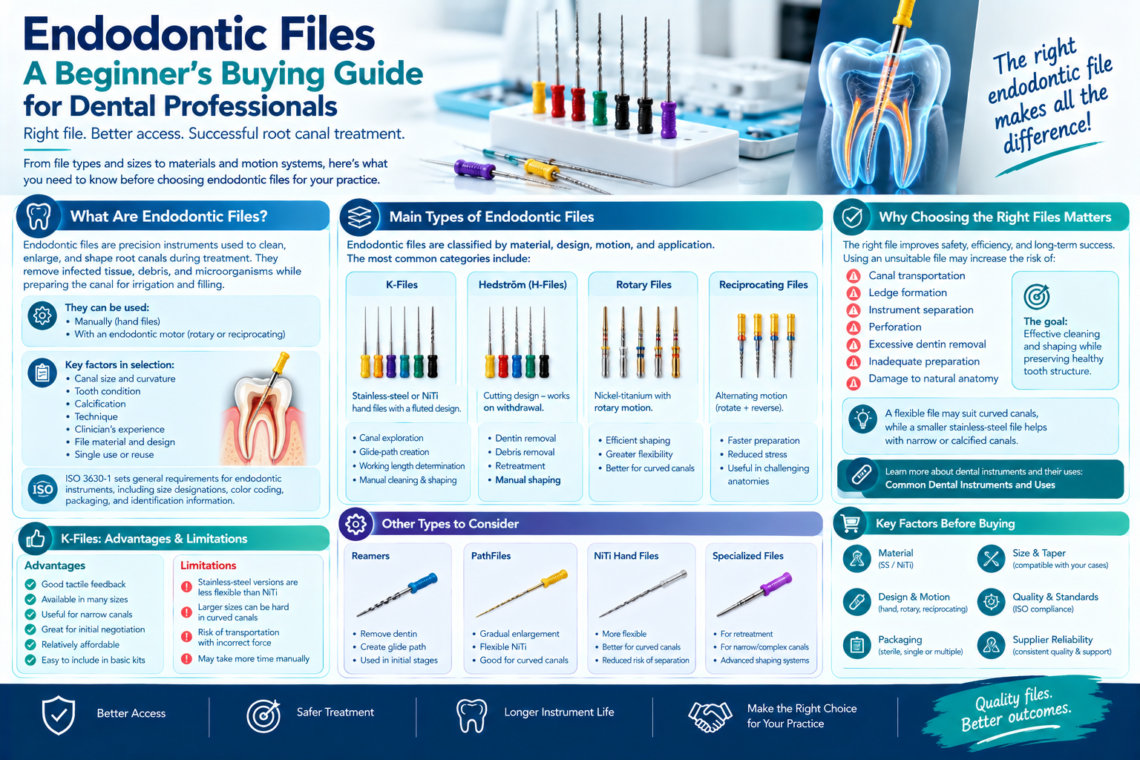
Endodontic files are specialized dental instruments used to clean, enlarge, and shape the root canal system during endodontic treatment. They help remove infected tissue, dentin debris, and microorganisms while creating a suitable canal shape for irrigation and filling.
Endodontic files may be operated manually or with an endodontic motor. Traditional hand files are commonly used during canal exploration, working-length verification, and glide-path preparation. Rotary and reciprocating systems are designed to shape canals more efficiently using controlled mechanical motion.
The choice of file depends on several factors, including:
- The size and curvature of the canal
- The condition of the tooth
- The presence of calcification
- The desired preparation technique
- The clinician’s experience
- The file material and design
- Whether the file is intended for single use or reuse
ISO 3630-1 establishes general requirements for endodontic instruments, including size designations, color coding, packaging, and identification information.
Why Choosing the Right Endodontic Files Matters
File selection is not simply a matter of purchasing the most expensive system. The instrument must be appropriate for the clinical situation and compatible with the technique being used.
Using an unsuitable file may increase the risk of:
- Canal transportation
- Ledge formation
- Instrument separation
- Perforation
- Excessive dentin removal
- Inadequate canal preparation
- Damage to the natural canal anatomy
A flexible file may be more suitable for curved canals, while a smaller stainless-steel hand file may be useful for negotiating a narrow or calcified canal. The goal is to achieve effective cleaning and shaping while preserving as much healthy tooth structure as possible.
For a broader overview of dental instruments and their clinical applications, see the Dentistry Supplier guide on Common Dental Instruments and Uses.
Main Types of Endodontic Files
Endodontic files can be classified according to their material, design, motion, and intended application. The most common categories include stainless-steel hand files, nickel-titanium rotary files, reciprocating files, and specialized shaping instruments.
1. K-Files
K-files are among the most widely used hand instruments in endodontics. They are commonly manufactured by twisting a stainless-steel or nickel-titanium blank into a fluted design.
K-files are commonly used for:
- Canal exploration
- Initial negotiation
- Working-length determination
- Glide-path creation
- Manual cleaning and shaping
- Apical patency procedures, when clinically appropriate
They can be used with controlled motions such as watch-winding, filing, and balanced-force techniques, depending on the instrument and the clinician’s training.
Advantages of K-Files
- Good tactile feedback
- Available in many sizes
- Useful for narrow canals
- Suitable for initial canal negotiation
- Relatively affordable
- Easy to incorporate into basic endodontic kits
Limitations of K-Files
- Stainless-steel versions are less flexible than NiTi instruments
- Larger sizes may be difficult to use in sharply curved canals
- Incorrect force or technique can contribute to canal transportation
- Manual instrumentation may require more time
2. Hedström Files or H-Files
Hedström files, commonly called H-files, have a different cutting design from K-files. Their flutes are designed primarily to cut when the file is withdrawn rather than during aggressive rotational movement.
H-files may be used for:
- Filing dentin from canal walls
- Removing debris in selected situations
- Retreatment procedures
- Certain manual shaping techniques
- Removing gutta-percha when appropriate
H-files should be used carefully. They are generally not intended for forceful rotation because this can increase the risk of locking into dentin or fracturing the instrument.
3. K-Reamers
K-reamers are designed primarily for reaming motions. They usually have fewer flutes than K-files, allowing them to cut during controlled rotational movement.
They may be used for:
- Canal enlargement
- Manual reaming
- Initial shaping
- Specific endodontic techniques that require rotational instrumentation
The distinction between a K-file and a K-reamer relates mainly to flute design and intended motion. In practice, the exact use should follow the manufacturer’s instructions and the clinician’s training.
4. Nickel-Titanium Rotary Files
Nickel-titanium, commonly abbreviated as NiTi, transformed endodontic instrumentation because of its flexibility, shape-memory characteristics, and superelastic behavior.
NiTi rotary files are used with an endodontic motor that operates at manufacturer-specified speed and torque settings. They are designed to create a reproducible canal shape while reducing the time required for mechanical preparation.
Advantages of NiTi Rotary Files
- Greater flexibility than traditional stainless-steel files
- Better ability to follow curved canals
- Efficient mechanical shaping
- Reduced operator fatigue in many procedures
- Available in different tapers and designs
- Can help maintain canal curvature when used correctly
Limitations of NiTi Rotary Files
- Require appropriate training
- Depend on correct motor settings
- Can fracture without obvious visible warning
- May be damaged by excessive pressure or incorrect use
- Cost more than basic hand files
- Must be selected according to the specific system’s protocol
A review of rotary endodontic instruments highlights the importance of alloy properties, instrument geometry, motion, and fracture prevention when selecting NiTi systems.
5. Reciprocating Files
Reciprocating files operate using alternating clockwise and counterclockwise movements rather than continuous rotation. Many modern reciprocating systems are manufactured from heat-treated NiTi alloys.
They are designed to simplify canal shaping by using a specific file sequence, sometimes involving a single primary shaping instrument or a limited number of files.
Potential Benefits
- Simplified instrumentation sequences
- Efficient canal preparation
- Useful flexibility in curved canals
- Reduced continuous rotational stress in certain systems
- Compatibility with dedicated reciprocating motors
However, reciprocating files are not automatically risk-free. They can still separate if used incorrectly, overused, forced, or applied in a canal that exceeds their design limitations.
Stainless Steel vs. Nickel-Titanium Endodontic Files
One of the most important buying decisions is whether to purchase stainless-steel hand files, NiTi files, or a combination of both.
| Feature | Stainless-Steel Files | Nickel-Titanium Files |
| Flexibility | Lower, especially in larger sizes | Higher |
| Tactile feedback | Strong | Different and sometimes less direct |
| Common use | Exploration and glide path | Mechanical shaping |
| Curved canals | More challenging in larger sizes | Generally more suitable |
| Cost | Usually lower | Usually higher |
| Motion | Mostly manual | Rotary or reciprocating |
| Fracture concerns | Deformation and torsional stress | Cyclic fatigue and torsional stress |
Stainless-steel files remain valuable because they provide tactile control during initial canal negotiation. NiTi files are often preferred for shaping canals with complex curvature, but they require careful technique and adherence to the manufacturer’s instructions.
For a related material comparison, read Stainless Steel vs Titanium Dental Instruments.
Understanding Endodontic File Sizes
Endodontic file sizes are generally identified using a number that corresponds to the approximate tip diameter in hundredths of a millimeter.
For example:
- A size 10 file has an approximate tip diameter of 0.10 mm
- A size 15 file has an approximate tip diameter of 0.15 mm
- A size 20 file has an approximate tip diameter of 0.20 mm
- A size 25 file has an approximate tip diameter of 0.25 mm
- A size 30 file has an approximate tip diameter of 0.30 mm
These measurements refer to the nominal file tip size. Actual dimensions and tolerances may vary according to the manufacturer, instrument design, and applicable standards.
Common ISO Color Coding
Traditional ISO color coding helps clinicians identify file sizes quickly. Common examples include:
| File Size | Common Color |
| 06 | Pink |
| 08 | Gray |
| 10 | Purple |
| 15 | White |
| 20 | Yellow |
| 25 | Red |
| 30 | Blue |
| 35 | Green |
| 40 | Black |
Color coding may vary in appearance or application across proprietary systems, so clinicians should always verify the manufacturer’s labeling and instructions.
ISO/TR 3630-6:2023 also describes a numeric coding system that identifies characteristics such as instrument type, nominal size, taper, length, working-part material, and handle or shank details.
What Does File Taper Mean?
Taper describes how much the diameter of a file increases from the tip along the working portion of the instrument.
A conventional 0.02 taper increases approximately 0.02 mm in diameter for every 1 mm from the file tip. A 0.06 taper increases approximately 0.06 mm per millimeter.
For example, a size 25 file with a 0.06 taper has:
- A tip diameter of approximately 0.25 mm
- A diameter of approximately 0.31 mm at 1 mm from the tip
- A diameter of approximately 0.37 mm at 2 mm from the tip
Higher-taper files can create a more pronounced canal shape, but they may also remove more dentin and experience greater stress in certain regions of the canal. Taper should therefore be selected according to canal anatomy, treatment objectives, and the file system’s recommended sequence.
Choosing the Correct File Length
Endodontic files are commonly available in lengths such as:
- 21 mm
- 25 mm
- 28 mm
- 31 mm
A 25 mm file is often considered a versatile option for many routine cases. Shorter files may be convenient when access is limited, while longer files may be necessary for long-rooted teeth or specific clinical situations.
When choosing file length, consider:
- Tooth type
- Root length
- Access cavity design
- Working length
- Patient anatomy
- Handpiece or motor access
- The length of the file’s working portion and shank
A file that is too short may not reach the required working length. A file that is unnecessarily long may make access and control more difficult.
Important Factors to Consider Before Buying Endodontic Files
1. Intended Clinical Application
First, determine what the files will be used for. A beginner’s endodontic kit may require small hand files for exploration and glide-path creation, while a practice performing advanced root canal procedures may need rotary or reciprocating systems.
2. File Material and Metallurgy
Material affects flexibility, cutting behavior, fatigue resistance, and handling characteristics.
Different heat-treated NiTi alloys may have different mechanical properties. However, no alloy eliminates the need for correct technique and inspection.
3. File Geometry
File geometry includes:
- Cross-sectional design
- Cutting-edge configuration
- Tip design
- Taper
- Helical angle
- Pitch
- Core diameter
- Flute depth
4. Compatibility With the Endodontic Motor
Rotary and reciprocating files must be compatible with the motor used in the clinic.
Using a rotary file at incorrect speed or torque settings can increase the risk of file damage or separation.
5. Single-Use and Reuse Policy
Some endodontic files are marketed for single use, while others may be reused according to the manufacturer’s instructions and the clinic’s infection-control policy.
6. Packaging and Traceability
Reliable packaging helps protect instruments from contamination, moisture, and damage before use. Check whether the packaging clearly identifies:
7. Supplier Reputation and Quality Control
A dependable dental supplier should provide clear product information and consistent quality. Extremely low prices may be attractive, but they can create problems if the files have inconsistent dimensions, poor surface finishing, weak handles, or unreliable packaging.
How to Inspect Endodontic Files Before Use
Even new files should be checked before clinical use. A basic inspection may include looking for:
- Bent tips
- Unwound flutes
- Irregular cutting edges
- Surface defects
- Corrosion
- Damaged handles
- Packaging damage
- Incorrect size or taper labeling
Common Buying Mistakes to Avoid
Beginners may make several mistakes when purchasing endodontic files.
Buying Only One File Type
No single file category is suitable for every clinical situation. A balanced inventory usually includes hand files for exploration and glide-path procedures, along with shaping instruments appropriate for the practice’s treatment techniques.
Ignoring File Size and Taper
Purchasing files without understanding size and taper can lead to an incomplete or unsuitable inventory. Make sure the sequence includes the sizes and tapers needed for the procedures performed in the clinic.
Choosing Based Only on Price
Low cost does not always mean good value. Poor-quality files may produce inconsistent results, require frequent replacement, or increase the risk of instrument problems.
Using Rotary Files Without Proper Training
Rotary and reciprocating systems require knowledge of canal anatomy, file motion, motor settings, irrigation, and instrument limitations. Beginners should follow formal training and manufacturer instructions before using mechanical systems independently.
Reusing Files Indefinitely
Repeated use can contribute to fatigue, deformation, and reduced reliability. Reuse should never be based solely on whether a file still looks acceptable.
Ignoring Storage and Sterilization Instructions
Improper storage, moisture exposure, or incorrect processing may damage instruments. Always follow the manufacturer’s instructions and the clinic’s infection-control procedures.
For additional guidance on protecting dental instruments and maintaining equipment, read the Dental Equipment Maintenance Checklist.
Frequently Asked Questions About Endodontic Files
What are endodontic files used for?
Endodontic files are used to explore, clean, enlarge, and shape root canals during root canal treatment. They help remove tissue and debris and prepare the canal for irrigation and obturation.
What is the difference between K-files and H-files?
K-files are commonly used for canal exploration, glide-path creation, and manual shaping. H-files, or Hedström files, are designed primarily to cut during withdrawal and should not be aggressively rotated because this may increase the risk of fracture.
Are stainless-steel or NiTi endodontic files better?
Neither material is universally better for every situation. Stainless-steel files provide useful tactile feedback and are commonly used during initial canal negotiation. NiTi files offer greater flexibility and are often preferred for shaping curved canals.
What does a size 25 endodontic file mean?
A size 25 file has a nominal tip diameter of approximately 0.25 mm. The actual design, tolerance, and dimensions may vary depending on the manufacturer and file system.
What does taper mean in endodontic files?
Taper describes the increase in a file’s diameter along its working length. For example, a 0.06 taper increases approximately 0.06 mm in diameter for every millimeter from the tip.
Conclusion
Choosing endodontic files becomes easier when the buying decision is based on clinical purpose rather than brand popularity or price alone. Beginners should understand the differences between K-files, H-files, K-reamers, NiTi rotary files, and reciprocating systems before building an inventory.
File size, taper, length, material, geometry, motor compatibility, packaging, and reuse instructions all influence the suitability of an instrument. Stainless-steel hand files remain valuable for exploration and glide-path preparation, while NiTi systems can provide flexibility and efficient shaping when used correctly.
The best approach is to purchase reliable instruments from a reputable dental supplier, follow manufacturer instructions, inspect files carefully, and select systems that match the clinician’s training and the anatomy encountered in everyday practice.
CTA
Looking for reliable dental instruments for your practice? Explore Dentistry Supplier’s range of dental products and educational resources to learn more about instrument quality, selection, maintenance, and clinical applications before making your purchasing decision.