When a damaged, weakened, or heavily decayed tooth needs protection, a dental crown can restore its strength, shape, and appearance. However, patients are often faced with an important choice: should they receive a same-day crown made in the dental office, or a traditional crown fabricated by an outside dental laboratory?
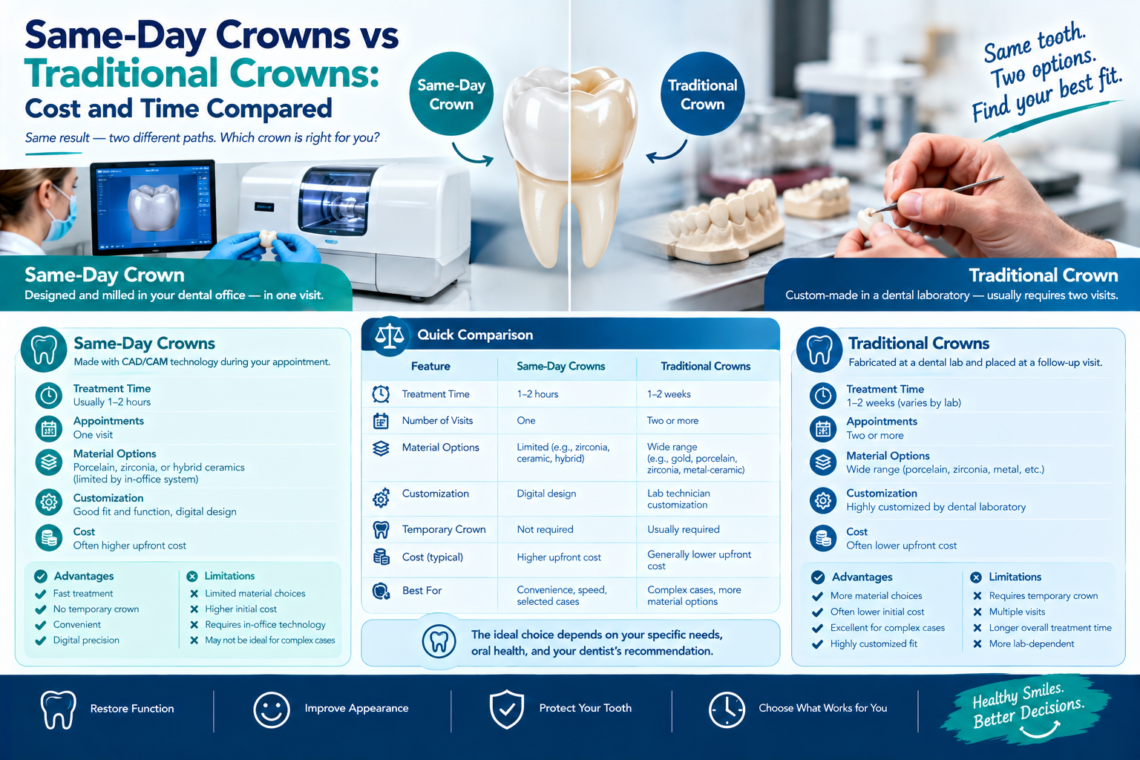
The main differences between same-day crowns vs traditional crowns involve treatment time, number of appointments, material options, customization, and cost. Same-day crowns are designed and milled using digital technology during one appointment, while traditional crowns generally require a temporary restoration and a second visit.
Neither option is automatically best for every patient. The right choice depends on the tooth’s location, the amount of remaining tooth structure, bite forces, cosmetic expectations, available technology, and the dentist’s recommendation.
This guide explains the differences between same-day and traditional crowns, compares their cost and treatment time, and outlines the advantages and limitations of each option.
What Are Dental Crowns?
A dental crown is a custom-made restoration that covers and protects a damaged or weakened tooth. It restores the tooth’s shape, function, and appearance while helping prevent further damage.
Dentists may recommend a crown when a tooth has:
- Extensive decay
- A large filling that has weakened the tooth
- A crack or fracture
- Significant wear
- A root canal treatment
- A cosmetic or structural defect
- Insufficient strength to support another restoration
For additional information about crown longevity, read How Long Do Dental Crowns Last?.
What Are Same-Day Crowns?
Same-day crowns are dental crowns designed, manufactured, and placed during one extended dental appointment. They are often created using CAD/CAM technology, which stands for computer-aided design and computer-aided manufacturing.
During the procedure, the dentist generally:
- Examines and prepares the tooth.
- Captures a digital scan of the prepared tooth.
- Designs the crown using specialized software.
- Mills the crown from a ceramic or other suitable material.
- Finishes, checks, adjusts, and bonds the crown in place.
Some same-day crown systems are commonly associated with brands such as CEREC, although the exact equipment and workflow vary between dental practices.
A same-day crown may allow a patient to leave the clinic with a permanent restoration after one appointment, eliminating the need for a temporary crown in many suitable cases. Modern digital workflows can reduce laboratory-related delays, although the total appointment may still take several hours.
What Are Traditional Crowns?
Traditional crowns, also called lab-made crowns, are fabricated in a dental laboratory rather than being fully manufactured inside the dental office.
The traditional process usually includes two main appointments.
First Appointment
During the first visit, the dentist:
- Examines the tooth
- Administers local anesthesia
- Removes decay or damaged tooth structure
- Shapes the tooth for crown placement
Second Appointment
Once the crown is ready, the patient returns to the dental office. The dentist:
- Removes the temporary crown
- Checks the permanent crown’s fit
- Evaluates the bite and contacts
- Reviews the appearance
Same-Day Crowns vs Traditional Crowns: Quick Comparison
| Feature | Same-Day Crowns | Traditional Crowns |
| Number of visits | Usually one | Usually two or more |
| Manufacturing location | Dental office | External dental laboratory |
| Production method | Digital design and chairside milling | Laboratory fabrication |
| Temporary crown | Often not required | Usually required |
| Treatment time | Often completed in a few hours | Commonly takes one to several weeks |
| Material options | May be more limited | Generally broader |
| Customization | Good for many cases | Extensive options for complex cases |
| Cost | Varies by practice and material | Varies by practice, material, and laboratory |
| Best suited for | Suitable cases needing quick restoration | Complex, highly customized, or material-specific cases |
Same-day crowns are generally faster, while traditional crowns may provide greater flexibility in material selection and laboratory customization. Research comparing digital and conventional crown workflows has found that modern digital methods can produce clinically acceptable restorations, but outcomes depend on the specific system, material, preparation, and clinical workflow.
Same-Day Crowns vs Traditional Crowns: Treatment Time
Time is one of the clearest differences between the two options.
How Long Do Same-Day Crowns Take?
A same-day crown appointment may take approximately two to four hours, although the exact duration depends on:
- Tooth location
- Number of crowns being placed
- Tooth preparation requirements
- Digital scanning time
- Crown design complexity
- Milling and finishing time
- Occlusal adjustments
- Cementation or bonding
- Whether additional treatment is required
A simple case may be completed more quickly, while a complex case may take longer. The phrase “same-day” refers to completing the crown within one visit, not necessarily completing the procedure in a short appointment.
How Long Do Traditional Crowns Take?
Traditional crowns typically require:
- One appointment for preparation and impressions
- A temporary crown period
- A second appointment for final placement
The laboratory production period may range from approximately one to three weeks, although some clinics and laboratories may work faster or require more time. Complex cases, custom shading, specialized materials, shipping, and laboratory adjustments can extend the timeline.
Time Comparison
| Treatment Stage | Same-Day Crown | Traditional Crown |
| Tooth preparation | Same appointment | First appointment |
| Impression or scan | Same appointment | First appointment |
| Crown design | Same appointment | Laboratory stage |
| Crown fabrication | In-office milling | Dental laboratory |
| Temporary crown | Often unnecessary | Usually used |
| Final placement | Same appointment | Second appointment |
| Total calendar time | Usually one day | Often one to several weeks |
Which Option Is Faster?
Same-day crowns are usually faster in terms of total calendar time. They can be useful for patients who have demanding schedules, live far from the dental office, are traveling, or want to avoid wearing a temporary crown.
However, traditional crowns may still be completed efficiently when the dental laboratory has a short turnaround time. The actual treatment timeline should be confirmed with the dentist before treatment begins.
Same-Day Crown Cost vs Traditional Crown Cost: What Should You Expect?
Because dental fees vary by region and provider, it is not responsible to provide one universal price. Instead, patients should compare written estimates from their dentist.
When discussing cost, ask:
- Is the quoted price for the complete treatment?
- Is the crown material included?
- Are temporary restorations included?
- Is a buildup charged separately?
- Are adjustments included?
- Does dental insurance cover both options?
- Is the same-day crown made from the same material as the traditional crown?
- What happens if the crown needs to be remade?
Insurance policies may cover crowns according to the plan’s restorative benefits rather than simply whether the crown is made in one visit or through a laboratory. Coverage restrictions, waiting periods, deductibles, annual limits, and material exclusions may affect the patient’s final out-of-pocket cost.
Material Options for Same-Day and Traditional Crowns
Material selection can be more important than the manufacturing method.
Same-Day Crown Materials
Same-day crowns are often made from tooth-colored ceramic materials, such as:
- Lithium disilicate
- Feldspathic or other dental ceramics
- Selected zirconia materials
- Other CAD/CAM-compatible restorative blocks
The available materials depend on the dental office’s equipment and the manufacturer’s system.
Traditional Crown Materials
Traditional laboratory crowns may be made from:
- Lithium disilicate
- Layered porcelain
- Zirconia
- Porcelain-fused-to-metal
- Gold alloys
- Other metal alloys
- Resin-based provisional or selected restorative materials
Traditional laboratory workflows may provide more options for layered ceramics, custom shading, specialized frameworks, and complex restorations.
Does Material Affect Durability?
Yes. Crown durability depends on more than whether the crown was made on the same day.
Advantages of Same-Day Crowns
1. Treatment in One Visit
The most obvious benefit is convenience. A suitable crown may be prepared, manufactured, and placed in a single appointment.
2. No Temporary Crown in Many Cases
Traditional crowns commonly require a temporary restoration while the laboratory makes the permanent crown. Same-day crowns often eliminate this stage.
3. Less Time Away From Work
Patients may not need to schedule a second appointment several days later. This can be especially useful for professionals, parents, travelers, and people with limited access to dental care.
Limitations of Same-Day Crowns
1. Limited Material Selection
The materials available for same-day crowns depend on the office’s CAD/CAM system. A traditional laboratory may offer a wider range of materials and layered customization.
2. Not Suitable for Every Case
Some teeth may require:
- Complex laboratory customization
- Specialized material selection
- Extensive subgingival preparation
- Advanced cosmetic layering
- Unusual bite management
- Multi-unit restorative planning
In such situations, a traditional laboratory crown may be more appropriate.
3. Long Appointment
Although same-day crowns reduce the number of visits, the appointment may last several hours. Some patients may find one long appointment less comfortable than two shorter visits.
Advantages of Traditional Crowns
1. Broader Material Options
Traditional laboratory workflows can accommodate many materials, including ceramic, zirconia, metal alloys, and porcelain-fused-to-metal restorations.
2. Detailed Laboratory Customization
Dental technicians can provide customized shade effects, translucency, surface texture, contours, and layered ceramic details. This may be particularly useful for highly visible front teeth or complex cosmetic cases.
3. Suitable for Complex Restorations
Traditional crowns may be preferred when the case requires:
- Complex occlusal design
- Multiple connected restorations
- Extensive cosmetic customization
- Specialized laboratory components
- Unusual anatomical requirements
- A material not available through the office’s milling system
Limitations of Traditional Crowns
1. Multiple Appointments
Most traditional crowns require at least two visits. This may be inconvenient for patients with demanding schedules.
2. Temporary Crown Period
Patients commonly wear a temporary crown while the permanent restoration is being fabricated. Temporary crowns require careful handling and may occasionally loosen or fracture.
3. Longer Calendar Time
The patient may need to wait one or more weeks before the final crown is ready.
Are Same-Day Crowns as Durable as Traditional Crowns?
Same-day crowns can be durable, but durability should not be judged only by the speed of fabrication. The quality of the restoration depends on the material, design, fit, tooth preparation, bonding or cementation, and the patient’s oral habits.
A well-designed same-day ceramic crown may perform successfully for many years. Likewise, a properly fabricated traditional crown can also provide long-term service.
Factors that may shorten the lifespan of either type include:
- Teeth grinding
- Clenching
- Chewing ice or hard objects
- Poor oral hygiene
- Untreated gum disease
- Recurrent decay
- Poor crown fit
- Excessive bite forces
- Trauma
- Irregular dental visits
The manufacturing method is only one part of the overall treatment process. A crown that fits poorly or is placed on an inadequately prepared tooth may fail regardless of whether it was made in the office or by a laboratory.
Same-Day Crowns vs Traditional Crowns for Front Teeth
Front teeth often require a high level of attention to:
- Shade
- Translucency
- Surface texture
- Shape
- Symmetry
- Gumline appearance
- Relationship with neighboring teeth
Same-day crowns can provide attractive results in many cases, particularly when the selected ceramic and digital workflow are appropriate. However, a traditional laboratory crown may be preferred when the patient requires highly customized shade layering or detailed aesthetic characterization.
The dentist should assess the patient’s smile, tooth position, cosmetic expectations, and available materials before choosing the manufacturing method.
Same-Day Crowns vs Traditional Crowns for Back Teeth
Back teeth experience substantial chewing forces. The appropriate crown material should be selected based on:
- Bite pressure
- Tooth position
- Remaining tooth structure
- Bruxism
- Crown thickness
- Opposing dentition
- Available restorative space
Same-day crowns may be suitable for many posterior teeth, but not every same-day material is appropriate for every high-load situation. Traditional crowns may offer additional material choices, including certain zirconia or metal-based options.
The dentist should not select a crown solely because it can be made quickly. Functional requirements must remain the priority.
Frequently Asked Questions About Same-Day Crowns vs Traditional Crowns
Are same-day crowns cheaper than traditional crowns?
Not always. The cost depends on the dental office, crown material, technology, laboratory fees, insurance coverage, and complexity of treatment. Same-day crowns may have similar, higher, or lower prices than traditional crowns.
How long does a same-day crown appointment take?
A same-day crown appointment commonly takes a few hours. The exact time depends on tooth preparation, scanning, design, milling, finishing, fitting, and bonding.
How long do traditional crowns take?
Traditional crowns generally require two appointments separated by a laboratory production period. The final crown may be ready in approximately one to several weeks, depending on the case and laboratory.
Do same-day crowns require temporary crowns?
In many suitable cases, same-day crowns do not require a temporary crown because the permanent restoration is made and placed during the same visit. However, a temporary restoration may still be needed if treatment cannot be completed that day.
Are same-day crowns as strong as traditional crowns?
Same-day crowns can be strong and durable when the appropriate material is selected and the restoration is properly designed and placed. Strength depends on the material, thickness, fit, bite, and clinical situation—not simply the manufacturing method.
Conclusion
The choice between same-day crowns vs traditional crowns involves more than comparing appointment times or prices. Same-day crowns offer convenience, digital impressions, and the possibility of completing treatment in one visit. Traditional crowns provide broader material options, laboratory customization, and flexibility for complex restorative and cosmetic cases.
Same-day crowns may be ideal for patients who value speed and whose teeth are suitable for an in-office restoration. Traditional crowns may be the better choice when a case requires specialized materials, advanced customization, or detailed laboratory work.
The most important factors are the health of the tooth, the quality of the preparation, the selected material, the crown’s fit, and the dentist’s clinical judgment. Before making a decision, ask for a complete cost estimate and discuss the expected treatment timeline, material options, durability, and insurance coverage.
CTA
Interested in learning more about dental crowns, restorative materials, and dental equipment? Explore Dentistry Supplier’s educational resources to better understand dental instruments, crown-related procedures, maintenance, and the products used in modern dental practices.