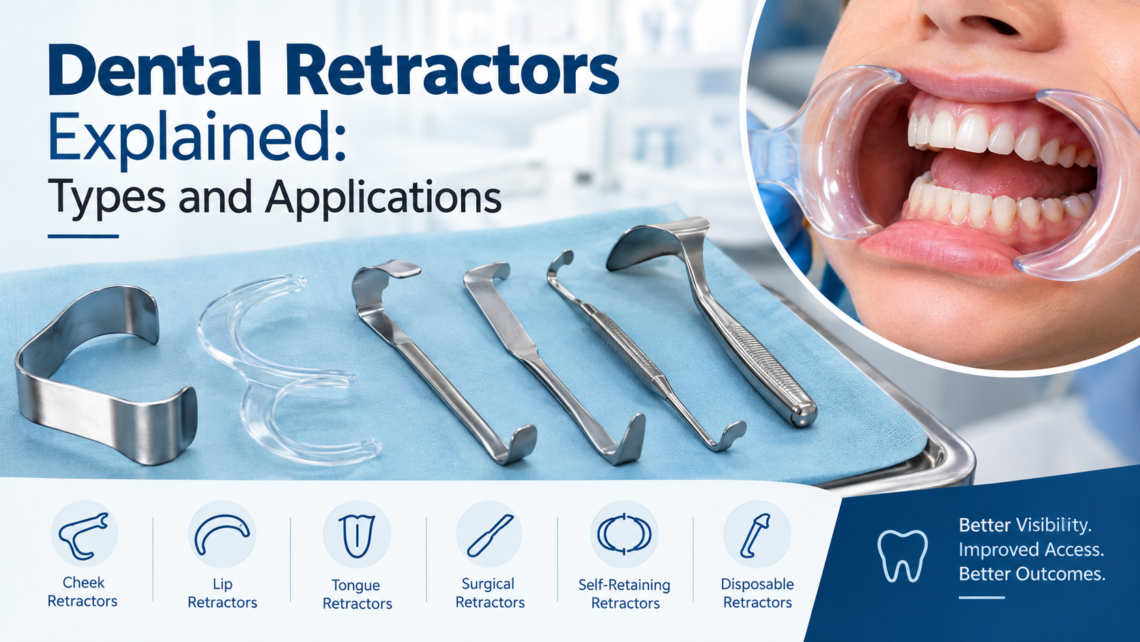
Dental retractors are essential instruments used to move and hold soft tissues away from the treatment area during dental and oral surgical procedures. By retracting the cheeks, lips, tongue, or mucoperiosteal flaps, these instruments help create a clearer field of vision, improve access, and protect surrounding tissues.
Although dental retractors may appear to be simple instruments, their design and application can significantly affect visibility, workflow, patient comfort, and procedural efficiency. Different procedures require different types of retractors, ranging from simple cheek retractors used during photography and restorative treatment to surgical retractors designed for flap management and deeper access.
In this guide, we explain the main types of dental retractors, their common applications, and the factors dental professionals should consider when selecting them.
What Are Dental Retractors?
Dental retractors are instruments designed to gently move soft oral tissues away from the working area. Depending on the design, they may retract:
- Cheeks
- Lips
- Tongue
- Gingiva
- Mucoperiosteal flaps
- Other soft tissues surrounding the surgical site
The primary purpose of retraction is to improve access and visibility while helping protect soft tissues from accidental contact with dental instruments. Retractors are particularly important during oral surgical procedures, where reflected tissue flaps may obstruct access to the underlying treatment area.
Why Are Dental Retractors Important?
Effective soft-tissue retraction offers several important benefits during dental procedures.
Improved Visibility
The cheeks, lips, tongue, and soft tissues can obstruct the clinician’s view of the teeth or surgical site. A properly selected retractor helps expose the treatment area and allows better illumination and visualization.
Better Access
Retractors create additional working space for instruments, particularly during procedures involving posterior teeth, surgical flaps, or difficult-to-reach areas of the oral cavity.
Soft-Tissue Protection
During procedures involving burs, surgical instruments, or other sharp tools, retractors can help keep vulnerable soft tissues away from the working area.
Increased Procedural Efficiency
Maintaining a clear and accessible treatment field can reduce interruptions caused by tissue movement and help the dental team work more efficiently.
Improved Documentation and Photography
Cheek and lip retractors are widely used in dental photography because they expose the teeth and surrounding structures for consistent clinical images. Self-retracting and single-sided retractors may be selected depending on the photographic view required.
Main Types of Dental Retractors
Dental retractors are available in numerous shapes, sizes, and configurations. They can generally be classified according to the tissue they retract and the clinical application.
1. Cheek Retractors
Cheek retractors are designed to move the cheeks away from the teeth and treatment area.
Some cheek retractors are handheld, while others are designed to remain in position without continuous assistance.
2. Lip Retractors
Lip retractors are designed primarily to hold the upper or lower lip away from the teeth and gingiva.
Some lip retractors are made from plastic or flexible materials and are designed to provide broad exposure of the anterior teeth. Others are metal instruments used for more localized or surgical retraction.
Self-retracting lip and cheek retractors are especially useful when broad exposure of the dental arches is required.
3. Tongue Retractors
The tongue can significantly obstruct access to the mandibular teeth and posterior areas of the oral cavity.
Examples include specialized tongue retractors such as the Lack tongue retractor, which can help stabilize the tongue and improve visualization.
Care must be taken to avoid excessive pressure, as the tongue is highly sensitive and contains important anatomical structures.
4. Minnesota Retractor
The Minnesota retractor is one of the most widely recognized instruments used in oral surgery.
Its broad, curved design allows it to retract soft tissues and surgical flaps while providing access to the treatment area.
Because of its versatility, the Minnesota retractor is often considered a standard instrument in oral surgical setups.
5. Langenbeck Retractor
The Langenbeck retractor is commonly used to retract soft tissue and wound edges.
Its blade-style design makes it useful when controlled tissue displacement is needed during surgical procedures.
Different blade sizes allow clinicians to select an instrument appropriate for the treatment area and the amount of tissue being retracted.
6. Farabeuf Retractor
The Farabeuf retractor is a double-ended instrument with blades of different sizes.
It is valued for its simple and versatile design and may be used for retracting soft tissue during smaller surgical procedures.
Its double-ended design provides flexibility when working in areas that require different blade sizes.
7. Austin Retractor
Austin retractors are commonly used in oral surgery to retract soft tissues and mucoperiosteal flaps.
They can be particularly useful during surgical extractions where maintaining visibility and protecting reflected tissue are important.
Along with instruments such as the Minnesota and Bowdler-Henry retractors, Austin retractors are commonly used for buccal mucoperiosteal flap retraction during surgical procedures.
8. Bowdler-Henry Retractor
The Bowdler-Henry retractor is another surgical instrument used to hold soft tissues away from the treatment area.
Its design can provide broad and stable retraction during oral surgical procedures.
The instrument is often used alongside other oral surgical instruments to maintain a clear operating field.
9. Self-Retaining Dental Retractors
Self-retaining retractors are designed to remain in position without being continuously held by a dentist or assistant.
These instruments can be particularly useful when hands-free tissue retraction is required.
Self-retaining retractors can help expose the lips and cheeks simultaneously and provide consistent access to the teeth.
However, patient comfort and proper sizing should always be considered.
10. Disposable Plastic Retractors
Many modern cheek and lip retractors are manufactured from plastic and intended for single-patient use.
Plastic retractors can offer patient comfort and broad visibility, particularly for photographic and cosmetic applications.
Handheld vs. Self-Retaining Retractors
Dental retractors can also be classified according to how they are held in position.
Handheld Retractors
Handheld retractors require the dentist or an assistant to maintain their position.
Advantages include:
- Greater control
- Easy adjustment
- Suitable for surgical procedures
- Available in many specialized designs
Handheld instruments are commonly used when the direction and amount of retraction need to change during treatment.
Self-Retaining Retractors
Self-retaining retractors remain in position without continuous manual support.
Advantages include:
- Hands-free operation
- Consistent tissue exposure
- Useful for photography and orthodontics
- Can reduce the need for continuous assistance
The best option depends on the procedure, treatment area, and clinical workflow.
Applications of Dental Retractors
Dental retractors are used across many areas of dentistry.
General Dentistry
During routine procedures, retractors can improve access to teeth and soft tissues.
Common uses include:
- Restorative procedures
- Clinical examinations
- Composite bonding
- Crown preparation
- Impression procedures
A dental mirror may also provide minor soft-tissue retraction during routine treatment.
Oral Surgery
Retractors are especially important in oral surgery.
They help maintain access during:
- Surgical tooth extractions
- Third molar surgery
- Implant placement
- Flap procedures
- Bone exposure
- Minor oral surgical procedures
Surgical retractors help move and protect reflected soft tissues while improving visualization of the treatment site.
Periodontal Procedures
Soft-tissue retraction may be required during periodontal surgery and other procedures involving gingival tissues.
Appropriate retractors can help expose:
- Gingival margins
- Root surfaces
- Surgical flaps
- Underlying bone
Gentle and controlled handling is particularly important to minimize unnecessary tissue trauma.
Restorative Dentistry
During restorative procedures, cheek and lip retractors can improve access and help keep soft tissues away from the working area.
They may be useful during:
- Composite restorations
- Crown preparation
- Veneer procedures
- Bonding procedures
Retraction can also improve visibility when working on anterior teeth.
Orthodontics
Orthodontic procedures frequently require broad exposure of the teeth.
Retractors are commonly used during:
- Bracket bonding
- Clinical photography
- Orthodontic documentation
- Cosmetic evaluations
Self-retaining cheek retractors are particularly useful when both dental arches need to remain visible.
Dental Photography
Dental retractors are essential tools for obtaining clear and consistent intraoral photographs.
They help expose:
- Anterior teeth
- Buccal segments
- Occlusal surfaces
- Gingival tissues
Different retractor designs may be used depending on whether frontal, lateral, or occlusal photographs are required.
How to Choose the Right Dental Retractor
Selecting the right dental retractor depends on several factors.
1. Type of Procedure
The procedure should determine the type of retractor required.
For example:
- Photography may require a plastic self-retracting cheek retractor.
- Oral surgery may require a Minnesota or other surgical retractor.
- Tongue control may require a dedicated tongue retractor.
2. Treatment Area
The location of the procedure is important.
Posterior procedures may require different access compared with anterior procedures.
Similarly, mandibular procedures may require tongue control, while maxillary surgical procedures may require cheek and flap retraction.
3. Patient Anatomy
Retractors should be available in sizes appropriate for different patients.
A retractor that is too large or applies excessive pressure may cause unnecessary discomfort or tissue trauma.
4. Material
Dental retractors may be manufactured from:
- Stainless steel
- Plastic
- Silicone
- Other medical-grade materials
Reusable stainless-steel retractors are commonly used for surgical procedures and are designed to undergo appropriate cleaning and sterilization.
Disposable or plastic retractors may be preferred for photography and certain non-surgical applications.
5. Instrument Design
The shape and blade size of the retractor should match the intended clinical application.
Important considerations include:
- Blade width
- Curvature
- Handle design
- Overall length
- Single-ended or double-ended configuration
- Manual or self-retaining design
Dental Retractor Materials and Manufacturing
The material and manufacturing quality of a dental retractor can influence its durability, surface finish, handling, and suitability for repeated reprocessing.
Reusable surgical retractors are commonly manufactured from stainless steel because it provides strength and resistance to corrosion when properly manufactured and maintained.
High-quality finishing is also important. Smooth surfaces and carefully finished edges can help reduce the risk of unnecessary tissue trauma while improving cleaning and maintenance.
For a broader understanding of how professional dental instruments are produced, you can also explore our related Dentistry Supplier guide on the journey of a dental instrument.
Manufacturing may involve processes such as:
- Material selection
- Forging or forming
- Machining
- Heat treatment
- Grinding
- Polishing
- Surface finishing
- Inspection
- Cleaning and packaging
The balance between skilled craftsmanship and modern manufacturing technology can also influence the consistency and finish of professional dental instruments. Read our related guide on skilled craftsmanship vs. automation in dental instrument manufacturing.
Cleaning, Sterilization, and Maintenance
Reusable dental retractors must be properly cleaned and reprocessed according to applicable professional standards and the manufacturer’s instructions.
A typical workflow may involve:
- Removing visible contamination.
- Cleaning the instrument.
- Inspecting the surface and working ends.
- Packaging when required.
- Sterilizing according to validated procedures.
- Storing the instrument appropriately.
Retractors should be inspected regularly for:
- Damage
- Corrosion
- Rough edges
- Deformation
- Surface deterioration
Proper reprocessing is particularly important for instruments used during oral surgery because they come into contact with oral tissues and may be exposed to blood and other biological materials.
For more information about sterilization equipment and workflow considerations, see our Dentistry Supplier article on dental autoclave sterilization and the cost of an autoclave sterilizer.
Common Mistakes When Using Dental Retractors
Even a well-designed retractor can be ineffective or uncomfortable if used incorrectly.
Applying Excessive Pressure
Too much pressure can cause patient discomfort and unnecessary tissue trauma.
Retraction should be firm enough to maintain access but controlled enough to avoid excessive stress on soft tissues.
Using the Wrong Retractor
A small cheek retractor may not provide sufficient access for an oral surgical procedure, while a large surgical retractor may be unnecessary for dental photography.
The instrument should match the procedure and treatment area.
Ignoring Patient Comfort
Long procedures may require periodic adjustment of the retractor.
Patient anatomy, mouth opening, and tissue sensitivity should always be considered.
Using Damaged Instruments
Rough edges, corrosion, or damaged surfaces can compromise performance and increase the risk of tissue injury.
Regular inspection is essential.
Dental Retractors and Other Surgical Instruments
Dental retractors are usually used as part of a larger clinical or surgical instrument setup.
Depending on the procedure, they may be used alongside:
- Dental mirrors
- Periosteal elevators
- Scalpels
- Surgical scissors
- Tissue forceps
- Elevators
- Extraction forceps
- Needle holders
- Dental burs
For example, during a surgical extraction, a periosteal elevator may first be used to reflect a mucoperiosteal flap, while a retractor holds the flap away from the surgical field.
You may also find our related Dentistry Supplier guides helpful, including common dental instruments and their uses, dental extraction forceps explained, and how to choose the right dental instruments.
Frequently Asked Questions About Dental Retractors
What is a dental retractor used for?
A dental retractor is used to hold the cheeks, lips, tongue, or other soft tissues away from the treatment area. This improves visibility, access, and soft-tissue protection during dental procedures.
What are the main types of dental retractors?
Common types include cheek retractors, lip retractors, tongue retractors, tissue retractors, Minnesota retractors, Langenbeck retractors, Farabeuf retractors, and self-retaining retractors.
What is a Minnesota retractor used for?
A Minnesota retractor is commonly used during oral surgery to retract the cheeks, tongue, and mucoperiosteal flaps. It is particularly useful during surgical extractions and other procedures requiring soft-tissue management.
Are dental retractors used in dental photography?
Yes. Cheek and lip retractors are widely used in dental photography to expose the teeth and improve the consistency of clinical photographs.
Are dental retractors reusable?
Many metal dental retractors are reusable and can be reprocessed according to manufacturer instructions and applicable infection-control requirements. Some plastic retractors are designed for single-patient or limited use.
Conclusion
Dental retractors play a critical role in improving visibility, access, and soft-tissue protection across many areas of dentistry.
From simple cheek and lip retractors used for photography and orthodontics to specialized instruments such as the Minnesota, Langenbeck, and Farabeuf retractors used during surgical procedures, each design serves a specific clinical purpose.
Choosing the right dental retractor requires consideration of the procedure, treatment area, patient anatomy, and level of tissue control required. High-quality materials, smooth finishing, appropriate sizing, and proper instrument maintenance are also essential for reliable clinical performance.
For dental professionals, clinics, distributors, and instrument buyers, understanding the different types and applications of dental retractors makes it easier to build practical instrument sets and select tools suited to specific procedures.
Call To Action
Explore our Dentistry Supplier educational resources to learn more about professional dental instruments, surgical instrument manufacturing, sterilization, dental burs, extraction instruments, and other essential tools used in modern dentistry.