After braces or clear aligner treatment, keeping your teeth in their new positions is just as important as straightening them. This is where orthodontic retainers play an essential role. Retainers help reduce the risk of teeth shifting back toward their previous positions, a process commonly called orthodontic relapse.
When choosing a retainer, patients are often presented with two main options: fixed retainers and removable retainers. Both can help maintain orthodontic results, but they differ in comfort, maintenance, appearance, hygiene, convenience, and the level of daily responsibility required.
So, which option is better?
The answer depends on your treatment history, the teeth being retained, your oral hygiene habits, and how consistently you can follow your orthodontist’s instructions. Neither option is universally best for every patient. Recent evidence suggests that fixed retainers may provide stronger long-term stability for certain lower front teeth, while removable retainers can be easier to clean and may offer comparable results when worn correctly.
This guide explains the differences between fixed and removable retainers, including their advantages, disadvantages, maintenance requirements, and how to decide which may suit your needs.
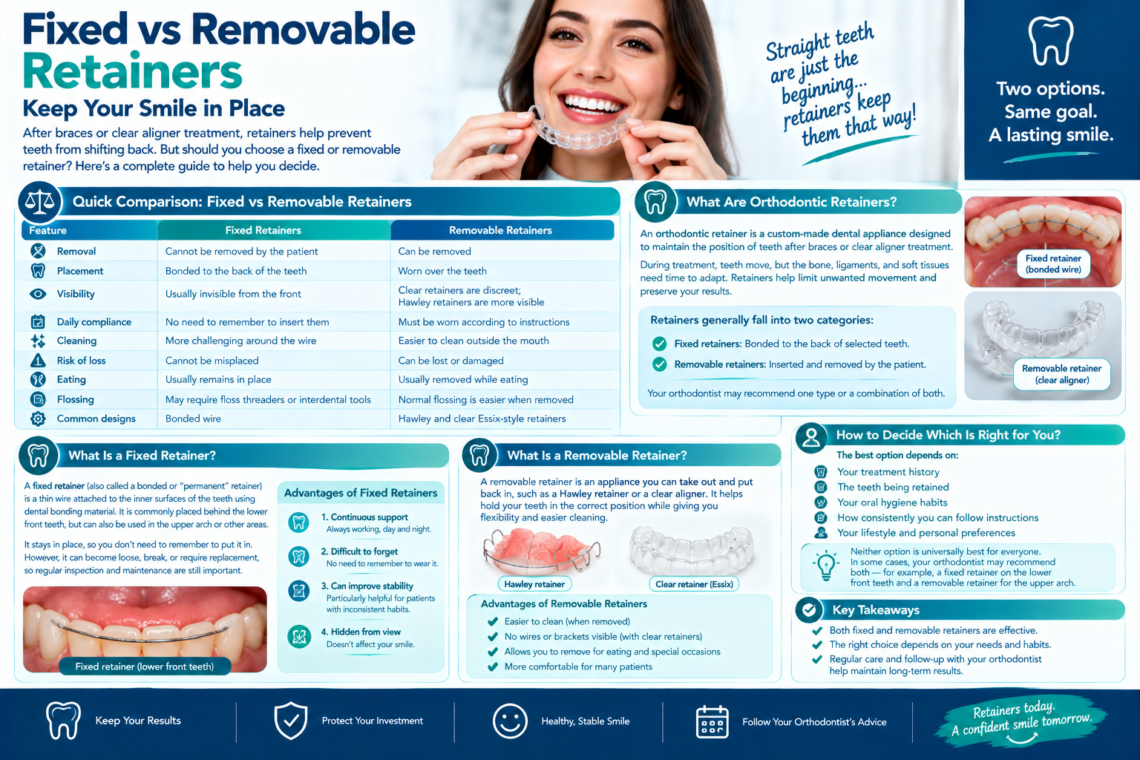
Quick Comparison: Fixed vs Removable Retainers
| Feature | Fixed Retainers | Removable Retainers |
| Removal | Cannot be removed by the patient | Can be removed |
| Placement | Bonded to the back of the teeth | Worn over the teeth |
| Visibility | Usually invisible from the front | Clear retainers are discreet; Hawley retainers are more visible |
| Daily compliance | No need to remember to insert them | Must be worn according to instructions |
| Cleaning | More challenging around the wire | Easier to clean outside the mouth |
| Risk of loss | Cannot be misplaced | Can be lost or damaged |
| Eating | Usually remains in place | Usually removed while eating |
| Flossing | May require floss threaders or interdental tools | Normal flossing is easier when removed |
| Common designs | Bonded wire | Hawley and clear Essix-style retainers |
What Are Orthodontic Retainers?
An orthodontic retainer is a custom-made dental appliance designed to maintain the position of teeth after braces or clear aligner treatment.
During orthodontic treatment, braces or aligners gradually move teeth into a new alignment. However, the surrounding bone, ligaments, and soft tissues need time to adapt. Even after treatment is completed, teeth naturally tend to move throughout life. Retainers help limit these unwanted changes and preserve the results of orthodontic treatment.
Retainers generally fall into two categories:
- Fixed retainers: Bonded permanently or semi-permanently to the back surfaces of selected teeth.
- Removable retainers: Appliances that the patient can insert and remove as instructed.
Your orthodontist may recommend one type or a combination of both. For example, a patient may receive a fixed retainer behind the lower front teeth and a removable retainer for the upper teeth.
What Is a Fixed Retainer?
A fixed retainer, also called a bonded retainer or sometimes a “permanent retainer,” is a thin wire attached to the inner surfaces of the teeth using dental bonding material.
It is commonly placed behind the lower front teeth, although fixed retainers may also be used in the upper arch or in other areas depending on the patient’s treatment needs.
Because the wire remains attached to the teeth, the patient does not need to remember to put it in each night. However, the term “permanent” can be misleading. Fixed retainers can become loose, break, or require replacement, so they still need regular inspection and maintenance.
Advantages of Fixed Retainers
1. Continuous support
One of the biggest benefits of a fixed retainer is that it provides continuous retention. It remains in place throughout the day and night, reducing dependence on the patient remembering to wear an appliance.
This can be particularly useful for people who have difficulty maintaining a consistent removable-retainer routine.
2. Difficult to forget
A removable retainer only works when it is worn. If it is left in a bathroom drawer, forgotten during travel, or worn inconsistently, teeth may begin to shift.
A fixed retainer eliminates this particular problem because it is already bonded to the teeth.
3. Discreet appearance
Fixed retainers are placed behind the teeth, so they are generally not visible when a person smiles or speaks. This makes them an appealing option for patients who prefer a discreet retention solution.
4. Useful for high-relapse areas
The lower front teeth are particularly susceptible to post-treatment crowding and movement. Research indicates that fixed retainers may offer better long-term alignment in the mandibular anterior region than removable retainers, although the choice should still be individualized.
5. No need to remove during meals
Because fixed retainers remain attached, patients do not need to remove them before eating. However, they should still follow their orthodontist’s advice about foods that could damage or dislodge the wire.
Disadvantages of Fixed Retainers
1. Cleaning can be more difficult
The wire and bonding material can create additional areas where plaque, food particles, and calculus accumulate. Cleaning around the retainer requires more attention than cleaning teeth without a bonded wire.
A systematic review found that fixed retainers are generally associated with greater plaque and calculus accumulation than removable retainers.
Patients may need to use:
- Floss threaders
- Super floss
- Interdental brushes
- Water flossers, when appropriate
- Small, soft toothbrushes or specialized cleaning tools
2. Flossing may take more effort
Traditional floss may not pass easily beneath a fixed retainer wire. A floss threader or specialized floss can help guide floss under the wire and between the teeth.
If plaque remains around the retainer, the risk of gum inflammation, calculus buildup, and tooth decay may increase.
3. The wire can break or detach
A fixed retainer can become partially detached or completely loose. Sometimes, a patient may not notice the problem immediately.
A loose wire can allow one or more teeth to shift. It may also irritate the tongue or create an uncomfortable sensation. Contact your orthodontist promptly if the wire feels loose, sharp, bent, or different from normal.
4. Repairs require a dental professional
Unlike a removable retainer, a fixed retainer cannot be repaired or adjusted by the patient. A dental professional must evaluate the wire and determine whether it can be rebonded, repaired, or replaced.
5. It may affect comfort
Some patients notice the wire with their tongue, particularly during the first few days after placement. Most people adapt, but persistent irritation should be evaluated by an orthodontist.
What Is a Removable Retainer?
A removable retainer is a custom-fitted appliance that the patient can take out and put back in. It is usually worn for a specific number of hours per day or during sleep, depending on the orthodontist’s instructions.
The two most common removable retainers are:
- Hawley retainers
- Clear plastic retainers, often called Essix-style retainers
Hawley Retainers
A Hawley retainer typically consists of an acrylic or plastic base combined with a metal wire. The base fits against the roof of the mouth for upper retainers or behind the lower teeth for lower retainers. The wire helps maintain tooth alignment.
Hawley retainers are durable and can sometimes be adjusted by an orthodontist as the patient’s needs change.
Clear Removable Retainers
Clear retainers are made from transparent plastic and are molded to fit over the teeth. They resemble clear aligners but are designed primarily to maintain alignment rather than actively move teeth.
They are less noticeable than traditional Hawley retainers and are often chosen for cosmetic reasons. However, clear plastic can become scratched, cloudy, warped, or damaged if it is cleaned incorrectly or exposed to heat.
Advantages of Removable Retainers
1. Easier to clean
Removable retainers can be taken out, allowing patients to brush and floss their teeth normally. The retainer itself can also be cleaned separately according to the manufacturer’s or orthodontist’s instructions.
This can make daily oral hygiene easier compared with cleaning around a bonded wire.
2. Convenient during meals
Removable retainers are generally taken out before eating. This allows patients to enjoy meals without food becoming trapped around a retainer appliance.
Removing the retainer during meals can also reduce the risk of staining, damage, or distortion.
3. Better access for flossing
Because the appliance can be removed, patients can floss between their teeth without working around a fixed wire. This may be especially helpful for people who already struggle with plaque control.
However, removable retainers still require proper cleaning. A retainer that is not cleaned regularly can develop odor, plaque buildup, and bacterial contamination.
4. Easy to inspect
Patients can visually examine removable retainers for cracks, discoloration, distortion, or buildup. They can also check whether the appliance still fits properly.
If the retainer no longer fits comfortably, it should not be forced into place. The American Association of Orthodontists advises patients to contact their orthodontist if a retainer becomes painful or no longer fits correctly.
5. More flexibility
Removable retainers can be temporarily taken out for:
- Eating
- Brushing and flossing
- Certain sports or activities
- Cleaning
- Special occasions, when permitted by the orthodontist
This flexibility makes them suitable for patients who prefer greater control over their appliance.
Disadvantages of Removable Retainers
1. They depend on patient compliance
The biggest disadvantage of removable retainers is that they only work when they are worn.
Patients may forget to wear them, remove them for too long, or stop using them once their teeth appear straight. Over time, inconsistent wear can increase the risk of tooth movement.
Research suggests that declining adherence can limit the long-term effectiveness of removable retainers.
2. They can be lost
Removable retainers are easy to misplace, especially when wrapped in tissues, placed on restaurant trays, left in school bags, or stored without a case.
The American Association of Orthodontists recommends keeping removable retainers in their protective case when they are not being worn and keeping them away from pets, which may chew or damage them.
3. They may affect speech temporarily
Some patients experience a slight change in speech or increased saliva production when they first begin wearing a removable retainer. This is often temporary as the mouth adapts.
Hawley retainers may be more noticeable because of their acrylic base and front wire. Clear retainers are generally less visible but may still affect speech during the adjustment period.
4. Clear retainers can be damaged by heat
Clear plastic retainers may warp when exposed to hot water, boiling water, direct sunlight in a hot vehicle, or other high-temperature environments.
A warped retainer may no longer fit correctly and could place unwanted pressure on the teeth.
5. They require regular replacement
Removable retainers can wear down, crack, stain, or lose their shape. Clear retainers may need replacement more frequently depending on wear, grinding habits, cleaning methods, and the material used.
Replacement schedules vary, so patients should follow their orthodontist’s recommendations.
Fixed vs Removable Retainers: Which Is Better?
There is no single answer for every patient. The better option is the one that matches the patient’s orthodontic needs, oral hygiene habits, lifestyle, and ability to follow the retention plan.
Fixed retainers may be better for patients who:
- Frequently forget to wear removable retainers
- Have a higher risk of relapse in specific teeth
- Need continuous retention for lower front teeth
- Prefer an appliance that is hidden behind the teeth
- Can maintain careful cleaning around the wire
- Are willing to attend regular dental and orthodontic checkups
Removable retainers may be better for patients who:
- Prefer easy removal during meals and cleaning
- Can consistently follow a wearing schedule
- Want easier access for brushing and flossing
- Prefer a clear, less noticeable appliance
- Have good organizational habits
- Want an appliance that can be inspected and cleaned outside the mouth
A combination may be the best solution
Some patients benefit from using both types. For example, a fixed retainer may be used behind the lower front teeth while a clear removable retainer is prescribed for the upper teeth.
Combination retention can provide continuous support in selected areas while allowing easier cleaning and additional retention elsewhere. Your orthodontist can determine whether this approach is appropriate for your case.
What Does Research Say About Fixed and Removable Retainers?
Current research does not show that one retainer type is universally superior.
A 2026 evidence-based review reported that fixed and removable retainers can provide similar stability in the upper arch. However, fixed retainers may offer better long-term stability for the lower front teeth, where relapse is more common. The same review also noted that fixed retainers are associated with more plaque and calculus accumulation, while removable retainers depend more heavily on patient adherence.
A Cochrane review found that the certainty of evidence surrounding orthodontic retention remains limited. It reported that differences between fixed and removable retainers may be small or clinically unimportant in some situations, particularly when removable retainers are worn according to a full-time protocol. Clear removable retainers may also provide some periodontal-health advantages compared with fixed retainers after one year.
The practical takeaway is simple:
The most effective retainer is not necessarily the most expensive, most modern, or most convenient. It is the retainer that is suitable for the patient’s case and maintained correctly over the long term.
How to Clean and Maintain Fixed Retainers
Proper hygiene is especially important when wearing a bonded retainer.
Recommended cleaning habits include:
- Brush your teeth twice daily with fluoride toothpaste.
- Brush carefully around the wire and bonding points.
- Use a floss threader or super floss to clean beneath the wire.
- Consider interdental brushes for spaces that are difficult to reach.
- Ask your dental professional whether a water flosser would be suitable.
- Attend regular dental cleanings.
- Avoid biting very hard foods directly with teeth supporting the retainer.
- Check periodically for loose or broken sections.
- Contact your orthodontist if the wire changes position or feels sharp.
Fixed-retainer care should be part of a broader dental maintenance routine. For additional information about dental instrument and equipment maintenance, see Dentistry Supplier’s guide to the Dental Equipment Maintenance Checklist.
How to Clean and Maintain Removable Retainers
Removable retainers should be cleaned regularly to prevent plaque, odor, and buildup.
General care tips include:
- Rinse the retainer with cool or lukewarm water after removing it.
- Clean it using a soft toothbrush or a method recommended by your orthodontist.
- Avoid hot or boiling water, especially with clear plastic retainers.
- Use a retainer-cleaning product when recommended.
- Avoid abrasive toothpaste unless your orthodontist specifically approves it.
- Store the retainer in its protective case when not in use.
- Keep the case clean and dry.
- Keep the appliance away from pets and small children.
- Do not place it in a napkin where it can be accidentally discarded.
Never attempt to bend, cut, heat, or repair a removable retainer yourself. If it becomes damaged or no longer fits, have it evaluated by a dental professional.
Common Mistakes Patients Make With Retainers
1. Stopping wear too early
Teeth can continue to shift even years after orthodontic treatment. Stopping retainer use without professional guidance may compromise the treatment result.
2. Wearing a removable retainer inconsistently
Skipping several nights or wearing the retainer only occasionally can allow teeth to move. Follow the schedule provided by your orthodontist.
3. Ignoring a loose fixed retainer
A loose or broken fixed retainer should be checked promptly. Delaying repairs may allow teeth to shift or make the appliance more difficult to repair.
4. Cleaning with hot water
Hot water can distort clear retainers, making them uncomfortable or ineffective.
5. Using harsh cleaning products
Bleach, strong household cleaners, and abrasive products may damage retainer materials or leave unwanted residues.
6. Failing to attend follow-up appointments
Retainers require monitoring. Your orthodontist can assess fit, tooth stability, gum health, and whether the appliance needs adjustment or replacement.
How Long Do You Need to Wear a Retainer?
The duration and schedule depend on the original orthodontic problem, the type of treatment, the patient’s age, the position of the teeth, and the orthodontist’s retention protocol.
Many patients wear retainers more frequently immediately after braces or aligners and later transition to nighttime or part-time wear. Some patients are advised to continue long-term or lifelong retention because teeth naturally change over time. The American Association of Orthodontists emphasizes that retainers are important for maintaining alignment and that the wearing schedule should be individualized.
Do not change your wearing schedule without consulting your orthodontist.
When Should You Contact Your Orthodontist?
Contact your orthodontist if:
- A fixed retainer becomes loose or detached
- The wire is sharp or irritating your tongue
- A removable retainer cracks or breaks
- Your retainer no longer fits
- The retainer causes persistent pain
- You notice teeth shifting
- Your gums bleed repeatedly around a fixed retainer
- The retainer develops a persistent odor despite cleaning
- You lose your removable retainer
Do not force a painful or ill-fitting retainer into place. Your orthodontist may need to adjust, replace, or remake the appliance.
Frequently Asked Questions
Are fixed retainers better than removable retainers?
Not always. Fixed retainers provide continuous support and may be particularly useful for maintaining lower front teeth. Removable retainers are easier to clean and can work very well when worn consistently. The best option depends on your orthodontic needs and habits.
Can fixed retainers damage teeth?
A fixed retainer does not automatically damage teeth, but poor cleaning can contribute to plaque, calculus, and gum inflammation around the wire. Proper brushing, flossing, professional cleanings, and regular inspections help reduce these risks.
Are removable retainers easier to clean?
Yes. Removable retainers can be taken out, allowing easier cleaning of both the appliance and the teeth. However, they still need regular cleaning and proper storage.
Can I eat with a removable retainer?
Most removable retainers should be removed before eating unless your orthodontist gives different instructions. Eating while wearing a retainer may stain, damage, or distort the appliance.
Can a fixed retainer fall off?
Yes. Although fixed retainers are bonded to the teeth, the wire or bonding material can loosen or break. Contact your orthodontist if you notice any change.
How often should removable retainers be replaced?
There is no universal replacement schedule. Replacement depends on the material, wear, grinding, cleaning habits, damage, and how well the retainer continues to fit. Your orthodontist can recommend when replacement is necessary.
Can I switch from a fixed retainer to a removable retainer?
Sometimes, but the decision should be made with your orthodontist. The professional will consider your relapse risk, tooth alignment, bite, oral hygiene, and ability to follow a wearing schedule.
Can I use both fixed and removable retainers?
Yes. Some patients use a combination of fixed and removable retainers to maintain alignment in different areas of the mouth. Your orthodontist will determine whether combination retention is appropriate.
What happens if I stop wearing my retainer?
Your teeth may gradually shift, particularly during the early period after orthodontic treatment. If your retainer no longer fits, do not force it. Contact your orthodontist for an assessment.
Final Thoughts
Choosing between fixed vs removable retainers is not simply a matter of deciding which appliance looks better or feels more convenient. Each option has clear advantages and limitations.
Fixed retainers offer continuous support, are discreet, and reduce the risk of forgetting to wear an appliance. However, they require careful cleaning and can become loose or damaged.
Removable retainers are easier to clean, flexible, and available in discreet clear designs. Their main limitation is that they depend on consistent patient use and can be lost or damaged.
The most suitable choice depends on your orthodontic history, oral hygiene, lifestyle, and professional treatment plan. Regardless of the type, long-term retention and regular dental care are essential for protecting your orthodontic results.
For more information about oral health, dental care, and professional dental equipment, explore the educational resources available at Dentistry Supplier.