Quick Answer
Dental emergencies range from manageable discomfort to life-threatening infections requiring immediate medical attention. Knocked-out teeth need replantation within 60 minutes for any chance of survival. Uncontrolled bleeding, facial swelling with fever, or difficulty breathing are medical emergencies—go to the emergency room. For everything else, temporary measures can stabilize the situation until you reach a dentist. Knowing what constitutes a true emergency versus urgent but non-critical pain saves unnecessary ER visits and prevents dangerous delays.
What This Article Covers
-
True emergencies versus urgent but manageable problems
-
Knocked-out tooth: the critical first hour
-
Severe toothache: temporary relief and when to seek help
-
Broken teeth and lost fillings: protection until repair
-
Soft tissue injuries: bleeding control and assessment
-
Abscesses and swelling: infection danger signs
-
Finding emergency dental care when your dentist is unavailable
True Emergencies: Go to the ER or Call 911
Some dental problems transcend dental care and require emergency medical intervention.
Uncontrolled bleeding that does not slow after 15 minutes of firm pressure suggests arterial damage, clotting disorder, or anticoagulant medication complication. The emergency room can address bleeding and underlying causes.
Facial swelling that extends to the eye, neck, or floor of the mouth indicates spreading infection. The danger space between facial planes allows bacteria to descend toward the airway. Ludwig’s angina—a rapidly progressive cellulitis of the submandibular space—can obstruct breathing within hours. Fever, difficulty swallowing, or voice changes accompanying swelling demand immediate evaluation.
Difficulty breathing or swallowing from any dental infection is life-threatening. Airway compromise requires emergency department management, often with surgical drainage and intravenous antibiotics.
Trauma with suspected jaw fracture—inability to close teeth together normally, severe misalignment, numbness of the lower lip or chin—needs imaging and possible surgical stabilization.
Dr. Chan: “I tell patients that dentists handle teeth. Emergency rooms handle airways and bleeding. If you’re worried about either, bypass the dental office entirely. I’ve seen patients delay with facial swelling, thinking they could wait for my morning appointment. One ended up in intensive care. When infection spreads beyond the tooth, the rules change completely.”
Knocked-Out Tooth: The Critical First Hour
Permanent teeth knocked completely from their sockets can sometimes be saved. Time is the enemy.
What to do immediately:
-
Handle the tooth by the crown only. Never touch the root surface. The periodontal ligament cells coating the root are essential for reattachment and die quickly when handled or dried.
-
If dirty, rinse gently with milk or saline. Do not scrub, rub, or use soap or chemicals.
-
Replant the tooth into its socket immediately if possible. Hold it in place by biting gently on gauze or a clean cloth.
-
If replantation is not possible, store the tooth in milk, saline, or inside the cheek. Do not store in water. Water’s hypotonicity damages root cells.
-
For young children who might swallow a tooth stored in the mouth, use milk or a tooth preservation product like Save-A-Tooth if available.
-
Get to a dentist or emergency room within 30 minutes. Success rates drop dramatically after 60 minutes and approach zero after several hours.
What not to do:
-
Do not wrap the tooth in tissue or paper towel. It dries out.
-
Do not attempt to clean the root surface aggressively.
-
Do not delay seeking care to find your regular dentist. Any dentist or ER can stabilize the tooth initially.
Primary (baby) teeth are not replanted. Replantation risks damage to the developing permanent tooth beneath. Control bleeding, comfort the child, and see a dentist promptly for space maintenance evaluation.
Severe Toothache: Temporary Relief and When to Seek Help
Toothaches vary in urgency. Distinguishing types guides appropriate response.
Pulpitis pain—sharp, lingering sensitivity to hot or cold, or spontaneous throbbing—indicates inflamed nerve tissue. Reversible pulpitis may settle with removal of the irritant. Irreversible pulpitis progresses to abscess without root canal or extraction. Over-the-counter pain relievers provide temporary relief but do not resolve the underlying problem.
Temporary relief measures:
-
Ibuprofen 400–600 mg every 6–8 hours reduces inflammation and pain. Acetaminophen 500–1000 mg every 6 hours if ibuprofen is contraindicated. Some evidence suggests alternating both provides superior relief.
-
Cold compress to the cheek for 15-minute intervals reduces inflammation.
-
Avoid extremely hot or cold foods and sweets on the affected side.
-
Clove oil (eugenol) on a cotton pellet placed in a cavity provides temporary numbing.
-
Saltwater rinses clean debris from exposed cavities.
When to seek same-day dental care:
-
Pain persists beyond 24–48 hours despite medication
-
Swelling develops
-
Pain localizes to a single tooth with biting tenderness
-
Fever accompanies toothache
-
You have compromised immunity, diabetes, or other conditions increasing infection risk
Broken Teeth and Lost Fillings: Protection Until Repair
Not every broken tooth is an emergency. The extent of damage determines urgency.
Minor enamel chip with no pain or sharp edges is cosmetic. Smooth with an emery board if rough, and see your dentist within days to weeks.
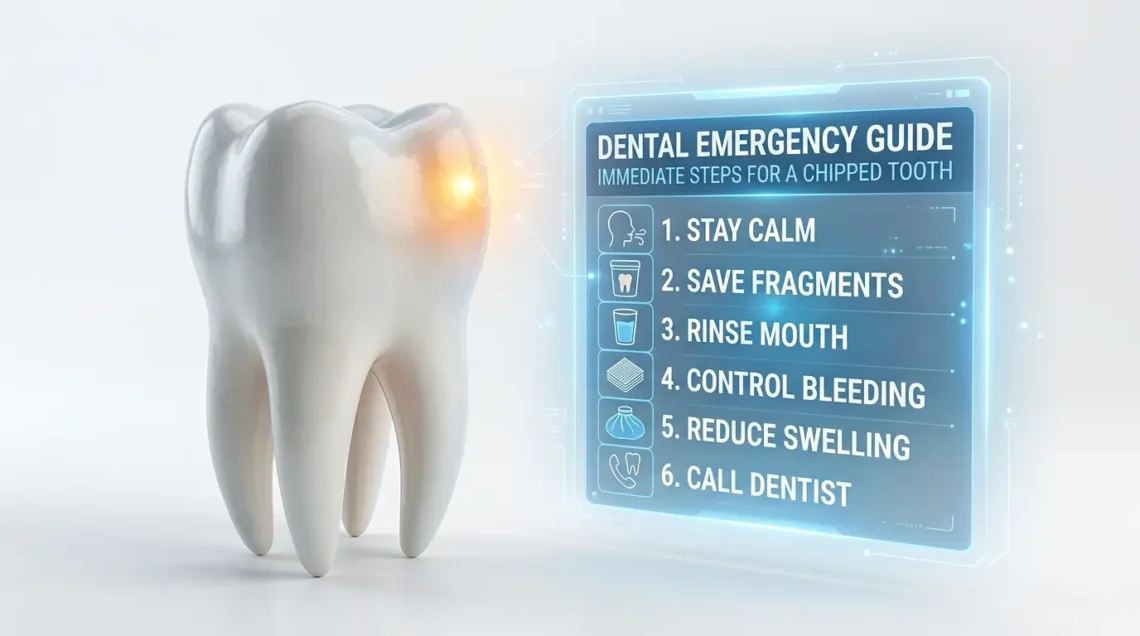
Fracture exposing dentin causes sensitivity but not necessarily immediate danger. Dental wax or temporary filling material from pharmacies covers exposed areas. Avoid temperature extremes and chewing on the affected side. See your dentist within 24–48 hours.
Fracture exposing pulp—visible pink or red center, severe pain, bleeding from the tooth—requires urgent dental care. The pulp is open to bacterial invasion. Root canal or extraction is likely necessary. Cover with temporary filling material and seek same-day care.
Lost filling or crown exposes tooth structure to decay and sensitivity. Temporary dental cement from pharmacies reattaches crowns temporarily. For lost fillings, temporary filling material seals the cavity. Do not use superglue or household adhesives. See your dentist within a few days.
Dr. Chan: “Patients panic when a crown falls off. In most cases, the tooth underneath is stable and the crown simply needs re-cementing. Keep the crown, keep the area clean, and call the next business day. The exception is when the tooth fractures with the crown, leaving a sharp or sensitive stump. Then you need prompt attention.”
Soft Tissue Injuries: Bleeding Control and Assessment
Lips, cheeks, tongue, and gums bleed profusely due to rich blood supply but usually heal well.
Bleeding control:
-
Apply firm, direct pressure with clean gauze or cloth for 10–15 minutes without checking.
-
If bleeding continues, repeat once. Persistent bleeding suggests need for suturing.
-
Cold compress reduces swelling and slows bleeding.
-
Avoid rinsing vigorously, which dislodges clots.
When to seek care:
-
Cuts deeper than one-quarter inch or gaping edges need suturing for proper healing.
-
Through-and-through lip lacerations involving both skin and mucosa require layered repair.
-
Tongue lacerations that split the edge or impair speech need evaluation.
-
Any injury from dirty objects or animal bites requires tetanus assessment and possible antibiotics.
Most minor cuts inside the mouth heal rapidly without intervention due to excellent blood supply and constant bathing in saliva.
Abscesses and Swelling: Infection Danger Signs
Dental abscesses form when bacteria accumulate at root tips or in gum pockets, creating pus-filled swellings. They range from localized discomfort to spreading infections.
Localized abscess presents as a pimple-like swelling on the gum that may drain foul-tasting fluid. Pain is often manageable. This requires dental treatment—drainage, root canal, or extraction—but is not immediately life-threatening if contained.
Spreading infection shows progressive swelling, warmth, redness extending beyond the immediate area, fever, malaise, or lymph node enlargement. This demands urgent dental or medical attention. Antibiotics alone are insufficient; the source must be drained or removed.
Danger signs requiring emergency care:
-
Swelling spreading toward the eye or down the neck
-
Difficulty opening the mouth (trismus)
-
Difficulty swallowing or breathing
-
Fever above 101°F (38.3°C)
-
Rapidly worsening symptoms over hours
-
Confusion or altered mental state
Temporary measures while seeking care:
-
Do not attempt to lance or drain swellings yourself. This spreads infection.
-
Warm saltwater rinses encourage drainage if the abscess is already draining.
-
Cold compresses reduce swelling.
-
Pain relievers manage discomfort but do not treat infection.
-
Antibiotics from previous prescriptions or emergency rooms provide temporary control but definitive dental treatment is still required.
Finding Emergency Dental Care When Your Dentist Is Unavailable
After-hours dental offices: Many practices have emergency lines with on-call dentists. Leave a detailed message describing symptoms.
Emergency dental clinics: Major cities have dedicated urgent dental care facilities. Search “emergency dentist near me” or call your local dental society for referrals.
Hospital emergency departments: For true emergencies involving airway, uncontrolled bleeding, or spreading infection. ERs can stabilize and provide antibiotics but rarely perform definitive dental procedures. You will still need follow-up dental care.
Dental schools: Often have emergency clinics at reduced cost, though waits may be longer.
Telehealth consultations: Some dental practices offer virtual assessments to determine urgency and guide temporary management until in-person care is available.
Building a Dental Emergency Kit
Prepare for inevitable after-hours problems:
-
Sterile gauze pads for bleeding control
-
Dental wax for sharp edges or broken orthodontic wires
-
Temporary filling material (Dentemp or similar)
-
Temporary dental cement for lost crowns
-
Clove oil for temporary pain relief
-
Ibuprofen and acetaminophen
-
Small container with lid for storing knocked-out teeth
-
Your dentist’s emergency contact number
The Bottom Line
Dental emergencies require clear thinking under pressure. True emergencies—airway compromise, uncontrolled bleeding, rapidly spreading infection—belong in emergency rooms. Everything else benefits from prompt dental care but can often be stabilized temporarily.
Know the critical timelines. Replant knocked-out teeth within an hour. Control bleeding with firm pressure. Protect broken teeth from further damage. Recognize infection danger signs before they become life-threatening.
Most importantly, establish a relationship with a dentist before emergencies arise. Patients with regular dental homes receive faster, more coordinated care when problems develop. Waiting for a crisis to find dental care adds stress and delay when you can least afford either.
Sources
-
American Dental Association. “Dental Emergencies: Patient Guidance and Professional Protocols.” JADA, 2025;156(7):456-468.
-
Chan A. “After-Hours Dental Emergencies: Management Strategies for General Practice Patients.” General Dentistry, 2025;73(4):401-407.
-
American Association of Endodontists. “Traumatic Dental Injuries: Treatment Guidelines and Prognosis.” AAE Position Paper, 2025.
-
Flynn TR, Topazian RG. “Severe Odontogenic Infections: Assessment and Management.” Oral and Maxillofacial Surgery Clinics of North America, 2024;36(3):289-301.
-
Andersson L, et al. “International Association of Dental Traumatology Guidelines for Management of Traumatic Dental Injuries: 2024 Update.” Dental Traumatology, 2024;40(4):312-330.