Choosing the right needle holders in dentistry is essential for accurate suturing, controlled needle handling, and efficient oral surgical procedures. Although needle holders may look similar to other surgical instruments, their jaw design, handle mechanism, length, grip, and locking system can significantly affect performance.
A suitable needle holder helps dental professionals secure the suture needle, guide it through soft tissue, and complete wound closure with greater precision. The best choice depends on the procedure, suture size, access area, clinician preference, and required level of control.
This guide explains what dental needle holders are, the most common types, important features to evaluate, material choices, sterilization requirements, and common purchasing mistakes.
What Is a Needle Holder in Dentistry?
A dental needle holder, also called a needle driver, is a surgical instrument designed to grasp and guide a suture needle during wound closure. It is commonly used after procedures such as tooth extraction, periodontal surgery, implant placement, bone grafting, oral biopsies, and other oral surgical treatments.
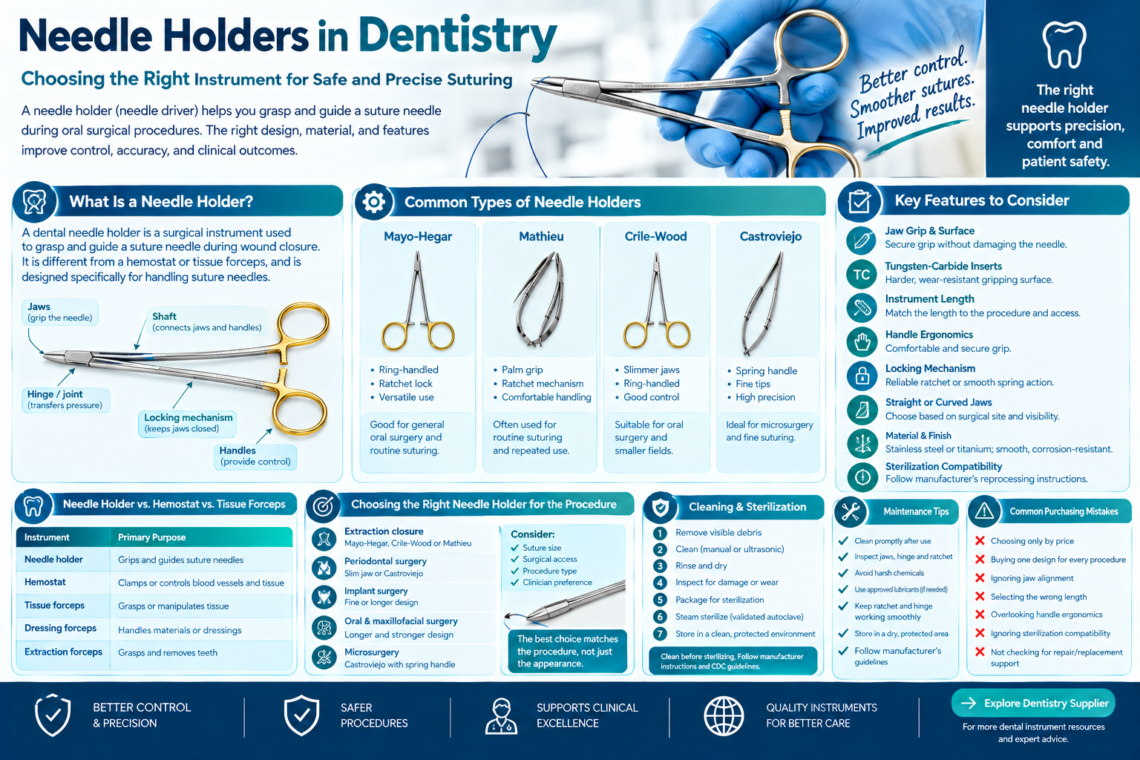
The instrument generally includes:
- Jaws that hold the suture needle.
- Handles that allow the operator to control the instrument.
- A locking or spring mechanism, depending on the design.
- A hinge or joint that transfers hand pressure to the jaws.
- A shaft connecting the handle and working end.
A needle holder is different from a dental injection needle holder or a hemostat. Its primary purpose is to hold a surgical suture needle, not to administer anesthesia or clamp blood vessels.
During suturing, the needle holder helps the clinician position the needle at the correct angle, pass it through tissue, and release it without repeatedly touching the needle directly.
Why Are Needle Holders Important in Oral Surgery?
Suturing requires accuracy because oral tissues are often delicate, access can be limited, and the surgical field may be small. A poorly designed or worn needle holder can make the needle rotate, slip, or become difficult to control.
A well-designed dental needle holder can help with:
1. Secure needle control
The jaws must grip the needle firmly enough to prevent unwanted movement during tissue penetration. This is especially important when working in posterior areas or around delicate periodontal tissues.
2. Precise needle placement
The handle and jaw design influence how easily the clinician can position the needle. Fine-control instruments are particularly useful for microsurgical procedures and aesthetic soft-tissue management.
3. Better access in confined spaces
Dental procedures often require instruments that can reach difficult areas without obstructing the clinician’s view. Length, curvature, and jaw profile should therefore be selected according to the surgical site.
For a broader overview of dental instruments and their functions, see this guide to common dental instruments and uses.
Common Types of Needle Holders Used in Dentistry
Different needle holders are designed for different levels of control, needle sizes, and surgical applications. The most common types include Mayo-Hegar, Mathieu, Crile-Wood, and Castroviejo needle holders.
1. Mayo-Hegar Needle Holder
The Mayo-Hegar needle holder is a traditional ring-handled instrument with a ratchet-loc mom king mechanism. It resembles the general design of many surgical hemostats but has jaws specifically shaped for gripping suture needles.
2. Mathieu Needle Holder
The Mathieu needle holder uses a palm-grip design rather than traditional finger rings. It commonly includes a spring mechanism and ratchet system that allows the clinician to close and lock the jaws by squeezing the handles.
3. Crile-Wood Needle Holder
The Crile-Wood needle holder is a ring-handled instrument with a relatively slimmer jaw profile than many traditional Mayo-Hegar models. Its design provides a balance between secure needle control and access in smaller surgical fields.
4. Castroviejo Needle Holder
The Castroviejo needle holder is commonly associated with microsurgery and fine suturing. It generally uses a spring-handle, pencil-grip design rather than ring handles.
The clinician controls the jaws through fingertip pressure, which can provide precise manipulation of small needles and fine suture materials.
Important Features to Consider When Buying Needle Holders
The appearance of a needle holder does not always indicate its quality. Before purchasing, evaluate the following features carefully.
1. Jaw Grip and Surface Pattern
The jaws are among the most important parts of a needle holder. They should hold the needle securely without causing unnecessary damage.
Some needle holders use cross-hatched jaw surfaces to improve grip. Others feature tungsten-carbide inserts that may provide a harder and more wear-resistant gripping surface than standard stainless-steel jaws.
2. Tungsten-Carbide Inserts
Tungsten-carbide, often abbreviated as TC, may be incorporated into the jaws of premium needle holders. These inserts are harder than the surrounding stainless steel and can provide improved resistance to wear.
TC inserts are not automatically necessary for every practice. Their value depends on procedure volume, instrument quality, budget, and maintenance practices.
3. Instrument Length
Needle holder length should match the working area rather than being selected only according to personal preference.
Shorter instruments may provide improved control in anterior or easily accessible areas. Longer instruments may help reach deeper posterior surgical sites but can feel less precise if they are too large for the procedure.
4. Handle Ergonomics
A needle holder should be comfortable to operate throughout the procedure. Poor ergonomics may contribute to hand fatigue, reduced control, or awkward wrist positioning.
A handle that is too tight or too stiff may be difficult to use repeatedly. A mechanism that is too loose may fail to provide reliable control.
5. Locking Mechanism
Many needle holders use a ratchet that allows the jaws to remain closed around the needle. The locking system should engage predictably and release without excessive force.
For microsurgical procedures, a non-ratcheted spring design may be preferred because it provides continuous fingertip control rather than locking the needle in a fixed position.
6. Straight or Curved Jaws
Straight needle holders are common and versatile. Curved designs may improve visibility or access in specific surgical areas.
A curved needle holder should not be selected solely because it appears more specialized. The shape must support the actual procedure.
7. Material and Corrosion Resistance
Most reusable dental needle holders are manufactured from surgical-grade stainless steel. Stainless steel is widely used because it offers a useful combination of strength, durability, corrosion resistance, and sterilization compatibility.
Titanium instruments may be lighter and offer excellent corrosion resistance, but they may have different hardness and wear characteristics compared with stainless steel. The best material depends on the instrument’s intended use and design.
For a detailed comparison, read Stainless Steel vs Titanium Dental Instruments.
8. Surface Finish
A high-quality surface finish supports cleaning, inspection, and corrosion resistance. The instrument should not have rough areas, deep scratches, pits, flaking, or surface irregularities.
9. Manufacturer Documentation
Reusable dental instruments should be supplied with clear instructions for use and reprocessing. These instructions should explain appropriate cleaning, lubrication if required, sterilization parameters, and any restrictions.
Choosing a Needle Holder According to the Procedure
The best needle holder depends on the type of dental procedure being performed.
Routine Extraction Closure
For routine extraction-site closure, a general-purpose Mayo-Hegar, Mathieu, or Crile-Wood needle holder may be suitable. The choice depends on the suture size, access, and clinician preference.
A palm-grip Mathieu may be preferred for efficient repetitive suturing, while a ring-handled instrument may offer a more familiar technique for clinicians trained in general surgical handling.
Periodontal Surgery
Periodontal procedures may require precise manipulation around gingival tissues and narrow surgical fields. A slim-jaw needle holder or a fine Castroviejo-style instrument may be appropriate, particularly when using smaller sutures.
Implant Surgery
Implant-related soft-tissue procedures may involve delicate tissue handling and aesthetic considerations. The needle holder should provide controlled needle placement without obstructing visibility.
For fine suturing, a microsurgical needle holder may be useful. For routine implant closure, a general-purpose instrument may be sufficient.
Oral and Maxillofacial Surgery
More extensive oral surgical procedures may require different lengths and stronger jaw designs. A longer needle holder can provide access to deeper areas, but the instrument must still be manageable and properly balanced.
Microsurgery
Microsurgical procedures often require specialized instruments designed for small needles and fine sutures. Castroviejo-style needle holders are frequently selected for their spring-handle design and fingertip control.
Always confirm that the instrument’s jaw dimensions and recommended suture range match the intended procedure.
Needle Holder vs Hemostat vs Tissue Forceps
These instruments may appear similar, but they perform different functions.
| Instrument | Primary purpose |
| Needle holder | Grips and guides suture needles |
| Hemostat | Clamps or controls blood vessels and tissue structures |
| Tissue forceps | Grasps, stabilizes, or manipulates tissue |
| Dressing forceps | Handles materials or dressings |
| Extraction forceps | Grasps and removes teeth |
A hemostat is not a direct replacement for a needle holder. Its jaws and locking mechanism are designed for clamping rather than controlled needle driving. Using the wrong instrument may damage the needle, reduce precision, or compromise the surgical workflow.
Cleaning and Sterilization of Dental Needle Holders
Reusable needle holders can become contaminated with blood, saliva, tissue, and other organic material. Proper reprocessing is essential for patient safety and instrument longevity.
The CDC identifies cleaning as the first step before disinfection or sterilization because organic debris can interfere with the effectiveness of the process. Critical instruments that penetrate soft tissue or bone should be heat sterilized after each use when heat-stable.
Recommended Reprocessing Considerations
Follow the instrument manufacturer’s instructions, but the general workflow usually includes:
- Contain contaminated instruments safely after use.
- Transport them in a covered, leak-resistant container.
- Clean the instrument using an approved manual or mechanical process.
- Remove blood and organic debris, especially around the hinge and jaw surfaces.
- Rinse thoroughly to remove detergent residue.
- Dry the instrument completely.
- Inspect the jaws, joint, ratchet, and surface finish.
- Lubricate the joint if the manufacturer recommends it.
- Package the instrument appropriately.
- Sterilize using the approved cycle.
- Store the instrument in a clean, protected environment.
During manual cleaning, avoid reaching into containers of instruments that cannot be seen clearly. Use appropriate protective equipment and tools designed to reduce the risk of puncture injuries.
Inspect Before Sterilization
Sterilization does not repair a damaged instrument. Before packaging, inspect for:
- Misaligned jaws
- Loose hinges
- Cracked TC inserts
- Damaged ratchets
- Rust or pitting
- Incomplete jaw closure
- Stiff movement
- Excessive handle play
- Residual debris
An instrument that cannot be adequately cleaned or no longer functions as intended should be repaired, removed from service, or replaced.
For more maintenance guidance, review the Dental Equipment Maintenance Checklist.
Common Mistakes When Buying Dental Needle Holders
Selecting instruments based only on price or appearance can lead to poor performance and higher replacement costs.
Mistake 1: Choosing only by price
A low purchase price may not reflect long-term durability, jaw quality, or manufacturing consistency. Consider total value, including service life, maintenance, and replacement frequency.
Mistake 2: Buying one design for every procedure
A single general-purpose needle holder may not be suitable for routine extraction closure, microsurgery, and deep posterior procedures. Different surgical requirements may justify different designs.
Mistake 3: Ignoring jaw alignment
Misaligned jaws can cause the needle to rotate or slip. Always inspect the working end before purchase.
Mistake 4: Selecting the wrong length
An instrument that is too long may reduce precision, while one that is too short may not provide adequate access.
Mistake 5: Overlooking the handle mechanism
Ring-handled, palm-grip, and spring-handle designs feel different in use. Choose according to the clinician’s technique and procedure requirements.
Mistake 6: Failing to check sterilization compatibility
Reusable instruments must have clear reprocessing instructions. Avoid purchasing instruments when the manufacturer does not provide reliable cleaning and sterilization guidance.
Mistake 7: Neglecting replacement and repair support
Ask whether the supplier provides quality documentation, repair support, replacement availability, and product specifications.
For more purchasing guidance, see Common Mistakes Clinics Make When Buying Dental Instruments.
How to Maintain Needle Holders for Longer Service Life
Proper maintenance can help preserve jaw performance, joint movement, and surface condition.
Follow these practices:
- Clean instruments promptly after use.
- Do not allow blood or tissue debris to dry on the instrument.
- Open hinged instruments during cleaning when instructed.
- Use cleaning products compatible with the instrument’s material.
- Avoid abrasive pads that can damage the surface.
- Do not force a stiff ratchet or hinge.
- Inspect TC inserts regularly.
- Use manufacturer-approved lubricant when required.
- Avoid overloading sterilization trays.
- Store instruments in a dry, protected environment.
- Remove damaged instruments from clinical use.
- Maintain records for inspection, repair, and replacement when appropriate.
Cleaning agents should be compatible with the metals and materials used in the instrument. Incorrect chemicals, excessive exposure, or poor rinsing may contribute to corrosion or surface damage.
Frequently Asked Questions
What is a needle holder used for in dentistry?
A needle holder is used to grasp and guide a surgical suture needle during wound closure. Dental professionals may use it after extractions, implant procedures, periodontal surgery, biopsies, and other oral surgical treatments.
Is a needle holder the same as a needle driver?
The terms are often used interchangeably in surgical and dental settings. Both generally refer to an instrument designed to hold and manipulate a suture needle.
Which needle holder is best for routine dental suturing?
Mayo-Hegar, Mathieu, and Crile-Wood needle holders are commonly considered for routine dental suturing. The best option depends on handle preference, suture size, surgical access, and the clinician’s technique.
What is the difference between Mathieu and Castroviejo needle holders?
Mathieu needle holders generally use a palm-grip and ratchet mechanism, while Castroviejo needle holders typically use a spring-handle design for fingertip control. Mathieu instruments are often selected for routine suturing, whereas Castroviejo instruments are commonly used for fine or microsurgical suturing.
Are tungsten-carbide needle holders better?
Tungsten-carbide inserts can provide a harder, wear-resistant gripping surface and may improve needle control. However, quality depends on the entire instrument, including jaw alignment, construction, maintenance, and manufacturing standards.
Conclusion
Selecting the right needle holders in dentistry requires more than choosing a familiar instrument or the lowest-priced option. Jaw grip, handle design, length, material, locking mechanism, ergonomics, and sterilization compatibility all influence clinical performance.
Mayo-Hegar and Crile-Wood designs may be suitable for general oral surgery, Mathieu needle holders can support routine palm-grip suturing, and Castroviejo instruments are often preferred for fine or microsurgical procedures. The ideal choice should always match the procedure, suture size, surgical access, and clinician’s working style.
Dental practices should also prioritize reliable manufacturing, clear reprocessing instructions, routine inspection, and proper maintenance. Investing in well-designed instruments can support safer workflows, more controlled suturing, and better long-term value.
CTA
Understanding dental instruments is an important part of building an efficient and well-maintained clinical setup. Explore Dentistry Supplier for educational resources covering dental instruments, equipment selection, maintenance, and clinical practice considerations.