When a dentist holds a dental instrument, the finished product can look simple: a pair of forceps, an explorer, a scaler, or a dental elevator designed for a specific clinical task.
Behind that apparently simple tool, however, is a combination of material selection, forging, shaping, grinding, heat treatment, polishing, assembly, inspection, and human skill.
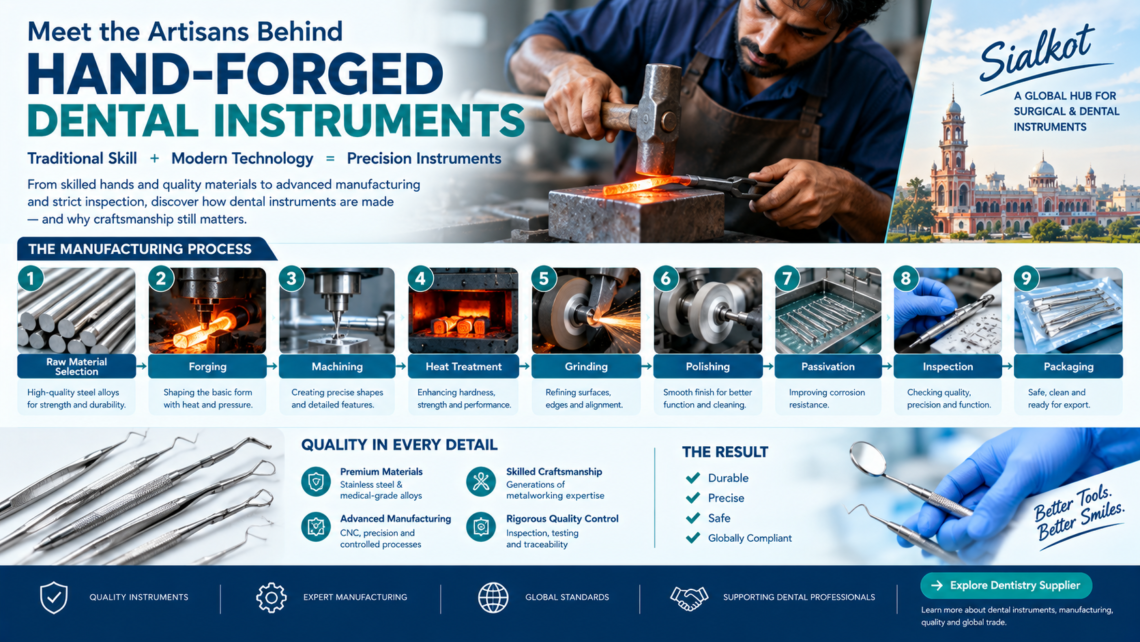
Meet the Artisans Behind Hand-Forged Dental Instruments, where experienced craftsmen remain an important part of the manufacturing process. Sialkot, Pakistan, has developed a long-established surgical and dental instrument manufacturing cluster in which generations of metalworking expertise have been combined with increasingly modern production and quality-control systems. Historical research traces the development of Sialkot’s surgical-instrument industry to the late 19th and early 20th centuries, when local craftsmen began repairing and reproducing medical instruments.
Today, manufacturing does not simply mean putting metal into a forge and shaping it by hand. Modern facilities can combine traditional forging skills with CNC machining, controlled heat treatment, polishing, passivation, dimensional inspection, and documented quality systems.
So who are the people behind these instruments, and what exactly do they contribute?
What Are Hand-Forged Dental Instruments?
Hand-forged dental instruments are tools whose basic metal form is created through a forging process before subsequent manufacturing and finishing operations.
Forging involves applying controlled force to heated metal so it takes the desired general shape. The forged blank then undergoes additional processes to create the precise working surfaces, joints, edges, serrations, handles, and other features required for the finished instrument.
The term “hand-forged” should not be interpreted to mean that every manufacturing step is performed manually.
Modern manufacturers may combine:
- Traditional forging
- Mechanical or drop forging
- CNC machining
- Manual grinding
- Heat treatment
- Precision finishing
- Polishing
- Passivation
- Dimensional inspection
- Functional testing
Research describing the Sialkot manufacturing cluster has documented a sequence that can include hot forging, trimming, cold forging, machining, grinding, tempering, polishing, testing, cleaning, and packaging.
This combination of craftsmanship and technology is what allows manufacturers to produce instruments that require both strength and precision.
Who Are the Artisans Behind Dental Instruments?
The word “artisan” can describe several different specialists involved in instrument production.
A single dental instrument may pass through the hands of workers with different skills rather than being completed by one person from beginning to end.
These specialists may include:
- Forging specialists
- Grinding technicians
- Machining operators
- Heat-treatment technicians
- Polishers
- Assembly workers
- Finishing specialists
- Quality inspectors
- Packaging personnel
Each stage contributes something different to the final instrument.
The artisan’s role is particularly important where visual judgment, hand control, surface finishing, alignment, and detailed inspection are required.
The Tradition of Instrument Making in Sialkot
Sialkot is widely recognized as an important global manufacturing center for surgical and dental instruments.
Historical studies describe the development of the city’s surgical-instrument cluster through local metalworking expertise and early relationships with medical institutions. Over time, specialized production networks developed around forging, machining, finishing, testing, and export.
That history helped create a workforce familiar with the fine metalworking skills required for small medical instruments.
Manufacturers operating in Sialkot today describe combining generations of craftsmanship with modern manufacturing technologies and quality-management systems.
This heritage is important because dental instruments often require more than simply cutting metal to a particular shape.
The instrument must feel right in the hand, function smoothly, maintain alignment, and provide the intended working performance.
Step 1: Selecting the Right Steel
The manufacturing process begins with the raw material.
Dental instruments require materials capable of tolerating repeated clinical use and, for reusable instruments, appropriate cleaning and sterilization processes.
Manufacturers may use different stainless-steel grades depending on the instrument’s intended characteristics.
For example, some manufacturers report using AISI 420 and related stainless steels for instruments where hardness and edge performance are important.
Material selection can influence:
- Hardness
- Strength
- Corrosion resistance
- Edge retention
- Flexibility
- Wear resistance
- Finishing characteristics
The correct material therefore depends on the design and intended application rather than simply choosing the hardest available steel.
For a deeper comparison, read our guide on Stainless Steel vs Titanium Dental Instruments.
Step 2: Forging the Instrument Blank
Once suitable steel has been selected, the material is prepared for forging.
The steel is heated to an appropriate temperature and shaped using controlled force.
At this stage, the instrument does not yet resemble the finished dental tool perfectly.
Instead, the forging creates the basic form from which later machining and finishing can produce the precise final geometry.
A skilled forging technician needs to understand:
- Material behavior
- Heating
- Die alignment
- Forging pressure
- Instrument geometry
- Metal flow
- Defect prevention
Historical descriptions of Sialkot’s production system show that forging has long been an important specialized stage within the broader instrument-manufacturing cluster.
Step 3: Trimming and Shaping
After forging, excess material may need to be removed.
The rough blank is then shaped closer to its intended final form.
This can involve:
- Trimming
- Cutting
- Grinding
- Milling
- Drilling
- Profile formation
The exact sequence varies according to the instrument.
A dental extraction forceps, for example, requires very different geometry from a dental explorer or orthodontic plier.
Read our detailed guide on Dental Extraction Forceps: How to Choose the Right Set to understand why instrument geometry matters.
Step 4: Precision Machining
Modern dental instrument manufacturing increasingly combines craftsmanship with precision machinery.
CNC and other machining systems can create detailed features that require consistent dimensions.
These may include:
- Serrations
- Grooves
- Working tips
- Holes
- Joint components
- Handle profiles
- Cutting surfaces
Manufacturers in Sialkot describe using both CNC and manual processes during instrument production.
This combination allows production to benefit from machine consistency while retaining the practical knowledge of experienced technicians.
Step 5: Heat Treatment
Heat treatment is a critical stage for many stainless-steel instruments.
Controlled heating and cooling can modify the mechanical properties of the steel.
Depending on the material and process, heat treatment can influence:
- Hardness
- Toughness
- Spring characteristics
- Wear resistance
- Edge performance
Some manufacturers describe hardening and tempering processes designed to establish appropriate hardness and spring characteristics.
The process must be controlled carefully because excessive hardness or inappropriate treatment can create undesirable properties.
Step 6: Grinding and Refining
After forging, machining, and heat treatment, the instrument still requires detailed refinement.
Grinding technicians shape surfaces and remove imperfections.
This stage can determine the precision of:
- Cutting edges
- Working tips
- Instrument profiles
- Contact surfaces
- Joints
- Serrations
Grinding is particularly important for instruments where the working end must interact precisely with a tooth, wire, tissue, or another dental component.
This is where an experienced technician’s judgment can become especially valuable.
Step 7: Polishing the Instrument
Polishing improves the surface finish of the instrument.
Depending on the product specification, manufacturers may produce:
- Mirror finishes
- Satin finishes
- Matte surfaces
Polishing is not simply cosmetic.
A properly finished surface can improve the instrument’s appearance, facilitate cleaning, and remove surface imperfections.
However, the desired finish depends on the instrument and manufacturer specifications.
Step 8: Passivation and Corrosion Protection
Stainless steel naturally forms a passive oxide layer that contributes to its corrosion resistance.
Manufacturers may use passivation processes to improve the condition of the surface after manufacturing.
Some Sialkot manufacturers describe chemical passivation as part of their finishing processes.
Proper surface treatment is particularly relevant for reusable instruments because they can be repeatedly exposed to cleaning, disinfection, and sterilization processes.
Step 9: Assembly
Some dental instruments consist of multiple components that must work together accurately.
Examples include:
- Forceps
- Scissors
- Pliers
- Needle holders
- Hinged instruments
Assembly technicians check whether the components move correctly and whether the working ends align.
For hinged instruments, smooth movement is essential.
A poorly aligned instrument may look acceptable but perform poorly in clinical use.
Step 10: Human Inspection
This is where the artisan’s role becomes particularly visible.
Even when manufacturing uses advanced machinery, experienced personnel can inspect the finished instrument for issues that require practical judgment.
Inspection may involve checking:
- Alignment
- Surface quality
- Tip symmetry
- Joint movement
- Cutting performance
- Serration quality
- Finish
- Dimensions
Some manufacturers report 100% dimensional and functional inspection before dispatch.
The precise inspection system varies by manufacturer, but human oversight remains an important part of quality assurance.
Craftsmanship vs Automation
The modern instrument industry should not necessarily be viewed as a choice between craftsmanship and automation.
The strongest manufacturing systems can use both.
| Craftsmanship | Automation |
| Manual finishing | CNC machining |
| Visual inspection | Digital measurement |
| Hand polishing | Controlled production processes |
| Practical adjustment | Repeatable dimensions |
| Experienced judgment | Production consistency |
| Traditional skills | Modern quality systems |
Automation can improve repeatability, while skilled workers can provide judgment and refinement.
The two approaches can complement one another.
For more information, read our article on Skilled Craftsmanship vs Automation in Instrument Manufacturing.
What Makes a High-Quality Hand-Forged Dental Instrument?
A quality instrument is not defined by the word “hand-forged” alone.
Buyers should consider the complete manufacturing and quality process.
Important factors include:
Material Quality
The manufacturer should specify the material used and ensure it is appropriate for the instrument.
Manufacturing Precision
The working end, joints, handles, and other components should meet the required dimensions.
Surface Finish
The instrument should have an appropriate, consistent finish without obvious defects.
Functional Performance
The instrument should perform its intended task reliably.
Corrosion Resistance
Reusable instruments need appropriate material and surface treatment for their intended reprocessing conditions.
Quality Control
The manufacturer should have documented inspection and quality procedures appropriate to the product.
Why Manufacturing Quality Matters for Dentists
Dental instruments are repeatedly handled during clinical procedures.
A poorly manufactured instrument may lead to:
- Reduced precision
- Difficult handling
- Poor cutting performance
- Premature wear
- Corrosion
- Misalignment
- Increased replacement requirements
For dentists and dental practices, instrument quality can therefore influence workflow and long-term equipment costs.
If you’re building or upgrading an instrument inventory, see our Common Dental Instruments and Uses guide.
How to Evaluate a Dental Instrument Manufacturer
If you are purchasing dental instruments for a clinic, distributor, or dental supply business, do not evaluate manufacturers based only on photographs or price.
Consider asking about:
- Material specifications
- Manufacturing process
- Quality-control procedures
- Applicable certifications
- Product testing
- Traceability
- Sterilization instructions
- OEM capabilities
- Customization options
- Warranty or replacement policies
- Export experience
A reputable manufacturer should be able to explain how its instruments are produced and inspected.
From Artisan Workshop to Global Supply Chain
The finished instrument does not necessarily go directly from an artisan’s workbench to a dentist.
The modern supply chain can include:
Raw material → Forging → Machining → Heat treatment → Grinding → Polishing → Passivation → Assembly → Inspection → Packaging → Export → Distributor → Dental practice
This means the artisan is one important part of a much larger system.
Quality depends on every stage working together.
The Future of Dental Instrument Craftsmanship
Traditional craftsmanship is unlikely to disappear simply because manufacturing technology is becoming more advanced.
Instead, the industry is increasingly combining:
- Experienced technicians
- CNC machining
- Digital measurement
- Modern heat treatment
- Improved materials
- Documented quality systems
- Traceability
- Automated finishing processes
The future may therefore be less about replacing artisans with machines and more about giving skilled workers better tools to produce consistent instruments.
Frequently Asked Questions
What does hand-forged mean in dental instruments?
Hand-forged generally refers to a manufacturing process in which heated metal is shaped through forging, with skilled workers often involved in controlling, refining, and finishing the instrument. Modern production may combine forging with CNC machining and other automated processes.
Are hand-forged dental instruments better?
Not automatically. Quality depends on the material, design, manufacturing precision, heat treatment, finishing, inspection, and intended application. The term “hand-forged” alone should not be treated as a guarantee of quality.
Why is Sialkot known for dental and surgical instruments?
Sialkot developed a specialized metalworking and medical-instrument manufacturing cluster over many decades. Historical research links the development of the surgical-instrument industry to local craftsmen and medical institutions, followed by the growth of specialized manufacturing and export networks.
What steel is used for dental instruments?
Different instruments can require different stainless-steel grades. Manufacturers commonly specify grades such as AISI 410 or AISI 420 for particular applications, but the appropriate material depends on the instrument design and required properties.
What happens after a dental instrument is forged?
The forged blank can undergo trimming, machining, heat treatment, grinding, polishing, passivation, assembly, inspection, cleaning, and packaging. The exact sequence depends on the instrument and manufacturer.
Conclusion
Meet the Artisans Behind Hand-Forged Dental Instruments, and you discover that every finished instrument represents more than a piece of shaped stainless steel.
Behind a dental forceps, scaler, elevator, plier, or other hand instrument can be a chain of specialized skills involving forging, machining, heat treatment, grinding, polishing, assembly, and inspection.
In manufacturing centers such as Sialkot, generations of metalworking knowledge have contributed to the development of a specialized dental and surgical instrument industry. Modern production now combines this craftsmanship with precision machinery and formal quality-control systems.
For dental professionals and buyers, understanding this process makes it easier to evaluate instruments beyond appearance and price.
The best purchasing decision should consider the material, design, manufacturing process, quality controls, intended clinical application, maintenance requirements, and manufacturer reliability.
A dental instrument may be small enough to fit in the palm of a hand, but producing it correctly can require decades of accumulated knowledge, modern technology, and careful attention to detail.
Call to Action
Want to learn more about how dental instruments are made, selected, maintained, and used?
Explore Dentistry Supplier for informative guides covering dental instruments, manufacturing processes, materials, equipment selection, maintenance, orthodontic tools, and other topics relevant to dental professionals, clinics, and dental-equipment buyers.


