When a tooth becomes severely decayed, infected, cracked, or damaged, one of the most important decisions is whether to save it with a root canal or remove it through a tooth extraction.
Both treatments can address serious dental problems, but they have very different long-term consequences. A root canal removes infected pulp from inside the tooth while preserving the natural tooth structure. Extraction removes the entire tooth and may require a replacement such as a dental implant, bridge, or partial denture.
The right choice depends on whether the tooth is structurally restorable, the condition of the surrounding gums and bone, the severity of infection, and your long-term oral health goals.
This guide explains Root Canal vs Tooth Extraction, including the procedures, pain, recovery, cost considerations, benefits, risks, and long-term effects.
Root Canal vs Tooth Extraction: Understanding Both Procedures
Before choosing between a root canal and extraction, it is important to understand what each treatment actually does.
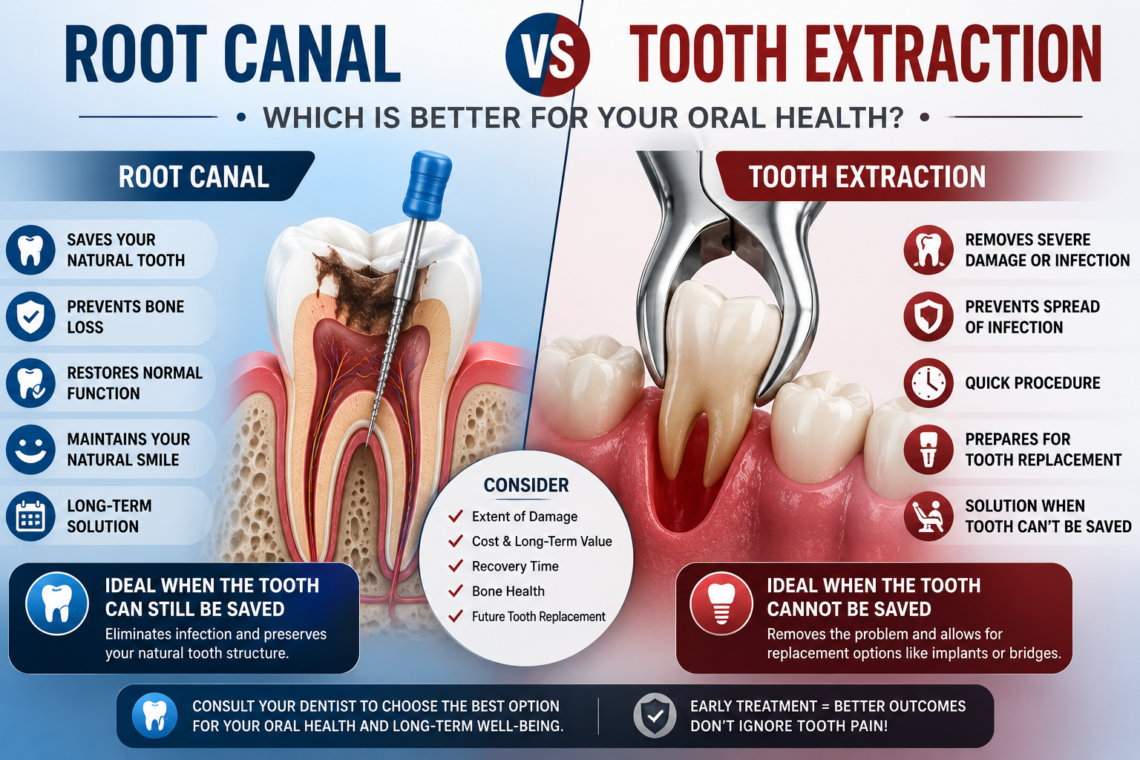
A root canal attempts to save the natural tooth by removing infected or inflamed pulp from inside it. Extraction, by contrast, removes the tooth completely from its socket.
Neither treatment is automatically right for every patient. The condition of the tooth determines whether it can still be restored successfully.
What Is a Root Canal?
A root canal treatment, also called endodontic treatment, is designed to remove infection or inflammation from the pulp inside a tooth.
The dentist creates an opening in the tooth, removes the infected pulp, cleans and disinfects the root canals, fills them, and seals the tooth. A crown or other permanent restoration may then be recommended to protect the remaining tooth structure.
The primary goal is to eliminate the infection while retaining the natural tooth.
Step-by-Step Root Canal Procedure
Although the exact treatment varies according to the tooth and infection, a typical root canal involves several stages.
Step 1: Examination and Diagnosis
Your dentist examines the tooth, reviews your symptoms, and may take X-rays or perform additional tests to determine the condition of the pulp and surrounding tissues.
Step 2: Local Anesthesia
The area surrounding the tooth is numbed with local anesthesia. Modern anesthesia helps make root canal treatment comfortable for most patients.
Step 3: Accessing the Pulp
The dentist creates a small opening through the tooth to reach the infected or inflamed pulp.
Step 4: Cleaning and Shaping
Specialized endodontic instruments are used to remove infected tissue and clean and shape the root canals.
Step 5: Filling the Canals
After cleaning and disinfecting, the canals are filled and sealed with a suitable dental material.
Step 6: Final Restoration
A permanent restoration is placed to restore function and protect the tooth. Depending on the amount of remaining tooth structure, a dental crown may be recommended.
For additional information about protecting teeth after treatment, you can also read How Long Do Dental Crowns Last?.
Benefits of Root Canal Treatment
One of the biggest advantages of root canal treatment is that it allows you to retain your natural tooth.
Potential benefits include:
- Preserving the natural tooth
- Maintaining normal chewing function
- Avoiding extraction when the tooth is restorable
- Removing infection from inside the tooth
- Maintaining natural tooth alignment
- Avoiding immediate tooth replacement
- Preserving the natural appearance of your smile
What Is a Tooth Extraction?
A tooth extraction is the removal of an entire tooth from its socket.
Dentists generally consider extraction when a tooth cannot be predictably repaired or when keeping it could negatively affect oral health.
Extraction may be necessary when restorative treatment cannot provide a reasonable long-term prognosis.
Step-by-Step Tooth Extraction Procedure
Step 1: Examination
The dentist evaluates the tooth and surrounding tissues and may take diagnostic X-rays.
Step 2: Local Anesthesia
Local anesthesia is administered to numb the tooth and surrounding gum tissue.
Step 3: Tooth Removal
For a simple extraction, specialized instruments are used to loosen and remove the tooth.
A surgical extraction may require an incision, removal of some surrounding tissue, or sectioning of the tooth into smaller pieces.
Step 4: Socket Care
The socket is cleaned after the tooth is removed.
Step 5: Stitches or Bone Grafting When Needed
Some extractions require stitches. In selected cases, a bone graft may be recommended to help manage bone loss and prepare the site for future tooth replacement.
Benefits of Tooth Extraction
Although preserving a natural tooth is generally desirable when predictable restoration is possible, extraction can be the appropriate treatment when the tooth cannot be saved.
Potential benefits include:
- Removes a non-restorable tooth
- Eliminates the source of infection when the tooth cannot be treated successfully
- Removes severely damaged tooth structure
- Can address certain impacted teeth
- May prepare the mouth for planned tooth replacement
- Can resolve problems caused by an unsalvageable tooth
The key issue is not whether extraction is effective—it is whether removing the tooth provides a better long-term outcome than attempting to save it.
Which Procedure Is More Painful?
Pain is one of the biggest concerns people have when comparing Root Canal vs Tooth Extraction.
The reality is that both procedures are performed using local anesthesia, so you should not normally experience significant pain during treatment.
During a Root Canal
You may feel:
- Pressure
- Vibration
- Movement
- Mild sensitivity in some circumstances
The purpose of root canal treatment is to remove infected pulp and eliminate the source of pain.
During an Extraction
You may also feel pressure while the dentist loosens and removes the tooth.
Afterward, extraction commonly causes some soreness and swelling as the extraction socket heals.
Root Canal vs Tooth Extraction Cost
The Root Canal vs Tooth Extraction cost comparison can be misleading if you only consider the initial procedure.
A simple extraction may cost less upfront than root canal treatment. However, extraction can create additional expenses if the missing tooth needs to be replaced.
Root Canal Costs May Include
- Dental examination
- X-rays
- Root canal procedure
- Temporary restoration
- Permanent filling
- Dental crown when required
- Follow-up appointments
Extraction Costs May Include
- Examination
- Diagnostic imaging
- Extraction procedure
- Bone graft when indicated
- Dental implant
- Implant crown
- Dental bridge
- Partial denture
- Follow-up visits
Therefore, ask your dentist for the total expected cost of treatment, not simply the cost of removing the tooth.
Long-Term Oral Health Comparison
The long-term difference between the two treatments is significant.
Root Canal Advantages
A successful root canal allows you to keep the natural tooth.
This can help:
- Maintain normal chewing
- Preserve the existing bite
- Avoid immediate tooth replacement
- Maintain natural tooth structure
- Reduce the need for procedures involving neighboring teeth
Keeping the natural tooth can also simplify long-term dental care compared with extracting the tooth and subsequently replacing it.
Tooth Extraction Considerations
After extraction, the missing tooth may need to be replaced.
Possible replacement options include:
- Dental implant
- Dental bridge
- Removable partial denture
For patients considering implants after extraction, tooth replacement should be discussed before the extraction whenever possible so the overall treatment plan can be coordinated.
When Is Extraction Better Than a Root Canal?
A root canal is not always the correct choice.
Extraction may be more appropriate when the tooth has:
- Extensive structural destruction
- A vertical root fracture
- Insufficient remaining tooth structure
- Severe periodontal support loss
- A poor long-term prognosis
- Failed previous treatment with no predictable retreatment option
Your dentist may refer you to an endodontist when the case is complex and there is a possibility of saving the tooth.
Risks and Considerations
Root Canal Risks
Possible complications include:
- Persistent infection
- Reinfection
- Complex root canal anatomy
- Tooth fracture
- Need for retreatment
- Need for endodontic surgery in selected cases
Root canal treatment does not guarantee that a tooth will last forever, but appropriate treatment and restoration can provide long-term function.
Tooth Extraction Risks
Possible considerations include:
- Bleeding
- Swelling
- Infection
- Dry socket
- Delayed healing
- Bone loss
- Tooth movement
- Need for tooth replacement
More complex extractions may involve a longer recovery period than simple extractions.
How to Decide Between Root Canal or Extraction
Before agreeing to treatment, discuss these questions with your dentist:
- Can the tooth be predictably restored?
- How much healthy tooth structure remains?
- Is there a crack or fracture?
- How much bone support is present?
- Is periodontal disease affecting the tooth?
- What is the expected prognosis?
- Will a crown be required?
- What is the total cost of each option?
- If the tooth is extracted, how will it be replaced?
- Will an implant or bone graft be necessary?
- Would an endodontist provide another treatment option?
This approach helps you compare the immediate procedure with the long-term consequences.
What Happens If You Extract a Tooth Instead of Saving It?
Extraction solves the immediate problem by removing the tooth, but it creates a missing-tooth space.
Depending on the location of the tooth, your dentist may recommend:
Dental Implant
An implant replaces the tooth root and supports a crown.
Dental Bridge
A bridge uses adjacent teeth or other supporting structures to replace the missing tooth.
Partial Denture
A removable partial denture can replace one or more missing teeth.
Root Canal Aftercare
Following root canal treatment, follow the instructions provided by your dentist.
General considerations include:
- Avoid chewing hard foods on the treated tooth until it has been permanently restored.
- Maintain regular brushing and flossing.
- Attend scheduled follow-up appointments.
- Have the recommended crown or final restoration placed promptly.
- Contact your dentist if severe or persistent pain develops.
Tooth Extraction Aftercare
After an extraction, your dentist will provide specific instructions based on the procedure.
General aftercare may include:
- Protecting the blood clot
- Following instructions about eating and drinking
- Avoiding activities that could disturb the extraction site
- Maintaining appropriate oral hygiene
- Taking prescribed or recommended medication as directed
- Attending follow-up appointments when necessary
If you experience persistent bleeding, worsening swelling, severe pain, fever, or other concerning symptoms, contact your dental professional.
The Importance of Good Oral Hygiene
Whether you receive a root canal or extraction, maintaining good oral hygiene remains essential.
Regular brushing and interdental cleaning can help control plaque and reduce the risk of future tooth decay and gum disease.
Maintaining healthy saliva flow is also important for the oral environment. Read What Is the Role of Saliva in Dental Health? for more information about saliva’s protective role.
Frequently Asked Questions
1. Is a root canal better than a tooth extraction?
When a tooth can be predictably restored, preserving the natural tooth with root canal treatment is often preferred. However, extraction may be the better option when the tooth cannot be successfully restored.
2. Which is more painful, a root canal or extraction?
Both procedures use local anesthesia. You may experience pressure during treatment, while soreness afterward varies between patients. Root canal treatment is generally considered a comfortable procedure with modern anesthesia.
3. Is a root canal more expensive than an extraction?
The initial root canal may cost more than a simple extraction. However, extraction may require additional treatment such as an implant, bridge, or denture, so the total cost should be compared rather than just the procedure fee.
4. Can every infected tooth be saved with a root canal?
No. A tooth with severe structural damage, certain fractures, inadequate support, or a poor prognosis may not be suitable for root canal treatment.
5. How long does root canal recovery take?
Many people experience only temporary soreness following treatment. Cleveland Clinic notes that most people recover in less than a week, although individual recovery varies.
Conclusion
Choosing between Root Canal vs Tooth Extraction should not be based solely on which procedure seems faster, cheaper, or less intimidating.
If a tooth is structurally sound enough to be predictably restored, root canal treatment can provide an opportunity to eliminate infection while preserving your natural tooth. Keeping the tooth can maintain normal chewing function and avoid the additional procedures that may be necessary after extraction.
However, not every tooth can be saved. Severe structural damage, certain fractures, advanced periodontal problems, or a poor prognosis may make extraction the more appropriate treatment.
The most important step is to have the tooth properly examined and discuss all reasonable options with your dentist. If extraction has been recommended but you are unsure whether the tooth can be saved, asking about an endodontic evaluation may be worthwhile.
Ultimately, the best choice in Root Canal vs Tooth Extraction is the treatment that provides the most predictable long-term outcome for your individual tooth and overall oral health.
Call to Action
Experiencing persistent tooth pain, sensitivity, swelling, or signs of an infected tooth?
Don’t delay professional evaluation. A dentist can determine whether your tooth may be saved with root canal treatment or whether extraction is the safer option.
For dental professionals looking to maintain a well-equipped practice, explore Detistry Supplier’s dental instruments and equipment for professional dental solutions.