The quality of a dental or surgical instrument begins long before it reaches a dental clinic, hospital, or distribution warehouse. While manufacturing precision, polishing, heat treatment, and final inspection are important, the entire process depends on one foundational factor: the quality of the raw material used to make the instrument.
Raw material sourcing affects an instrument’s strength, corrosion resistance, hardness, flexibility, surface finish, durability, and overall performance. When manufacturers purchase materials from unreliable suppliers or fail to verify material specifications, even advanced manufacturing equipment may not produce a dependable final product.
For dental instruments that are cleaned, disinfected, sterilized, and reused repeatedly, material quality becomes even more important. Instruments such as dental forceps, explorers, probes, scissors, needle holders, elevators, and surgical instruments must withstand mechanical stress and repeated exposure to moisture, chemicals, and sterilization cycles.
This guide explains how raw material sourcing affects instrument quality, which materials are commonly used, what buyers should evaluate, and how reliable sourcing contributes to safer, longer-lasting dental instruments.
Why Raw material sourcing affects instrument quality
Raw material sourcing refers to the process of selecting, purchasing, verifying, and managing the materials used to manufacture a product.
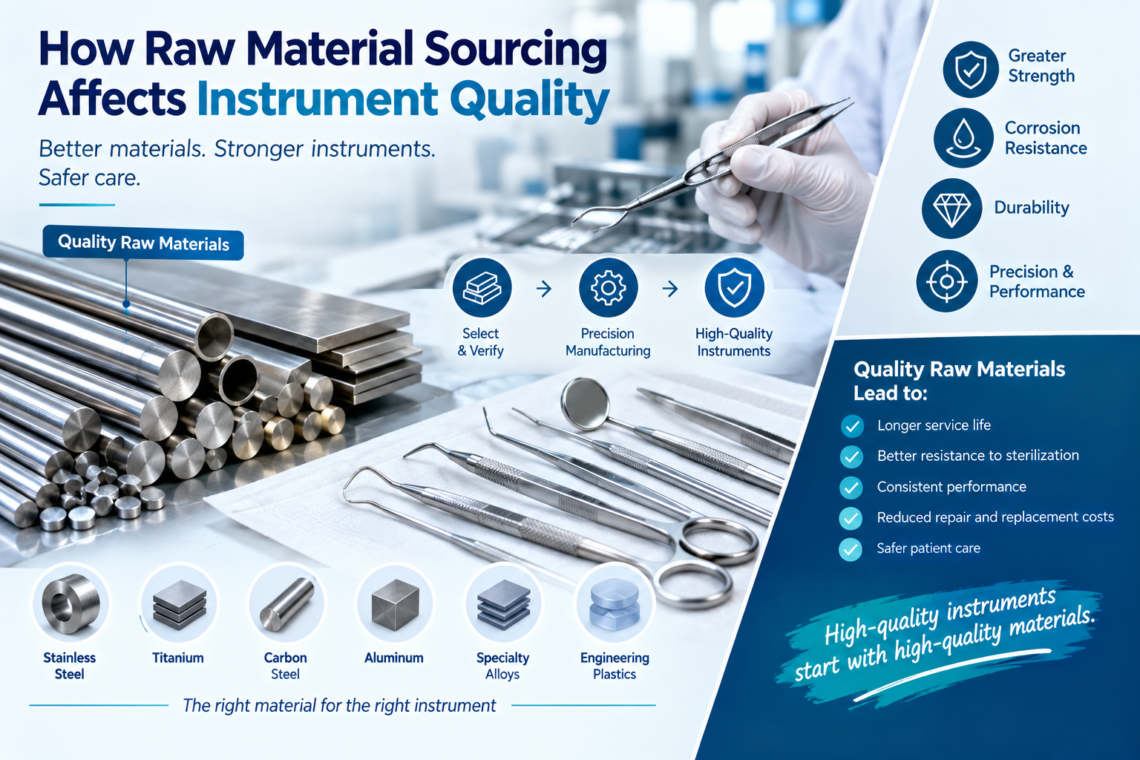
For dental and surgical instruments, sourcing may involve materials such as:
- Stainless steel
- Carbon steel
- Titanium
- Aluminum
- Specialty alloys
- Engineering plastics
- Silicone and polymer components
- Packaging and protective materials
The material selected must match the instrument’s intended function. A dental mirror, surgical scissors, needle holder, extraction forceps, and periodontal probe do not necessarily require the same mechanical or corrosion-resistance properties.
A manufacturer that sources materials based only on low price may encounter problems such as:
- Premature corrosion
- Weak or brittle instrument tips
- Loss of cutting performance
- Excessive wear
- Poor resistance to sterilization
- Surface discoloration
- Inconsistent dimensions after processing
- Cracks or deformation under pressure
- Increased repair and replacement costs
Reliable raw material sourcing helps manufacturers establish a stable foundation for consistent production and quality control.
For a broader overview of the instruments used in dental settings, see Dentistry Supplier’s guide to Common Dental Instruments and Uses.
The Relationship Between Raw Materials and Instrument Performance
Every instrument has specific performance requirements. The raw material must support those requirements throughout the product’s expected service life.
For example:
- Dental scissors require appropriate hardness, sharpness, edge retention, and corrosion resistance.
- Needle holders need strength, controlled grip, reliable jaw alignment, and resistance to repeated mechanical stress.
- Extraction forceps require sufficient strength and rigidity to withstand controlled pressure.
- Dental probes and explorers need precise working ends and adequate resistance to bending or deformation.
- Orthodontic instruments may require a balance of flexibility, spring action, hardness, and fatigue resistance.
- Surgical instruments need materials that tolerate repeated cleaning, disinfection, and sterilization.
A material that performs well for one instrument may be unsuitable for another. Therefore, quality sourcing is not simply about purchasing “stainless steel” or “medical-grade metal.” It involves selecting the correct grade, composition, condition, and treatment for the intended application.
Stainless Steel: A Key Material for Dental Instruments
Stainless steel is widely used in dental and surgical instrument manufacturing because it can offer a useful combination of strength, corrosion resistance, hardness, manufacturability, and durability.
However, stainless steel is not one single material. It includes multiple grades and metallurgical families, each with different properties.
The international standard ISO 21850-1:2020 specifies stainless steels commonly used in the manufacture of dental instruments. It applies to stainless steel used for complete instruments or parts of instruments, including single-use and reusable dental instruments.
Common stainless-steel categories
Austenitic stainless steel
Austenitic stainless steels are generally known for:
- Good corrosion resistance
- Good formability
- Good toughness
- Non-magnetic or low-magnetic behavior in many conditions
- Limited ability to be hardened through conventional heat treatment
These characteristics can make certain austenitic grades suitable for components where corrosion resistance and formability are important.
Martensitic stainless steel
Martensitic stainless steels are commonly used when higher hardness, strength, and wear resistance are required.
They can generally be hardened through heat treatment, making them useful for instruments such as:
- Scissors
- Cutting instruments
- Surgical blades
- Certain forceps
- Needle holders
- Instruments requiring edge retention
However, higher hardness does not automatically mean better performance. The material must be correctly heat-treated and balanced with toughness and corrosion resistance.
Precipitation-hardening stainless steel
Precipitation-hardening stainless steels can achieve high strength through specialized heat-treatment processes. They may be selected for applications requiring a particular combination of strength, hardness, and dimensional stability.
Ferritic stainless steel
Ferritic stainless steels may offer corrosion resistance and other useful properties, but they generally cannot be hardened through conventional heat treatment in the same way as martensitic grades.
The appropriate material depends on the instrument’s design, function, manufacturing process, and intended use.
For a practical comparison of common instrument materials, read Stainless Steel vs Titanium Dental Instruments, which explains how these materials differ in strength, weight, corrosion resistance, and handling characteristics.
How Reliable Suppliers Support Instrument Quality
A reliable raw material supplier does more than deliver metal. The supplier should provide consistent, traceable, and verifiable material that meets the manufacturer’s requirements.
1. Consistent chemical composition
The chemical composition of an alloy affects its performance. Variations outside the required specification may change hardness, corrosion resistance, machinability, or heat-treatment response.
Manufacturers should work with suppliers that can provide documentation confirming the material’s composition. Depending on the material and application, this may include:
- Material certificates
- Mill test certificates
- Heat or batch numbers
- Chemical composition reports
- Compliance declarations
- Supplier quality documentation
The goal is to confirm that the material received matches the material ordered.
2. Material traceability
Traceability allows a manufacturer to identify where a material originated and which production batches used it.
A strong traceability system may connect:
- Raw material supplier
- Material grade
- Heat or batch number
- Incoming inspection report
- Production batch
- Finished instrument lot
- Final inspection records
- Shipment documentation
If a quality issue is identified, traceability helps the manufacturer determine whether the issue is limited to one batch or affects a larger quantity.
3. Reliable material availability
Inconsistent sourcing can lead to frequent changes in material grades, suppliers, or production methods. These changes may affect the final instrument’s performance.
For example, if a manufacturer uses one steel grade for a batch of dental scissors and a different grade for the next batch without validating the change, the instruments may show differences in:
- Sharpness
- Flexibility
- Weight
- Corrosion resistance
- Cutting performance
- Heat-treatment response
A reliable supply chain helps manufacturers maintain consistent product specifications.
4. Proper storage and handling
Even high-quality raw material can be damaged through poor storage or handling.
Potential risks include:
- Surface contamination
- Moisture exposure
- Corrosion before manufacturing
- Mixing of different grades
- Scratches and dents
- Incorrect labeling
- Exposure to chemicals
- Improper stacking or transportation
Raw materials should be stored in controlled conditions and clearly identified to prevent material mix-ups.
How Poor Raw Material Sourcing Can Reduce Instrument Quality
Poor sourcing practices can create problems at multiple stages of production.
Incorrect material grade
If the wrong grade is supplied, the instrument may not achieve the required hardness, corrosion resistance, or flexibility.
For example, a material selected for a cutting instrument may not retain its edge if its hardness is inadequate. Conversely, excessive hardness without sufficient toughness may increase the risk of brittleness or cracking.
Inconsistent material properties
Even when the correct grade is ordered, inconsistent batches may respond differently during forging, machining, heat treatment, or polishing.
This can lead to variation in:
- Dimensions
- Hardness
- Surface finish
- Jaw alignment
- Cutting edges
- Spring action
- Overall instrument feel
Increased corrosion risk
Corrosion can occur when the material is unsuitable, contaminated, improperly processed, or inadequately finished.
Reusable dental instruments may be exposed to:
- Water
- Saliva
- Blood
- Cleaning agents
- Disinfectants
- Steam sterilization
- Humidity
- Residual chemicals
Corrosion testing can help manufacturers evaluate material selection and manufacturing processes. Surface treatment, passivation, polishing, and proper cleaning may also influence corrosion performance.
However, corrosion is not always caused by poor raw material alone. Incorrect cleaning chemicals, inadequate rinsing, high mineral content in water, instrument contact, and improper sterilization practices can also contribute.
For more information about maintaining dental equipment and reducing preventable damage, review the Dental Equipment Maintenance Checklist.
Raw Material Sourcing and Manufacturing Processes
Material quality must be compatible with the manufacturing method. Different processes place different demands on raw materials.
Forging
Forging shapes metal through controlled force. It is often used for instruments requiring strength and structural integrity, such as certain forceps, needle holders, and surgical instruments.
The quality of the raw material affects:
- Forging response
- Internal structure
- Crack resistance
- Dimensional consistency
- Final strength
- Heat-treatment behavior
Poor material quality can create defects that become more visible during forging or later machining.
CNC machining
CNC machining removes material to create precise shapes and dimensions. It is useful for instruments requiring accurate profiles, tight tolerances, or complex geometries.
Raw material consistency affects:
- Cutting-tool wear
- Machining stability
- Surface finish
- Dimensional accuracy
- Production efficiency
- Repeatability
If the material’s hardness or composition varies significantly, machining conditions may need to change, potentially affecting consistency.
Grinding and honing
Grinding and honing are especially important for instruments with:
- Cutting edges
- Fine tips
- Contact surfaces
- Serrated jaws
- Precision working ends
The material must respond predictably to these processes. Inadequate material quality may result in uneven edges, excessive wear, overheating, or inconsistent geometry.
Heat treatment
Heat treatment can modify hardness, strength, toughness, and wear resistance. However, the outcome depends on the material grade and the accuracy of the process.
If the raw material is incorrectly identified or has inconsistent composition, the same heat-treatment cycle may produce different results from one batch to another.
Polishing and passivation
Polishing improves surface smoothness and appearance, while passivation can help improve the corrosion resistance of suitable stainless-steel surfaces by supporting the development of a more protective passive layer.
However, surface finishing cannot fully compensate for an unsuitable base material. A poorly selected alloy may still corrode or fail despite an attractive polished appearance.
For additional guidance on maintaining equipment and instruments throughout their service life, see Dental Handpiece Maintenance: The Complete Guide for Long-Lasting Performance.
Raw Material Sourcing and Compliance Standards
Standards do not replace good manufacturing practices, but they provide a useful framework for material selection, documentation, testing, and quality assurance.
For dental instruments, ISO 21850-1:2020 provides a recognized reference for stainless steels commonly used in dental instrument manufacturing. The standard includes material designations and chemical-composition information for relevant stainless-steel categories.
Depending on the product and market, manufacturers may also work within quality-management systems such as:
- ISO 13485 for medical-device quality management
- ISO 9001 for general quality management
- Applicable national medical-device regulations
- Relevant ASTM material and testing standards
- Customer-specific technical specifications
Certification alone does not guarantee that every individual instrument is perfect. Buyers should also evaluate actual product samples, inspection procedures, documentation, and supplier performance.
Raw Material Sourcing vs Final Instrument Inspection
Raw material quality is essential, but it is only one part of overall instrument quality.
A high-quality raw material can still result in a poor instrument if the manufacturer has problems with:
- Design
- Forging
- Machining
- Heat treatment
- Grinding
- Polishing
- Assembly
- Alignment
- Cleaning
- Packaging
- Quality inspection
Likewise, a skilled manufacturer cannot fully overcome an unsuitable material.
A strong quality system therefore includes controls at several stages:
- Supplier qualification
- Raw material specification
- Incoming material inspection
- Material traceability
- Controlled manufacturing
- In-process inspection
- Heat-treatment verification
- Surface finishing
- Functional testing
- Final inspection
- Packaging and storage
- Customer feedback and corrective action
This approach helps ensure that quality is built into the instrument rather than checked only at the end.
Raw Material Sourcing and Long-Term Instrument Value
Lower-priced raw materials may appear attractive, especially when purchasing large quantities. However, the initial price does not always reflect the total cost of ownership.
Poor material sourcing can increase costs through:
- Higher defect rates
- Production delays
- Increased material waste
- More frequent repairs
- Product returns
- Warranty claims
- Customer complaints
- Replacement purchases
- Damage to supplier reputation
- Reduced customer trust
For dental professionals and distributors, the true value of an instrument includes its performance, service life, reliability, maintenance requirements, and consistency—not only its purchase price.
A slightly higher material cost may be justified when it supports better durability, corrosion resistance, precision, and long-term reliability.
The Importance of Transparency in Instrument Sourcing
Transparency helps buyers make informed decisions. Manufacturers and suppliers should be able to explain:
- Where raw materials are sourced
- Which material grades are used
- How materials are inspected
- How batches are identified
- What testing is performed
- How nonconforming materials are controlled
- How changes in suppliers or materials are managed
Transparency is particularly important for dental instruments used in professional environments, where inconsistent quality can affect workflow, maintenance, and patient-care procedures.
Buyers do not necessarily need access to every proprietary manufacturing detail, but they should receive enough information to evaluate whether the supplier has a credible and controlled quality process.
Frequently Asked Questions
What is raw material sourcing in instrument manufacturing?
Raw material sourcing is the process of selecting, purchasing, verifying, and managing the materials used to manufacture dental or surgical instruments. It includes supplier selection, material specifications, documentation, inspection, and traceability.
Why is stainless-steel quality important for dental instruments?
Stainless-steel quality affects an instrument’s strength, hardness, corrosion resistance, durability, surface finish, and ability to withstand repeated cleaning and sterilization. Different stainless-steel grades have different properties, so the correct grade must be selected for the intended application.
Does expensive raw material always produce a better instrument?
Not necessarily. The material must be appropriate for the instrument’s function and processed correctly. A more expensive material is not automatically better if it is unsuitable for the design or manufacturing process.
What documents should a manufacturer provide for raw materials?
Depending on the material and product, useful documentation may include material certificates, chemical-composition reports, heat or batch numbers, compliance declarations, supplier inspection records, and traceability information.
How does raw material quality affect corrosion resistance?
Alloy composition, surface condition, contamination, heat treatment, and passivation can influence corrosion resistance. However, cleaning chemicals, water quality, sterilization, and storage practices can also affect whether an instrument corrodes.
Conclusion
Raw material sourcing is one of the most important foundations of dental and surgical instrument quality. The material selected at the beginning of the manufacturing process influences strength, hardness, corrosion resistance, edge retention, flexibility, durability, and long-term performance.
Reliable manufacturers do more than purchase metal at the lowest possible price. They select appropriate material grades, verify chemical composition, maintain supplier relationships, control storage, document batches, and use traceability systems. They also combine material controls with precise manufacturing, heat treatment, surface finishing, functional testing, and final inspection.
For dental clinics, distributors, and purchasing teams, evaluating raw material sourcing can provide valuable insight into a supplier’s overall quality standards. Choosing instruments from manufacturers with transparent and controlled sourcing practices can help reduce premature failures, improve consistency, and support better long-term value.
For more educational resources about dental instruments, manufacturing, and equipment care, explore the professional guides available from Dentistry Supplier.