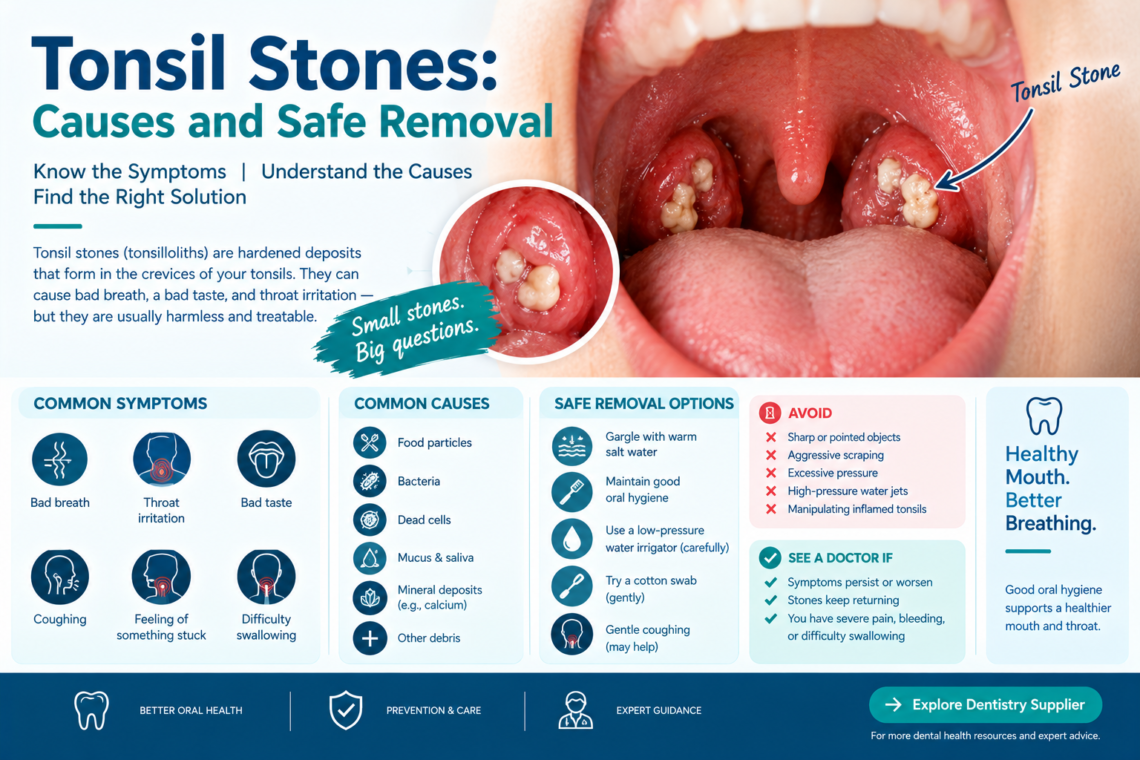
Have you noticed tiny white or yellow lumps at the back of your throat, experienced persistent bad breath, or felt as though something is stuck in your throat? These symptoms may be related to tonsil stones.
Tonsil stones, medically known as tonsilloliths, are hardened collections of material that develop inside the natural pockets and folds of the tonsils. They can contain trapped food particles, bacteria, mucus, dead cells, and mineral deposits. Most tonsil stones are harmless, but they can sometimes cause unpleasant symptoms such as bad breath, a bad taste, throat irritation, coughing, or difficulty swallowing.
The good news is that small tonsil stones often fall out on their own and may not require medical treatment. However, attempting to remove them aggressively can injure the delicate tonsil tissue.
This guide explains tonsil stones: causes and safe removal, including how they form, their symptoms, safe home-care options, prevention strategies, and when you should see a healthcare professional.
What Are Tonsil Stones?
Tonsil stones are small, hardened deposits that develop in the crypts, or natural grooves and pockets, on the surface of the tonsils.
The material trapped inside these crypts can gradually accumulate and become harder through calcification. The resulting tonsil stones may appear as small white, cream-colored, or yellowish spots or lumps.
Some stones are visible when you look at your tonsils in a mirror, while others form deeper inside the tonsillar tissue and cannot easily be seen. Their size can vary considerably, from tiny particles to larger formations.
Tonsil stones are different from tonsillitis. Tonsillitis involves inflammation or infection of the tonsils, whereas a tonsil stone is a hardened accumulation within the tonsil crypts.
How Do Tonsil Stones Form?
Understanding the causes of tonsil stones starts with understanding the structure of the tonsils.
The tonsil surface isn’t completely smooth. It contains small folds and openings called tonsillar crypts. These crypts can trap material passing through the mouth and throat.
Over time, trapped material can accumulate and harden.
Common material found in tonsil stones
Tonsil stones may develop from a combination of:
- Food particles
- Bacteria
- Dead cells
- Mucus
- Saliva
- Mineral deposits, including calcium
- Other debris from the mouth and throat
As these substances become trapped in tonsillar crypts, they can gradually become compacted and calcified.
Why some people get tonsil stones more often
Certain people are more prone to developing tonsilloliths. Risk may be greater in people with:
- Deep or enlarged tonsil crypts
- Large tonsils
- A history of recurrent tonsillitis
- Repeated inflammation of the tonsils
- Inadequate oral hygiene
- Dry mouth or dehydration
Repeated tonsil infections can enlarge or alter the crypts, potentially creating more areas where debris can become trapped.
Tonsil Stone Symptoms
Not everyone with tonsil stones experiences symptoms. Small stones may be discovered accidentally during a dental or medical examination.
When symptoms occur, bad breath is one of the most common complaints. Bacteria associated with material trapped in the tonsils can contribute to unpleasant odors. Clinical literature has also associated tonsillar conditions, including tonsillolithiasis, with tonsillar-related halitosis.
Other possible symptoms include:
1. Persistent bad breath
You may notice an unpleasant odor even after brushing and using mouthwash.
If you’re dealing with ongoing bad breath, don’t automatically assume tonsil stones are the cause. Gum disease, poor oral hygiene, dry mouth, certain foods, and other conditions can also contribute.
Our guide on mouthwash and whether it actually helps can help you understand where mouthwash fits into an overall oral-care routine.
2. White or yellow spots on the tonsils
A visible tonsil stone may look like a tiny white or yellow pebble embedded in the tonsil.
However, not every white spot is a tonsil stone. White patches can also occur with infections and other throat conditions, so persistent or concerning changes should be evaluated by a healthcare professional.
3. Feeling that something is stuck
Larger stones may create a sensation that something is lodged in the throat.
4. Sore or irritated throat
Some people experience localized irritation or discomfort around the tonsils.
5. Bad taste
Material associated with tonsil stones can sometimes produce an unpleasant taste in the mouth.
6. Coughing or difficulty swallowing
Larger or irritating stones may occasionally cause coughing or discomfort when swallowing.
Tonsil Stones: Causes and Safe Removal Methods
The safest removal approach depends on the size and location of the stone and whether it is causing symptoms.
Many small tonsil stones eventually loosen and fall out without treatment. If a stone is visible and causing minor irritation, gentle methods may help dislodge it.
1. Gargle with warm salt water
Gargling with warm salt water is one of the simplest approaches.
It may help loosen debris and soothe irritation around the tonsils. Gargling after meals can also help reduce debris and bacteria in the mouth and throat.
Avoid swallowing large amounts of the solution.
2. Maintain thorough oral hygiene
Brush your teeth regularly and clean your tongue gently. Flossing is also important because food debris and bacteria throughout the mouth can contribute to oral odor and plaque accumulation.
Good oral hygiene doesn’t guarantee that tonsil stones won’t return, particularly when someone has deep tonsil crypts, but it can help minimize the amount of debris and bacteria in the mouth.
For a broader understanding of dental instruments and their functions, see our guide to common dental instruments and their uses.
3. Try gentle coughing
A gentle cough may occasionally dislodge a loose tonsil stone.
Don’t repeatedly force yourself to cough or strain your throat if the stone doesn’t move.
4. Use a low-pressure water irrigator carefully
Some medical guidance suggests using a low-pressure water irrigator to gently rinse tonsil crypts. The key word is low-pressure.
High-pressure streams can injure tonsil tissue and cause bleeding. If you’re unsure how to use an irrigator safely, ask a healthcare professional for advice.
5. Use a cotton swab carefully
A visible, accessible tonsil stone may sometimes be gently dislodged with a clean cotton swab.
Never force a stone out if it appears deeply embedded. Stop if you experience pain or bleeding. Mayo Clinic Health System specifically recommends discussing self-removal with your healthcare team and describes gentle cotton-swab removal as an option.
What You Should NOT Do When Removing Tonsil Stones
The tonsils are sensitive tissues, so aggressive removal can cause unnecessary injury.
Avoid:
- Digging into the tonsils with sharp objects
- Using dental instruments to scrape the tonsils yourself
- Applying excessive pressure
- Using high-pressure water jets directly against the tonsils
- Repeatedly squeezing an inflamed tonsil
- Continuing to manipulate the area after bleeding begins
A common mistake is assuming that because a tonsil stone looks like a hard object, it should be treated like something that can simply be picked out.
That’s not the case. The stone may be embedded in delicate tissue, and aggressive manipulation can cause trauma or bleeding.
If you regularly experience dental or oral discomfort, our guide on sensitive teeth: causes and treatments covers another common source of oral discomfort and when professional evaluation is appropriate.
Can Tonsil Stones Go Away on Their Own?
Yes.
Many tonsil stones are small and eventually loosen and fall out naturally. You may even swallow one without noticing it. Cleveland Clinic notes that swallowing a tonsil stone is generally not harmful.
If a stone isn’t causing discomfort, aggressive removal usually isn’t necessary.
Instead, focus on good oral hygiene and monitor your symptoms.
How to Prevent Tonsil Stones
There is no guaranteed way to prevent tonsil stones because the structure of your tonsils plays an important role in whether debris becomes trapped.
However, several habits may reduce the amount of debris and bacteria available to accumulate.
Brush twice daily
Use fluoride toothpaste and brush thoroughly, paying attention to all tooth surfaces and the gumline.
Clean your tongue
Bacteria and debris can accumulate on the tongue, so gently cleaning it can be a useful part of daily oral hygiene.
Floss every day
Flossing helps remove food particles and plaque between teeth where a toothbrush cannot reach.
Stay hydrated
Adequate hydration supports normal saliva production and helps prevent excessive dryness in the mouth.
Gargle after meals
Gargling with water or an appropriate mouth rinse can help clear residual debris from the mouth and throat.
Mayo Clinic Health System recommends good oral hygiene—including brushing, tongue cleaning, flossing, and an appropriate mouthwash—as a way to minimize factors that may contribute to tonsil stone development.
Regular dental examinations are also valuable because a dentist may notice oral or throat-related abnormalities during an examination.
When Should You See a Doctor or ENT?
Most tonsil stones aren’t dangerous. However, recurring or troublesome stones may require professional evaluation.
Consider seeing a doctor or ENT specialist if:
- Tonsil stones repeatedly return
- Stones are large
- You cannot safely remove a visible stone
- You have persistent throat pain
- Your tonsils are very red or swollen
- Your tonsils bleed easily
- You have persistent ear pain
- Swallowing becomes difficult
- Bad breath continues despite good oral hygiene
- You are unsure whether the white spot is actually a tonsil stone
Mayo Clinic Health System specifically recommends professional evaluation when tonsils look red, bleed easily, or are associated with persistent sore throat or ear pain.
If symptoms are severe or you have significant difficulty breathing or swallowing, seek urgent medical attention rather than attempting home removal.
How Are Tonsil Stones Diagnosed?
Diagnosis is usually straightforward.
A healthcare professional can often identify tonsil stones by examining the mouth and throat.
If a stone is hidden deeper within the tonsil tissue, imaging may sometimes be considered. Cleveland Clinic notes that healthcare providers may use an imaging scan when stones aren’t easily visible.
A dentist may also notice a tonsil stone during a routine oral examination.
It’s important to distinguish tonsil stones from other causes of white or yellow patches, especially infections.
What Treatment Is Available for Recurrent Tonsil Stones?
For occasional, small tonsil stones, treatment may not be necessary.
If stones become frequent or significantly affect quality of life, a healthcare professional can discuss additional options.
Professional removal
A healthcare professional can remove a troublesome stone in an appropriate clinical setting.
This is preferable to repeatedly digging at a deeply embedded stone yourself.
Tonsillectomy
A tonsillectomy is surgery to remove the tonsils.
It can prevent tonsil stones from forming because the tonsils—and therefore their crypts—are removed. However, surgery is not automatically necessary for every person with tonsil stones.
Mayo Clinic lists severe halitosis associated with tonsil stones among conditions for which tonsillectomy may sometimes be considered, while Cleveland Clinic notes that surgery may be considered when stones repeatedly cause significant problems.
The decision should be made with an appropriately qualified healthcare professional after considering symptoms, recurrence, medical history, and potential surgical risks.
Tonsil Stones vs. Tonsillitis: What’s the Difference?
These conditions are related but not identical.
| Feature | Tonsil Stones | Tonsillitis |
| Main issue | Hardened material trapped in tonsil crypts | Inflammation/infection of tonsils |
| Appearance | Small white or yellow stones | Red, swollen tonsils with possible white/yellow patches |
| Common symptom | Bad breath | Sore throat |
| Fever | Not typical | Can occur, particularly with infection |
| Cause | Trapped debris that becomes hardened | Usually viral or bacterial infection |
| Treatment | Often observation or gentle removal | Depends on underlying cause |
Tonsillitis can be caused by viruses or bacteria and commonly produces swollen, inflamed tonsils and a sore throat.
If you have fever, significant swelling, severe throat pain, or rapidly worsening symptoms, don’t assume that you simply have tonsil stones.
Can Tonsil Stones Cause Bad Breath?
Yes.
Bad breath, or halitosis, is one of the symptoms most commonly associated with tonsil stones. Bacteria and trapped organic material within tonsil crypts can contribute to unpleasant odors.
However, tonsil stones are not the only possible cause of bad breath.
Persistent halitosis may also be associated with:
- Poor oral hygiene
- Gum disease
- Plaque accumulation
- Dry mouth
- Certain foods
- Tobacco use
- Some medical conditions
That’s why persistent bad breath deserves a broader oral-health evaluation rather than automatically being attributed to tonsil stones.
Frequently Asked Questions About Tonsil Stones
Are tonsil stones dangerous?
Most tonsil stones are harmless and are more of a nuisance than a serious health problem. However, persistent symptoms, significant swelling, bleeding, or difficulty swallowing should be professionally evaluated.
Can you swallow a tonsil stone?
Yes. Accidentally swallowing a tonsil stone is generally not harmful. Tonsil stones can loosen and fall into the throat naturally.
Are tonsil stones contagious?
No. Tonsil stones themselves aren’t contagious. They are formed from material trapped in the tonsil crypts rather than being an infection that can simply be passed from one person to another.
Why do I keep getting tonsil stones?
Recurring tonsil stones may be associated with enlarged or deep tonsil crypts and a history of repeated tonsil infections. Some people are simply more prone to them because of their tonsil anatomy.
Does mouthwash get rid of tonsil stones?
Mouthwash may support overall oral hygiene and reduce bacteria, but it isn’t guaranteed to remove an established tonsil stone. A stone may need to loosen naturally, be gently removed, or be professionally treated.
Should I squeeze out a tonsil stone?
Avoid aggressive squeezing. If a stone is superficial and easily accessible, gentle removal may sometimes be possible, but stop if there is pain or bleeding. Deeply embedded stones should be evaluated by a healthcare professional.
Can poor oral hygiene cause tonsil stones?
Poor oral hygiene can increase the amount of bacteria and debris in the mouth, which may contribute to the material available to accumulate in tonsil crypts. However, tonsil anatomy and previous tonsil inflammation also play important roles.
Conclusion
Tonsil stones are common, usually harmless formations that develop when debris becomes trapped and hardens inside tonsil crypts. They can cause bad breath, an unpleasant taste, throat irritation, coughing, or a sensation of something being stuck in the throat.
The safest approach is usually conservative. Small stones may fall out naturally, while gentle salt-water gargling, good oral hygiene, and carefully performed low-pressure rinsing may help in appropriate situations. Avoid sharp instruments, aggressive scraping, and excessive pressure because these can injure the tonsils.
If stones keep returning, cause significant discomfort, or are accompanied by bleeding, persistent pain, difficulty swallowing, or other concerning symptoms, professional evaluation is the better option.
Call to Action
Good oral hygiene remains an important part of overall mouth and throat care. For dental professionals and practices interested in understanding the equipment used to support oral healthcare, explore Dentistry Supplier’s dental equipment and instrument resources.
- tonsil stones