Dental instruments must meet demanding requirements for strength, precision, corrosion resistance, hygiene, and long-term performance. Whether a manufacturer is producing dental forceps, elevators, scalers, curettes, surgical scissors, mirrors, or customized instrument components, the manufacturing process directly affects the quality and reliability of the final product.
Two important manufacturing methods used in Dental Instrument Manufacturing: Forging vs CNC Machining. Both processes can produce high-quality dental instruments, but they work differently and offer distinct advantages.
So, which process is better for dental instrument manufacturing?
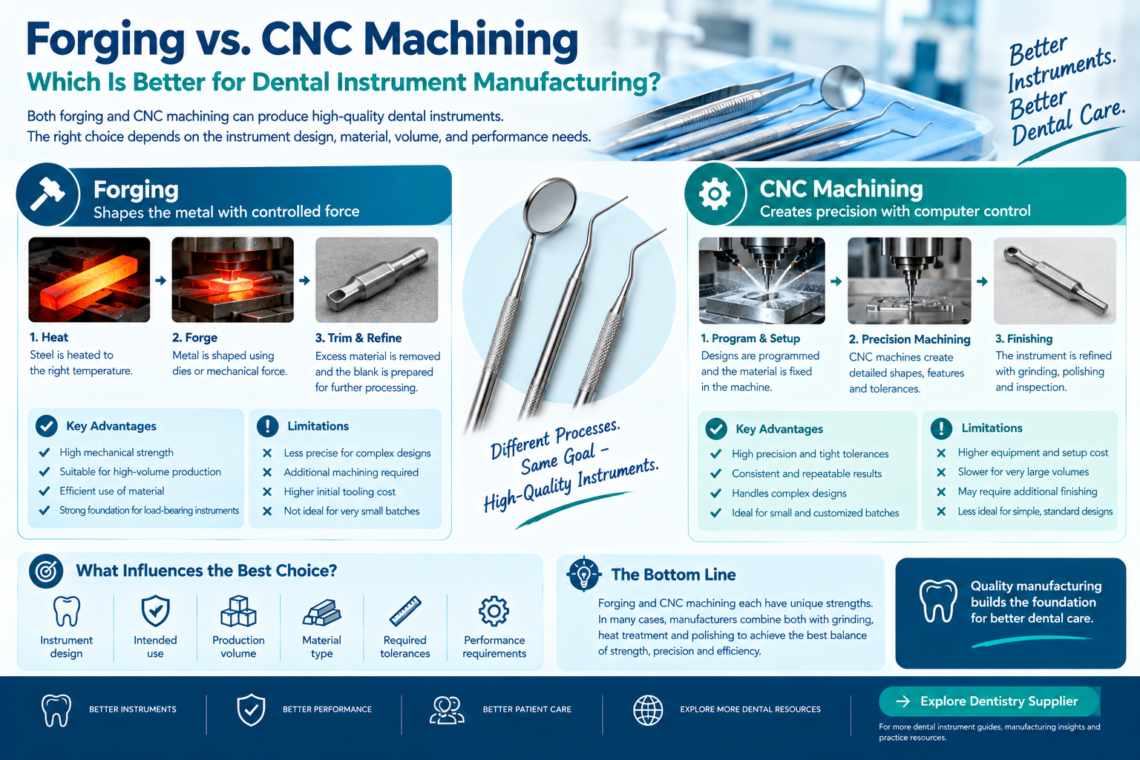
The answer depends on the instrument’s design, intended use, production volume, material, required tolerances, and performance requirements. In many cases, manufacturers use a combination of forging, CNC machining, grinding, heat treatment, and polishing rather than relying on only one process.
What Is Dental Instrument Manufacturing?
Dental instrument manufacturing is the process of transforming raw materials—commonly stainless steel—into functional instruments used for examination, diagnosis, restoration, periodontal care, extraction, surgery, and other dental procedures.
The manufacturing process may include:
- Material selection
- Raw material inspection
- Cutting and blank preparation
- Forging or machining
- Heat treatment
- CNC profiling
- Grinding and sharpening
- Polishing and finishing
- Assembly
The material and manufacturing method must be selected according to the instrument’s intended purpose.
What Is Forging in Dental Instrument Manufacturing?
Forging is a manufacturing process in which metal is shaped by applying compressive force. Depending on the material and design, forging may take place at elevated temperatures or under cold conditions.
In dental instrument production, steel blanks are often heated and placed into dies or shaped using controlled mechanical force. The metal is formed into a shape that closely resembles the final instrument.
Typical Forging Process
A general forging workflow may include:
- Raw material selection: Suitable stainless steel bars, sheets, or blanks are selected.
- Blank cutting: The raw material is cut into pieces of the required size.
- Heating: The blank may be heated to improve formability.
- Die forming: Pressure is applied to shape the metal.
- Trimming: Excess metal, known as flash, is removed.
- Heat treatment: The instrument is hardened or tempered according to its material and intended function.
- Grinding and finishing: The shape, edges, joints, and surfaces are refined.
- Inspection: The finished instrument is checked for dimensions, alignment, hardness, and performance.
Forging does not usually produce the complete finished instrument by itself. Additional operations such as grinding, milling, polishing, sharpening, and heat treatment are often required.
Advantages of Forging Dental Instruments
1. High Mechanical Strength
Forging can produce a strong metal structure suitable for instruments exposed to repeated mechanical stress. The process can help improve the material’s grain flow and mechanical performance when the design and process are properly controlled.
This is particularly valuable for instruments such as:
- Extraction forceps
- Dental elevators
- Needle holders
- Orthodontic pliers
- Surgical scissors
- Certain periodontal instruments
These instruments may experience gripping, twisting, bending, compression, or cutting forces during clinical use.
2. Suitable for High-Volume Production
Once the appropriate dies and production setup are established, forging can be efficient for producing large quantities of similar instruments.
This can make forging attractive for:
- Standardized dental instrument ranges
- Large distributor orders
- OEM production
- Repeated manufacturing programs
- Instruments with stable designs
The initial tooling investment may be higher than machining a small batch, but the cost per unit can become more competitive as production volume increases.
3. Efficient Use of Material
Forging can create a near-net-shape blank that requires less material removal than machining a complete instrument from a large block of steel.
Reduced machining requirements may help lower:
- Material waste
- Machining time
- Tool consumption
- Production costs
However, the actual material efficiency depends on the instrument’s geometry, forging design, trimming requirements, and finishing operations.
4. Strong Foundation for Load-Bearing Instruments
Forged blanks can provide a suitable foundation for instruments that must withstand repeated clinical forces. For example, extraction forceps and elevators need structural integrity because they are used to apply controlled force during dental procedures.
Limitations of Forging Dental Instruments
Although forging offers important benefits, it also has limitations.
Higher Initial Tooling Costs
Forging usually requires dies, tooling, and process development. These costs may not be practical for very small production runs or frequently changing designs.
Less Flexibility for Complex Designs
Forging is most effective when the instrument has a geometry suitable for forming. Highly complex features, small internal details, intricate grooves, or tight dimensional requirements may still require CNC machining or other finishing processes.
What Is CNC Machining in Dental Instrument Manufacturing?
CNC stands for Computer Numerical Control. CNC machining uses programmed instructions to control cutting tools and remove material from a solid workpiece.
Depending on the instrument design, manufacturers may use:
- CNC milling
- CNC turning
- CNC drilling
- CNC grinding
- Multi-axis machining
- Precision profiling
A digital CAD model is typically used to define the instrument’s dimensions and geometry. The CNC machine follows programmed tool paths to create the required shape.
Typical CNC Machining Process
A general CNC manufacturing workflow includes:
- CAD design: The instrument or component is designed digitally.
- Material preparation: Stainless steel bar, billet, sheet, or forged blank is selected.
- Programming: Tool paths and machining parameters are prepared.
- Workholding: The material is securely positioned in the machine.
- Material removal: Cutting tools create the required shape and features.
- Deburring: Sharp unwanted edges and machining burrs are removed.
- Grinding and polishing: Surfaces and functional edges are refined.
- Inspection: Dimensions, tolerances, surface finish, and performance are checked.
CNC machining is especially useful when the instrument requires accurate geometry, repeatable dimensions, or design flexibility.
Advantages of CNC Machining Dental Instruments
1. High Precision and Repeatability
CNC machines can produce consistent dimensions across repeated production cycles when the machine, tooling, programming, and inspection systems are properly controlled.
This is useful for:
- Instrument joints
- Fine tips
- Precision handles
- Custom instrument components
- Surgical instrument features
- Specialized dental tools
- Components requiring accurate alignment
Precision is particularly important when two parts must fit together or when the instrument’s performance depends on a specific geometry.
2. Excellent Design Flexibility
CNC machining can accommodate design changes more easily than forging because manufacturers can modify the digital model and machining program without necessarily creating a new forging die.
This makes CNC suitable for:
- Prototypes
- Custom dental instruments
- Low-volume production
- Specialty instruments
- Product development
For manufacturers developing a new instrument, CNC machining can help produce test samples before investing in dedicated forging tooling.
3. Suitable for Complex Features
CNC machining can create features that may be difficult to form directly through forging, such as:
- Fine grooves
- Accurate holes
- Detailed slots
- Complex contours
- Precise flat surfaces
- Small pockets
- Controlled edge profiles
The exact capabilities depend on the machine, cutting tools, workholding, material, and required tolerances.
4. Reduced Need for Dedicated Dies
Unlike forging, CNC machining does not generally require a dedicated forming die for each instrument shape. This can reduce initial tooling costs for small or customized production runs.
However, CNC machining may involve higher cycle times, cutting-tool costs, programming expenses, and material waste when producing complex shapes from solid stock.
Limitations of CNC Machining Dental Instruments
Higher Production Costs for Large Volumes
CNC machining removes material gradually, which can make it slower and more expensive for high-volume production of simple, repeatable shapes.
When thousands of identical instruments are required, forging followed by precision finishing may be more economical.
Greater Material Waste
Machining from a solid block or bar removes material to create the final shape. Depending on the design, this can generate more scrap than a near-net-shape forging process.
Tool Wear and Machining Challenges
Stainless steel can be challenging to machine because some grades are tough, generate heat, or work-harden under unsuitable cutting conditions. Tool selection, cutting speed, feed rate, coolant, chip control, and machine rigidity all affect the final result.
Surface Finishing Is Still Necessary
CNC machining may produce accurate dimensions, but the instrument may still require:
- Deburring
- Grinding
- Polishing
- Passivation
- Edge refinement
- Cleaning
- Surface inspection
A precise machined part is not automatically a clinically suitable finished instrument.
Which Process Produces Stronger Dental Instruments?
Forging is often associated with strength because it shapes metal under controlled force and can produce favorable grain flow. This can be beneficial for instruments exposed to repeated mechanical loads.
The final performance depends on:
- Stainless steel grade
- Material condition
- Forging temperature
- Forging reduction
- Grain structure
- Heat treatment
- Instrument geometry
- Machining depth
- Surface finish
- Quality control
- Intended clinical use
A well-designed CNC-machined instrument made from suitable material and correctly heat-treated stock can perform reliably. Likewise, a poorly processed forged instrument may fail to meet expectations.
The manufacturing process should therefore be evaluated alongside material certification, hardness testing, corrosion resistance, dimensional inspection, and functional testing.
Which Process Is Better for Dental Instrument Production?
There is no universal winner. The best method depends on the production requirements.
Forging may be preferable when:
- The instrument design is stable.
- Production volumes are high.
- The instrument must withstand repeated mechanical stress.
- The geometry is suitable for die forming.
- Lower unit costs are important at scale.
- The manufacturer wants to reduce extensive material removal.
CNC machining may be preferable when:
- Production volume is low or moderate.
- The design is customized.
- Tight dimensional tolerances are required.
- The instrument contains complex features.
- Rapid design changes are expected.
- Prototypes or samples are needed.
- Dedicated forging dies would be uneconomical.
Examples of Dental Instruments and Suitable Manufacturing Methods
Dental Extraction Forceps
Extraction forceps must provide strength, appropriate beak geometry, smooth movement, and reliable alignment. Forging may be suitable for the main body because of its mechanical requirements, while machining and grinding refine the beaks, joint, and handles.
Dental Elevators
Elevators are exposed to controlled leverage and force. A forged body may provide a suitable foundation, while CNC machining and grinding can create the working end and refine its dimensions.
Periodontal Scalers and Curettes
Scalers and curettes require precise working ends, controlled angles, and suitable edge geometry. Depending on the design, manufacturers may use forged or machined blanks followed by detailed grinding and sharpening.
For more information about dental instrument categories and their functions, see the guide to Common Dental Instruments and Uses.
Surgical Scissors
Surgical scissors require accurate blade alignment, smooth opening and closing, suitable hardness, and consistent cutting performance. Forging may be used for certain components, while CNC machining, grinding, sharpening, and manual adjustment help achieve the required function.
Material Selection in Dental Instrument Manufacturing
The manufacturing method cannot be separated from material selection. Stainless steel grades vary in hardness, corrosion resistance, toughness, machinability, and edge-retention performance.
Common considerations include:
- Corrosion resistance
- Hardness after heat treatment
- Toughness
- Wear resistance
- Machinability
- Surface finish
- Sterilization compatibility
- Intended clinical function
- Cost and availability
For example, cutting instruments may require a material and heat-treatment process that supports edge retention. Instruments exposed to repeated gripping or bending may require a different balance of toughness and hardness.
You can also review Stainless Steel vs Titanium Dental Instruments to understand how material choice can affect weight, corrosion resistance, strength, and instrument performance.
Quality Control in Dental Instrument Manufacturing
Regardless of whether an instrument is forged, CNC-machined, or produced through a hybrid process, quality control is essential.
A reliable manufacturing system may include the following checks.
Raw Material Inspection
Manufacturers should verify relevant material information, such as:
- Stainless steel grade
- Chemical composition
- Material certificates
- Mechanical properties
- Heat-treatment condition
- Traceability information
Dimensional Inspection
Critical dimensions may include:
- Overall length
- Working-end geometry
- Tip alignment
- Joint dimensions
- Handle dimensions
- Blade thickness
- Cutting-edge position
- Surface tolerances
Hardness Testing
Hardness testing helps confirm whether the material and heat-treatment process are appropriate for the instrument’s intended function.
Corrosion and Surface Inspection
Surface defects, contamination, roughness, and improper finishing can affect corrosion resistance and cleanability. Instruments should be inspected for:
- Pitting
- Discoloration
- Scratches
- Burrs
- Cracks
- Surface irregularities
- Improper polishing
- Residual contaminants
Functional Testing
Functional testing may evaluate:
- Cutting performance
- Jaw alignment
- Opening and closing action
- Tip fit
- Grip
- Spring action
- Locking mechanism
- Instrument balance
- Smoothness of movement
Sterilization Compatibility
Reusable dental instruments must be designed and manufactured for the cleaning, disinfection, and sterilization processes specified by the manufacturer.
For additional equipment-care guidance, see the Dental Equipment Maintenance Checklist.
How Buyers Should Evaluate a Dental Instrument Manufacturer
When purchasing dental instruments from a manufacturer or supplier, do not evaluate the product based only on whether it is forged or CNC-machined.
Instead, ask the manufacturer about:
- Material grade and certification
- Manufacturing process
- Heat-treatment procedures
- Dimensional tolerances
- Surface finishing
- Corrosion-resistance testing
- Functional testing
- Quality-management systems
For dental practices, proper maintenance also influences instrument longevity. Instruments and equipment should be cleaned, inspected, lubricated when appropriate, and sterilized according to manufacturer instructions. The Dental Handpiece Maintenance Guide provides additional information about maintaining dental equipment and preventing avoidable performance problems.
Frequently Asked Questions
Is forging better than CNC machining for dental instruments?
Neither process is always better. Forging is often suitable for high-volume production and instruments requiring strong formed bodies, while CNC machining is useful for precision features, complex designs, prototypes, and customized instruments.
Are forged dental instruments stronger than machined instruments?
Forging can provide favorable mechanical properties and grain flow, but strength depends on material, design, heat treatment, and quality control. A properly designed and manufactured CNC-machined instrument can also be strong and reliable.
Is CNC machining more precise than forging?
CNC machining generally offers greater flexibility for producing precise dimensions and complex features. Forged components often require secondary machining, grinding, or polishing to achieve final tolerances.
Which process is more cost-effective?
Forging may be more cost-effective for large production volumes after tooling costs are absorbed. CNC machining may be more economical for small batches, prototypes, customized instruments, or products requiring frequent design changes.
Can dental instruments be made using both forging and CNC machining?
Yes. Many instruments can benefit from a hybrid manufacturing process. Forging creates the basic shape, while CNC machining, grinding, sharpening, and polishing refine the final product.
Conclusion
Dental instrument manufacturing requires more than shaping metal into a recognizable instrument. The process must produce reliable performance, accurate dimensions, suitable hardness, corrosion resistance, smooth surfaces, and compatibility with appropriate cleaning and sterilization procedures.
Forging is often advantageous for durable, standardized instruments produced in larger quantities. It can reduce material waste and provide a strong foundation for instruments exposed to mechanical stress.
CNC machining offers precision, flexibility, and design freedom. It is particularly useful for customized instruments, prototypes, complex geometries, and components requiring accurate features.
In many cases, the most effective approach is not forging versus CNC machining, but a carefully controlled combination of both. The best manufacturing process depends on the instrument’s design, material, production volume, performance requirements, and quality standards.
Informational CTA
Understanding manufacturing methods can help dental professionals, distributors, and purchasing teams make more informed decisions when evaluating dental instruments. Explore more educational resources about dental instruments, materials, equipment, and maintenance at Dentistry Supplier.