Surgical scissors for dental use are precision instruments designed to cut soft tissue, sutures, membranes, and other materials during dental and oral surgical procedures. Although scissors may look simple compared with more specialized dental instruments, their blade design, tip shape, handle, cutting action, and material can significantly affect control and performance.
Dental professionals may use different scissors depending on the procedure. A fine, delicate scissors may be appropriate for precise soft-tissue work, while a stronger design may be better suited for cutting sutures or other surgical materials.
Choosing the right instrument is therefore more than simply selecting the sharpest pair available. Dentists and dental assistants should consider the intended application, blade geometry, working length, ergonomics, material quality, sterilization compatibility, and manufacturer instructions.
This guide explains the types, uses, materials, selection factors, sterilization requirements, maintenance practices, and common mistakes associated with surgical scissors used in dentistry.
For a broader overview of instruments used in clinical dentistry, see our guide to Common Dental Instruments and Uses.
What Are Surgical Scissors for Dental Use?
Surgical scissors are hinged cutting instruments used to make controlled cuts during clinical procedures.
In dentistry, they may be used for tasks involving:
- Soft-tissue trimming
- Periodontal procedures
- Oral surgery
- Suture cutting
- Membrane trimming
- Dressing and material cutting
- General surgical preparation
Unlike ordinary household scissors, dental surgical scissors are manufactured for clinical environments where precision, corrosion resistance, ergonomics, and reliable cutting performance are important.
The exact design varies according to the intended task.
Some scissors have straight blades, while others are curved. Tips may be sharp or blunt, and blade lengths can vary.
The correct design should always be selected according to the manufacturer’s intended application rather than assuming that one scissors type can perform every dental cutting task.
Why Are Surgical Scissors Important in Dentistry?
Precision is particularly important when working around delicate oral tissues.
A properly selected pair of scissors can provide:
Controlled cutting
Sharp, properly aligned blades can help clinicians make controlled cuts rather than repeatedly manipulating tissue.
Better visibility
The right blade length and shape can make it easier to work in restricted areas of the oral cavity.
Improved handling
Ergonomically designed finger rings and handles can provide better control during procedures.
Reduced unnecessary tissue manipulation
An appropriate cutting instrument can help minimize repeated movements around the surgical field.
Versatility
Different scissors can be selected for tissue cutting, suture cutting, and other clinical tasks.
The important point is that instrument design should match the clinical application.
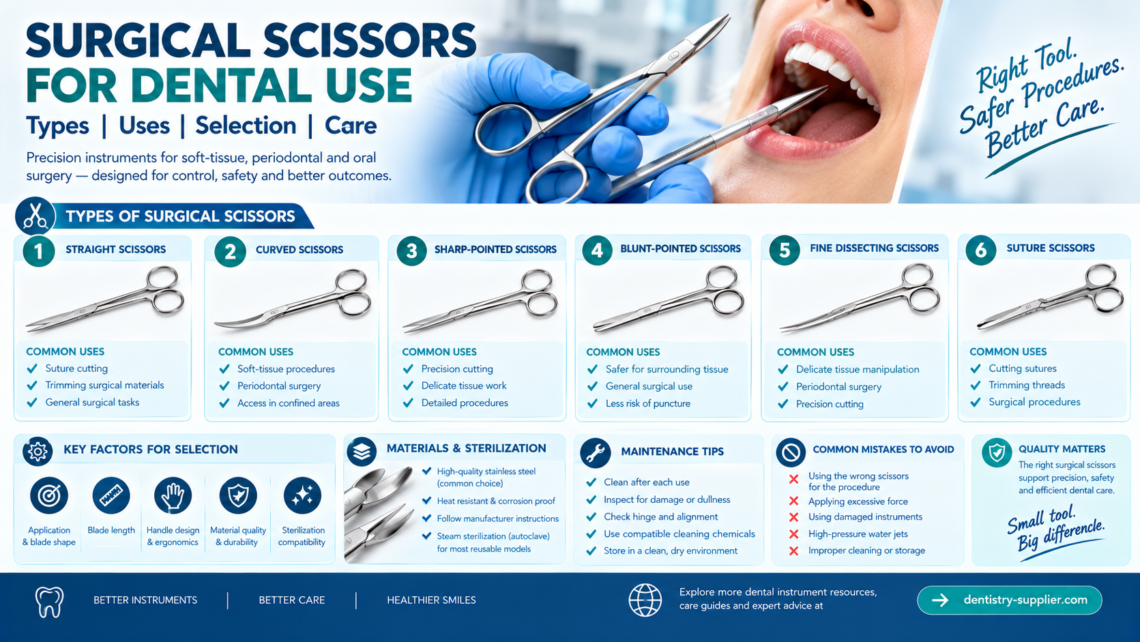
Common Types of Surgical Scissors Used in Dentistry
There is no single universal dental scissors design. Several configurations may be encountered in dental and oral surgical settings.
1. Straight Surgical Scissors
Straight scissors have blades that follow a relatively straight path from the hinge toward the tips.
They may be useful when the clinician needs direct access to the cutting area.
Common applications can include:
- Cutting sutures
- Trimming surgical materials
- Cutting membranes or other materials
- General surgical tasks
Straight scissors can provide a clear cutting path when the working area is easily accessible.
2. Curved Surgical Scissors
Curved scissors have blades that curve toward the tips.
The curved profile can be useful when working around anatomical structures or in areas where a straight blade would provide less convenient access.
Potential applications include:
- Soft-tissue procedures
- Periodontal surgery
- Oral surgery
- Cutting in confined areas
The appropriate curvature depends on the procedure and the clinician’s preferred technique.
3. Sharp-Pointed Scissors
Sharp-pointed scissors have pointed blade tips designed for precise cutting.
They may be useful when accuracy is particularly important.
However, sharp tips require careful handling because they can cause accidental injury if used or passed incorrectly.
For this reason, dental teams should follow appropriate sharps-safety procedures and handle instruments as contaminated until they have been properly cleaned and sterilized.
4. Blunt-Pointed Scissors
Blunt or rounded tips reduce the risk of accidentally puncturing or catching tissue during certain procedures.
They may be useful when the cutting task does not require an extremely pointed tip.
The choice between sharp and blunt tips should depend on the intended clinical application.
5. Fine Dissecting Scissors
Fine scissors are designed for delicate cutting and tissue manipulation.
They are generally characterized by relatively fine blades and controlled cutting action.
They may be appropriate for selected periodontal or oral surgical procedures where precision is more important than cutting heavy materials.
6. Suture Scissors
Suture scissors are designed specifically for cutting sutures.
Some designs incorporate specialized features that help the clinician position the blade around the suture before cutting.
Using an instrument intended for the specific material can help preserve the cutting edge and improve efficiency.
A scissors designed for delicate tissue work should not automatically be used for every heavy-duty cutting task.
How to Choose Surgical Scissors for Dental Use
Choosing the correct scissors requires considering several factors.
1. Intended Clinical Application
Start with the most important question:
What will the scissors be used for?
A pair intended for delicate tissue cutting may not be appropriate for cutting thick sutures or other materials.
Identify the procedure first and then select the instrument.
2. Blade Shape
Blade geometry influences access and cutting behavior.
Choose between:
- Straight blades
- Curved blades
- Fine blades
- Wider blades
- Sharp tips
- Blunt tips
The correct configuration depends on the intended procedure.
3. Blade Length
Longer blades may provide greater reach, while shorter blades can provide greater control in confined areas.
There is no universally ideal blade length.
The working area and procedure should determine the appropriate size.
4. Handle Design
The handles should provide a secure and comfortable grip.
Important considerations include:
- Finger-ring size
- Surface texture
- Balance
- Instrument weight
- Ease of opening and closing
- Operator comfort
Ergonomics becomes especially important when instruments are used frequently.
5. Material Quality
Stainless steel is widely used for surgical and dental instruments because it offers a combination of strength, durability, corrosion resistance, and suitability for repeated processing when the instrument is designed for it.
For a detailed comparison of instrument materials, read Stainless Steel vs Titanium Dental Instruments: Which Is Better?.
6. Cutting Performance
The blades should meet cleanly and provide consistent cutting action.
Poor blade alignment can cause:
- Tearing rather than cutting
- Increased force requirements
- Inconsistent performance
- Tissue manipulation
- Premature instrument replacement
Inspect cutting instruments regularly rather than waiting until they completely fail.
7. Sterilization Compatibility
If the scissors are reusable, verify that they are designed for the sterilization method used by your practice.
The manufacturer should provide validated instructions for cleaning, packaging, sterilization, and maintenance.
Stainless Steel Surgical Scissors: Why Are They Common?
Stainless steel remains a common material for dental and surgical instruments.
Its useful characteristics can include:
- Strength
- Durability
- Corrosion resistance
- Hardness
- Reusability when designed for it
- Compatibility with appropriate sterilization processes
However, “stainless steel” does not mean every instrument will perform identically.
Different alloys, manufacturing methods, heat treatments, finishing processes, and quality-control standards can influence instrument performance.
Therefore, buyers should consider the complete manufacturing specification rather than selecting an instrument solely because it is labeled stainless steel.
Surgical Scissors and Infection Control
Because surgical instruments can contact blood, tissue, or other potentially infectious material, proper instrument processing is essential.
CDC classifies instruments that penetrate soft tissue or bone as critical items, which should be sterilized by heat. The CDC also recommends following manufacturer instructions for reprocessing reusable dental instruments.
Depending on how a particular scissors is used, its classification and processing requirements should be determined according to applicable infection-control guidance and the manufacturer’s instructions.
Cleaning Comes Before Sterilization
One of the most important principles of instrument processing is that cleaning must occur before sterilization.
Blood, saliva, tissue, and other organic material can interfere with effective sterilization if they remain on an instrument.
A typical reusable-instrument workflow includes:
- Safe collection after use
- Appropriate transport
- Cleaning
- Rinsing
- Drying
- Inspection
- Packaging
- Sterilization
- Storage
- Inspection before reuse
The exact process should follow the instrument and sterilizer manufacturer’s validated instructions.
Can Dental Surgical Scissors Be Autoclaved?
Many reusable metal surgical scissors are designed for heat sterilization, but you should never assume that every scissors can be autoclaved.
Check the manufacturer’s instructions before processing.
CDC states that most dental patient-care items are heat tolerant and should be heat sterilized, while manufacturer instructions should be followed for sterilization parameters and packaging.
Steam sterilization is widely used for heat-stable medical and dental instruments because of its reliability and effectiveness when correctly performed.
Important sterilization practices
Dental teams should:
- Clean instruments before sterilization
- Follow manufacturer instructions
- Allow instruments to dry before packaging
- Use appropriate sterilization packaging
- Monitor sterilization cycles
- Inspect packages before opening
- Reprocess compromised packages
CDC recommends monitoring sterilization using mechanical, chemical, and biological indicators as part of an effective infection-prevention program.
For more information about maintaining dental equipment and sterilization systems, see our Dental Equipment Maintenance Checklist.
How to Maintain Surgical Scissors
Proper maintenance can extend instrument service life and preserve cutting performance.
Clean Promptly
Don’t allow blood or other organic material to dry on the scissors.
Cleaning should take place according to the manufacturer’s instructions.
Inspect the Blades
Check for:
- Nicks
- Corrosion
- Misalignment
- Dull edges
- Surface damage
- Loose joints
Damaged scissors should be removed from service until evaluated.
Check the Hinge
The hinge should open and close smoothly.
A stiff or excessively loose hinge can affect cutting control.
Avoid Improper Chemicals
Not every cleaning chemical is appropriate for every instrument.
Use products compatible with the instrument material and follow manufacturer instructions.
Store Correctly
After sterilization, store instruments in an environment that protects sterile packaging from damage and contamination.
CDC recommends storing sterile instruments and supplies in covered or closed cabinets and inspecting packages before use.
How Often Should Surgical Scissors Be Replaced?
There is no universal replacement schedule.
A high-quality reusable scissors can potentially remain in service for a long time when it is appropriately manufactured, used, cleaned, sterilized, and maintained.
Replacement should instead be based on condition and performance.
Consider removing scissors from service when you notice:
- Persistent dullness
- Damaged blades
- Blade misalignment
- Corrosion
- Loose or damaged handles
- A defective hinge
- Difficulty achieving a clean cut
- Structural damage
- Failure to meet the manufacturer’s performance requirements
Instrument replacement is ultimately a clinical and maintenance decision rather than a simple calendar-based schedule.
Surgical Scissors for Different Dental Specialties
Different specialties may have different instrument requirements.
General Dentistry
General dental practices may need scissors primarily for routine surgical support, suture cutting, and selected soft-tissue procedures.
Periodontics
Periodontal procedures may require fine, controlled instruments designed for work around gingival and periodontal tissues.
Oral and Maxillofacial Surgery
More extensive oral surgical procedures may require a broader range of scissors alongside retractors, tissue forceps, needle holders, scalpels, elevators, forceps, and other surgical instruments.
Implant Dentistry
Implant-related surgery may require specialized surgical instrumentation selected according to the specific procedure.
The instruments used should be appropriate for the procedure rather than selected simply because they are labeled “dental.”
How Surgical Scissors Fit Into a Dental Instrument Set
A well-organized surgical tray may contain several complementary instruments.
For example:
Cutting instruments
- Surgical scissors
- Scalpels
Grasping instruments
- Tissue forceps
- Extraction forceps
Holding instruments
- Needle holders
Elevating instruments
- Dental elevators
Retracting instruments
- Surgical retractors
Cleaning and tissue-management instruments
- Surgical curettes
Understanding how each instrument functions helps dental teams prepare appropriate procedure-specific trays.
Our article on Common Dental Instruments and Uses provides a broader overview of these instrument categories.
Frequently Asked Questions
What are surgical scissors used for in dentistry?
Surgical scissors can be used for selected soft-tissue cutting, suture cutting, periodontal procedures, oral surgery, and cutting certain surgical materials. The exact use depends on the scissors design and manufacturer’s intended application.
What is the difference between straight and curved surgical scissors?
Straight scissors provide a direct cutting path, while curved scissors can make access around anatomical structures or within confined areas more convenient. The best choice depends on the procedure.
Are surgical scissors reusable?
Many dental surgical scissors are reusable, but this depends on their design and manufacturer labeling. Reusable instruments must be appropriately cleaned, processed, sterilized, and maintained according to validated manufacturer instructions.
Can surgical scissors be sterilized in an autoclave?
Many heat-tolerant reusable metal scissors can be steam sterilized, but the manufacturer’s instructions must be followed. Never assume that every scissors model has identical sterilization requirements.
What material is best for dental surgical scissors?
High-quality stainless steel is a common choice because it combines strength, durability, corrosion resistance, and suitability for repeated processing when properly manufactured and maintained. The best material ultimately depends on the intended application.
Conclusion
Surgical scissors for dental use are important precision instruments for selected soft-tissue, periodontal, oral surgical, suture-cutting, and material-cutting applications.
The best scissors aren’t necessarily the most expensive or the sharpest. The right instrument is the one whose blade design, tip configuration, size, material, ergonomics, and cutting characteristics match the intended clinical task.
When selecting dental surgical scissors, consider the procedure first, then evaluate blade geometry, instrument quality, material, handle design, sterilization compatibility, manufacturer instructions, and long-term maintenance requirements.
Proper infection control is equally important. Reusable instruments should be cleaned and processed according to validated manufacturer instructions and applicable dental infection-prevention standards. CDC guidance emphasizes that cleaning must occur before sterilization and that sterilization processes should be appropriately monitored.
For dental practices, investing in appropriate surgical scissors and maintaining them correctly can support consistent instrument performance, efficient workflows, and safe clinical care.
CTA:
Want to learn more about dental instruments, equipment selection, maintenance, and clinical instrument care? Explore the educational resources at Dentistry Supplier for practical guides covering dental instruments, equipment, sterilization, and dental practice management.