Environmental responsibility has become an increasingly important part of modern instrument manufacturing. Manufacturers of dental, surgical, veterinary, and medical instruments must not only produce precise and durable products but also consider how raw materials, energy, water, chemicals, packaging, and industrial waste affect the environment.
Traditionally, instrument manufacturing has relied heavily on stainless steel, machining, forging, grinding, polishing, heat treatment, and surface finishing. Each stage can consume resources or generate waste if it is not properly managed. Modern manufacturers are therefore adopting cleaner production methods, improved resource efficiency, recycling programs, responsible sourcing, and environmental management systems.
These practices are important for more than environmental protection. They can also improve production efficiency, reduce operating costs, support regulatory compliance, strengthen supply-chain transparency, and contribute to the long-term quality of medical instruments.
This guide explains the key environmental practices in modern instrument manufacturing, how sustainable production works, and what buyers should look for when evaluating an environmentally responsible instrument supplier.
What Is Sustainable Instrument Manufacturing?
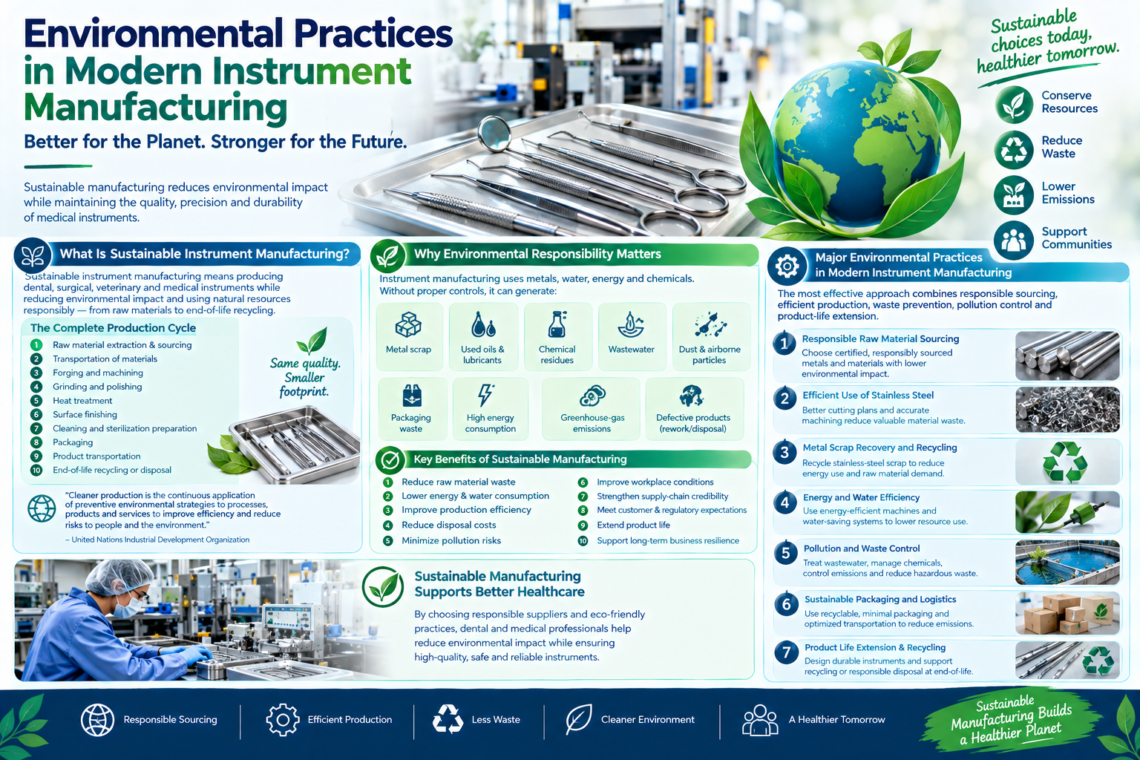
Sustainable instrument manufacturing is the process of producing dental, surgical, veterinary, and medical instruments while reducing negative environmental impacts and using natural resources responsibly.
It involves considering the environmental effects of the complete production cycle, including:
- Raw material extraction and sourcing
- Transportation of materials
- Forging and machining
- Grinding and polishing
- Heat treatment
- Surface finishing
- Cleaning and sterilization preparation
- Packaging
- Product transportation
- End-of-life recycling or disposal
Sustainable manufacturing does not mean compromising product quality. In medical instrument production, quality, precision, hygiene, corrosion resistance, and durability remain essential. Instead, sustainability aims to improve how these outcomes are achieved by reducing unnecessary waste, pollution, energy consumption, and resource use.
The United Nations Industrial Development Organization describes cleaner production as the continuous application of preventive environmental strategies to processes, products, and services to improve efficiency and reduce risks to people and the environment.
Why Environmental Responsibility Matters in Instrument Manufacturing
Instrument manufacturing often involves metals, industrial machinery, cutting fluids, polishing compounds, heat, water, and chemical treatments. Without effective controls, these processes can generate:
- Metal scrap
- Used oils and lubricants
- Chemical residues
- Wastewater
- Dust and airborne particles
- Packaging waste
- Excessive energy consumption
- Greenhouse-gas emissions
- Defective products requiring rework or disposal
Environmental practices help manufacturers reduce these impacts while improving operational performance.
Key Benefits of Sustainable Manufacturing
Responsible environmental practices can help manufacturers:
- Reduce raw material waste
- Lower energy and water consumption
- Improve production efficiency
- Reduce disposal and treatment costs
- Minimize pollution risks
- Improve workplace conditions
- Strengthen supply-chain credibility
- Meet customer and regulatory expectations
- Extend product life
- Support long-term business resilience
Sustainability is therefore not separate from manufacturing quality. Efficient production, careful material selection, accurate machining, and durable products can support both environmental and commercial goals.
Major Environmental Practices in Modern Instrument Manufacturing
Modern instrument manufacturers can improve their environmental performance through several connected strategies. The most effective approach is usually a combination of responsible sourcing, efficient production, waste prevention, pollution control, and product-life extension.
1. Responsible Raw Material Sourcing
Stainless steel is widely used in dental and surgical instruments because it can provide strength, corrosion resistance, cleanability, and durability. However, the environmental impact of an instrument begins before manufacturing, at the stage where metals and other materials are extracted, processed, and transported.
2. Efficient Use of Stainless Steel
Material efficiency is one of the most important sustainability practices in metal instrument manufacturing. Poor cutting plans, inaccurate machining, and unnecessary rejection can cause valuable steel to become waste.
3. Metal Scrap Recovery and Recycling
Stainless-steel scrap generated during cutting, machining, grinding, and finishing can often be collected and sent to appropriate recycling channels. Recycling metal can reduce the demand for virgin raw materials and help recover value from manufacturing waste.
4. Energy-Efficient Manufacturing Equipment
Instrument manufacturing can require energy-intensive operations, including:
- Forging
- Heat treatment
- CNC machining
- Grinding
- Polishing
- Electropolishing
- Drying
- Compressed-air generation
- Lighting and ventilation
Manufacturers can reduce energy consumption by upgrading equipment and improving production management.
5. Renewable Energy Integration
Some manufacturers are introducing renewable energy into their operations through methods such as:
- Rooftop solar panels
- Renewable electricity purchasing
- Solar-powered auxiliary systems
- Energy storage systems
- Hybrid energy solutions
- Improved energy monitoring
The environmental benefit depends on the source of the electricity being replaced, the efficiency of the renewable system, and the manufacturer’s overall energy consumption.
6. Water Conservation and Responsible Water Use
Water may be used in several instrument-manufacturing processes, including:
- Equipment cooling
- Cleaning
- Grinding
- Surface preparation
- Rinsing
7. Wastewater Treatment and Chemical Management
Surface finishing and cleaning operations may involve chemicals, acids, alkaline solutions, polishing compounds, oils, or other substances. If these materials are poorly managed, they can contaminate soil or water and create risks for workers and nearby communities.
8. Cleaner Grinding, Polishing, and Finishing Processes
Grinding and polishing are essential for producing smooth, precise, and functional instruments.
9. Pollution Prevention and Air-Quality Controls
Instrument manufacturing may generate dust, fumes, vapors, or airborne particles during grinding, polishing, heat treatment, and chemical processing.
10. Sustainable Packaging
Packaging protects instruments from contamination, moisture, physical damage, and handling risks. However, excessive or poorly selected packaging can create unnecessary waste.
How Product Durability Supports Sustainability
One of the most important environmental practices is manufacturing instruments that last.
A durable instrument may reduce the need for:
- Frequent replacement
- Repeated transportation
- Additional raw material production
- Manufacturing energy
- Packaging
- Disposal
For reusable dental and surgical instruments, durability is especially important because the product may be cleaned, sterilized, handled, and used repeatedly over an extended period.
Product durability depends on:
- Appropriate raw material selection
- Correct heat treatment
- Accurate forging or machining
- Proper surface finishing
- Corrosion resistance
- Reliable joints and hinges
- Precision alignment
- Appropriate maintenance
- Correct use and sterilization
Sustainability claims should therefore be evaluated alongside product quality. An instrument that is marketed as environmentally friendly but fails prematurely may create more waste over time than a durable product with a longer service life.
For guidance on maintaining dental equipment and extending its useful life, see the Dental Equipment Maintenance Checklist.
Circular Economy Principles in Instrument Manufacturing
A circular economy aims to reduce waste by keeping products and materials in use for as long as possible. In instrument manufacturing, circular practices may involve:
- Designing durable products
- Repairing instruments
- Refurbishing usable instruments
- Reusing suitable components
- Recycling metal scrap
- Recovering valuable materials
- Reducing production defects
- Improving product traceability
- Developing take-back or recovery programs
Repair and Refurbishment
Some reusable instruments may be repaired or refurbished when their condition and intended use allow it. Examples may include:
- Replacing suitable components
- Restoring alignment
- Repairing hinges
- Reconditioning handles
- Refinishing certain surfaces
- Replacing worn parts
However, not every instrument should be repaired or reused. Instruments that are structurally compromised, excessively worn, corroded, or unable to meet required performance standards should be removed from service.
Recycling at End of Life
When an instrument can no longer be safely used, its materials may be directed toward appropriate recycling streams. Stainless steel is particularly valuable in this context because it can be recovered and reprocessed, subject to contamination, alloy separation, and recycling-facility capabilities.
End-of-life handling should follow applicable healthcare, infection-control, hazardous-waste, and local environmental requirements.
Environmental Management Systems and ISO 14001
Manufacturers may use an environmental management system, or EMS, to organize and improve their environmental performance.
An EMS can help a company:
- Identify environmental aspects
- Evaluate environmental risks
- Establish measurable objectives
- Assign responsibilities
- Monitor resource consumption
- Maintain compliance obligations
- Train employees
- Track waste and emissions
- Review performance
- Improve processes over time
ISO 14001 is an internationally recognized standard for environmental management systems. ISO explains that the standard provides a framework for organizations to manage environmental responsibilities, improve environmental performance, meet compliance obligations, and consider environmental impacts from a life-cycle perspective.
What ISO 14001 Certification Means
ISO 14001 certification generally indicates that an organization’s environmental management system has been assessed against the standard by an independent certification body.
However, certification does not mean that a manufacturer has no environmental impact. It indicates that the organization has implemented a structured management system for identifying, managing, and improving environmental performance.
Buyers should distinguish between:
- ISO 14001 certification
- Internal environmental policies
- Environmental claims without verification
- Product-specific environmental declarations
- Actual performance data
A supplier should be able to explain what its certification covers, whether it is current, and which facility or operations are included.
Life-Cycle Thinking in Instrument Manufacturing
Environmental impact should not be assessed only inside the factory. Life-cycle thinking considers the stages before, during, and after manufacturing.
A simplified instrument life cycle may include:
- Raw material extraction
- Steel production and processing
- Transportation
- Instrument manufacturing
- Packaging
- Distribution
- Clinical use
- Cleaning and sterilization
- Repair or refurbishment
- Recycling or disposal
A recent life-cycle assessment study of single-use and multi-use surgical equipment reported that environmental outcomes can be strongly influenced by product lifetime, energy systems, and material sourcing.
This means that a sustainability evaluation should consider more than the factory’s electricity use. For reusable instruments, cleaning and sterilization practices may also influence the total environmental impact. For disposable instruments, material selection, packaging, manufacturing, and disposal may be especially important.
Common Challenges in Sustainable Instrument Manufacturing
Although sustainable manufacturing offers many benefits, implementation can be challenging.
1. Initial Investment
Energy-efficient machinery, wastewater-treatment systems, solar installations, filtration equipment, and monitoring tools may require significant upfront investment.
2. Complex Supply Chains
Manufacturers may rely on multiple suppliers for steel, chemicals, packaging, machinery, and other inputs. Monitoring environmental practices across the supply chain can be difficult.
3. Balancing Quality and Sustainability
A cheaper or less resource-intensive material may not meet the required standards for strength, corrosion resistance, sterilization, or clinical performance.
4. Measuring Environmental Impact
Companies may track electricity and water use but lack detailed data about carbon emissions, supplier impacts, product life, or end-of-life recovery.
5. Avoiding Greenwashing
Environmental claims must be accurate and specific. Statements such as “100% green,” “zero impact,” or “fully sustainable” can be misleading unless supported by a clear scope and verifiable evidence.
6. Regulatory Requirements
Medical and dental instruments must meet applicable quality, safety, labeling, sterilization, and regulatory requirements. Environmental changes must not compromise these obligations.
Frequently Asked Questions About Environmental Practices in Instrument Manufacturing
What are environmental practices in instrument manufacturing?
Environmental practices in instrument manufacturing are methods used to reduce pollution, waste, energy consumption, water use, and resource depletion during the production of dental, surgical, veterinary, and medical instruments.
Why is sustainability important in medical instrument manufacturing?
Sustainability helps reduce environmental impacts while supporting efficient production, responsible resource use, regulatory compliance, cost control, and long-term product quality.
How can stainless-steel instrument manufacturers reduce waste?
Manufacturers can reduce waste through accurate cutting, optimized forging blanks, precision machining, process monitoring, defect reduction, scrap segregation, reuse of suitable offcuts, and metal recycling.
Can stainless steel be recycled?
Yes. Stainless steel can generally be recovered and recycled through appropriate metal-recycling systems. The process depends on material separation, contamination, alloy composition, and the capabilities of the recycling facility.
How does energy efficiency improve instrument manufacturing?
Energy-efficient machinery, improved furnace insulation, reduced idle time, compressed-air maintenance, and efficient lighting can reduce energy consumption while potentially improving production consistency and lowering operating costs.
Conclusion
Environmental practices in modern instrument manufacturing are becoming an important part of responsible production. Manufacturers can reduce their environmental impact through responsible raw material sourcing, efficient use of stainless steel, scrap recycling, energy-efficient machinery, water conservation, wastewater treatment, chemical management, pollution prevention, and sustainable packaging.
Sustainability also extends beyond the factory. Durable instruments, repair programs, refurbishment, responsible sterilization practices, and end-of-life recycling can help reduce the environmental impact across the product life cycle.
For buyers, the best approach is to evaluate environmental claims alongside product quality, material traceability, manufacturing consistency, regulatory compliance, and long-term durability. A genuinely responsible manufacturer should be able to explain its environmental practices clearly and support its claims with meaningful information.
CTA
Want to learn more about dental instrument quality, material selection, maintenance, and responsible purchasing? Explore Dentistry Supplier’s educational resources to better understand how dental instruments are manufactured, evaluated, maintained, and selected for professional use.