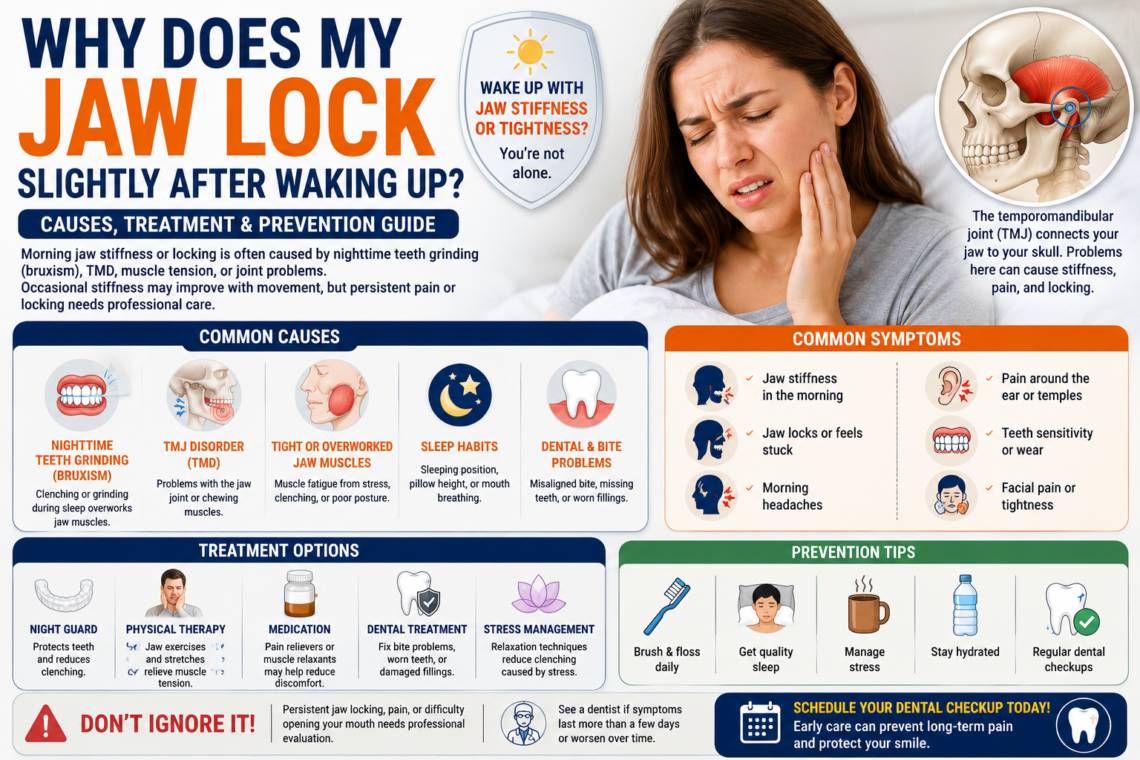
If you wake up and notice that your jaw feels tight, stiff, or slightly difficult to open, you may wonder, “Why does my jaw lock slightly after waking up?”
Morning jaw stiffness can have several causes. One of the most common possibilities is nighttime teeth clenching or grinding, also called bruxism. When you repeatedly clench your jaw during sleep, the chewing muscles can become tired or sore by morning. Bruxism can also contribute to headaches, tooth sensitivity, tooth wear, and jaw discomfort.
Another possibility is a temporomandibular disorder (TMD) affecting the jaw joint or the muscles that control jaw movement. TMD is a broad group of conditions that can cause jaw pain, stiffness, limited movement, and locking.
Occasional mild stiffness may settle as you start moving your jaw. However, repeated locking, increasing pain, or difficulty opening or closing your mouth deserves professional attention.
This guide explains the most common causes of jaw locking after waking up, what you can do to relieve mild symptoms, how nighttime grinding may contribute, and when it’s time to see a dentist or healthcare professional.
Why Does My Jaw Lock Slightly After Waking Up?
There isn’t one explanation for Why does my jaw lock slightly after waking up?.
Possible causes include:
- Nighttime teeth grinding or clenching
- Temporomandibular disorders
- Tight or overworked jaw muscles
- Problems involving the jaw-joint disc
- Stress-related muscle tension
- Previous jaw injury
- Arthritis affecting the jaw joint
- Habits that place excessive strain on the jaw
NIDCR describes TMD as a group of more than 30 conditions involving the jaw joints and chewing muscles. Symptoms can include jaw stiffness, limited movement, and jaw locking.
For many people, however, morning symptoms are closely associated with muscle tension and nighttime clenching.
1. Nighttime Teeth Grinding or Clenching
Sleep bruxism occurs when you grind, clench, or otherwise activate your jaw muscles during sleep.
Because you’re asleep, you may not know that it’s happening. Your dentist may notice signs such as worn, chipped, or cracked teeth, while a partner may notice grinding sounds during the night.
According to NIDCR, bruxism can cause:
- Jaw muscle soreness
- Tightness in the jaw
- Tired jaw muscles
- Headaches
- Tooth sensitivity
- Tooth wear
- Cracked or damaged teeth
- Facial pain
This makes bruxism an important possibility if your jaw feels particularly tight immediately after waking.
If you want to learn more about this problem, read our detailed guide on Teeth Grinding (Bruxism): Symptoms, Causes, and Treatments.
Signs you may be grinding your teeth at night
Morning jaw stiffness is more suspicious for bruxism when it occurs alongside:
- Morning headaches
- Sore cheeks or temples
- Flattened or worn teeth
- Tooth sensitivity
- Chipped teeth
- Jaw fatigue
- Clicking or popping
- A partner hearing grinding sounds
Not everyone with bruxism experiences every symptom.
2. Temporomandibular Disorders (TMD)
Another common explanation for a jaw that feels stuck or restricted is a temporomandibular disorder.
Your temporomandibular joints connect your lower jaw to your skull. You have one joint on each side of your face, just in front of your ears.
These joints work together with several muscles to allow you to:
- Open and close your mouth
- Chew
- Speak
- Yawn
- Move your jaw from side to side
TMD can affect the joints, the chewing muscles, or both.
Common symptoms include:
- Jaw pain
- Jaw stiffness
- Limited movement
- Jaw locking
- Painful clicking or popping
- Facial pain
- Pain around the ear
- Headaches
- Difficulty chewing
For a more detailed explanation, see our existing guide to TMJ Disorder: Symptoms, Causes, and Treatment Options.
3. Tight or Overworked Jaw Muscles
Your jaw muscles work throughout the day, and they may remain tense during sleep.
If your muscles are overworked or continuously contracted overnight, you may wake up with:
- Tight jaw muscles
- Muscle tenderness
- Difficulty opening your mouth comfortably
- Facial fatigue
- Morning jaw pain
Muscle-related TMD can occur without major structural damage to the joint. NIDCR recommends conservative approaches such as reducing clenching, avoiding excessive gum chewing, using heat or cold, and maintaining gentle jaw movement for appropriate TMD symptoms.
4. Jaw-Joint Disc Problems
The temporomandibular joint contains a small disc that helps the joint move smoothly.
In some TMD conditions, this disc may not move normally during jaw opening and closing. This can produce clicking, popping, catching, or locking.
A person may notice that their jaw:
- Catches during opening
- Feels temporarily stuck
- Doesn’t open as widely as usual
- Clicks before becoming easier to move
If this happens repeatedly, don’t try to force the jaw into a wider position. A dentist or qualified healthcare professional can examine the joint and determine whether further evaluation is necessary.
5. Stress and Anxiety
Stress can contribute to jaw tension and clenching.
You might clench your teeth while concentrating, working, driving, or sleeping without consciously realizing it.
NIDCR identifies psychological and life stressors among factors that may contribute to TMD, while stress is also associated with bruxism.
If you notice that your jaw symptoms become worse during stressful periods, relaxation and stress-management strategies may be useful as part of a broader approach.
6. Previous Jaw Injury
A previous injury to the jaw, face, or head can sometimes contribute to problems involving the temporomandibular joint.
Examples include:
- A sports injury
- A fall
- A car accident
- A blow to the face
- Previous jaw dislocation
If morning jaw locking began after an injury, professional evaluation is particularly important.
7. Arthritis and Other Joint Problems
The temporomandibular joints can also be affected by arthritis.
Joint-related problems may produce:
- Stiffness
- Pain
- Reduced movement
- Clicking or grinding
- Difficulty opening the mouth
The cause of TMD isn’t always obvious. NIDCR notes that TMD may involve a combination of biological, psychological, and life-related factors rather than one single cause.
What Does Morning Jaw Stiffness Feel Like?
People describe morning jaw stiffness in different ways.
You might feel:
- A tight sensation around your jaw
- Difficulty opening your mouth fully
- A catching sensation
- Mild pain near your ears
- Jaw muscle soreness
- Facial fatigue
- Clicking when opening the mouth
- Difficulty chewing hard foods
- A temporary feeling that your jaw is stuck
Sometimes the jaw becomes easier to move after several minutes.
Other times, the restricted movement continues throughout the morning.
The duration, severity, and frequency of your symptoms can help a dentist determine whether the problem is more likely related to muscle tension, bruxism, TMD, or another condition.
Is Morning Jaw Locking a Sign of TMJ Disorder?
It can be, but morning jaw locking does not automatically mean you have TMD.
NIDCR lists jaw stiffness and limited movement or locking among symptoms that may signal a TMD. At the same time, painless clicking and popping are common and don’t necessarily require treatment.
The combination of symptoms is more important than one symptom by itself.
For example:
Mild stiffness + no pain:
May be related to temporary muscle tension.
Morning stiffness + tooth wear + headaches:
May suggest bruxism.
Locking + painful clicking + restricted movement:
May indicate a TMD requiring evaluation.
Locking after an injury:
Should be professionally assessed.
How to Relieve Mild Jaw Stiffness in the Morning
If your symptoms are mild and your jaw still moves normally, conservative care may help.
1. Don’t force your jaw open
If your jaw feels stiff, avoid aggressively pulling it open.
Forceful stretching can increase discomfort and may aggravate an already irritated joint or muscle.
Instead, allow the jaw to move gradually within a comfortable range.
2. Apply comfortable heat
A warm compress may help relax tense jaw muscles.
Place it against the side of your face for a short period and use a temperature that feels comfortable.
NIDCR includes heat or cold combined with gentle exercises among conservative approaches that may be recommended for TMD symptoms.
3. Eat softer foods temporarily
If chewing causes pain, choose foods that require less jaw effort.
Examples include:
- Yogurt
- Eggs
- Soft rice
- Pasta
- Oatmeal
- Soup
- Soft vegetables
Avoid very chewy or hard foods while symptoms are active.
4. Avoid chewing gum
Chewing gum requires repetitive jaw movement and can increase muscle workload.
Reducing gum chewing is specifically included among NIDCR’s helpful self-care measures for TMD.
5. Stop unnecessary clenching
During the day, check whether your teeth are constantly pressed together.
If you aren’t eating, your jaw doesn’t need to remain tightly clenched.
Becoming aware of daytime clenching can help reduce unnecessary muscle activity.
6. Manage stress
Relaxation techniques may be useful when stress contributes to jaw tension or bruxism.
You can try:
- Deep breathing
- Meditation
- Gentle stretching
- Regular physical activity
- A consistent sleep routine
- Relaxation before bedtime
NIDCR also recommends self-management and behavioral approaches for some people with TMD.
Could a Night Guard Help?
If nighttime grinding or clenching is contributing to your symptoms, a dentist may recommend an oral appliance or night guard.
These devices can separate the teeth and help protect them from damage caused by grinding. NIDCR notes that intraoral appliances may protect teeth and may help with clenching habits, although evidence for their ability to improve TMD pain is limited.
A night guard isn’t automatically the right solution for everyone with jaw locking.
If a dental professional recommends one, it should be appropriately fitted and monitored. If an appliance causes pain, NIDCR advises stopping its use and consulting your dentist or doctor.
Can Teeth Grinding Cause Morning Jaw Pain?
Yes.
Frequent or severe bruxism can leave the chewing muscles sore and tired after sleep. It can also contribute to headaches and tooth damage.
This is why the combination of morning jaw pain, jaw stiffness, headaches, and tooth wear can be a useful clue for your dentist.
Bruxism can also contribute to tooth sensitivity. If you experience sensitivity along with jaw tension, you can read Sensitive Teeth: Causes, Treatments & When to See a Dentist for additional information.
How Is Jaw Locking Diagnosed?
There isn’t one universal test that diagnoses every type of TMD.
A dentist or healthcare professional will generally begin by asking about your symptoms and examining your jaw.
They may ask:
- When does your jaw lock?
- How long does the stiffness last?
- Is there pain?
- Do you hear clicking or popping?
- Do you grind your teeth?
- Do you wake with headaches?
- Can you open your mouth normally?
- Have you experienced a previous jaw injury?
- Does chewing make the symptoms worse?
The examination may include checking your jaw movement, facial muscles, joint sounds, and areas of tenderness.
When clinically appropriate, imaging may also be used. NIDCR notes that X-rays, MRI, or CT scans may be considered depending on the suspected problem.
For more information about dental imaging, read Dental X-Rays: Types, Safety, and How Often You Need Them.
When Should You See a Dentist?
Occasional mild stiffness isn’t necessarily an emergency.
However, you should consider seeing a dentist or healthcare professional if:
- Your jaw locks repeatedly
- The problem is becoming more frequent
- You have persistent jaw pain
- Your mouth opening becomes limited
- Chewing becomes difficult
- You experience painful clicking or popping
- You frequently grind or clench your teeth
- Your teeth show signs of unusual wear
- Symptoms interfere with eating or speaking
- Home-care measures aren’t helping
TMD symptoms can sometimes improve without treatment, but persistent or troublesome symptoms deserve appropriate evaluation.
When Is a Locked Jaw an Emergency?
A completely locked jaw is different from mild morning stiffness.
Seek prompt medical or dental care if you cannot properly open or close your mouth, particularly if the problem follows an injury or is accompanied by significant swelling or severe pain.
Urgent evaluation is especially important when jaw symptoms occur alongside:
- Significant facial swelling
- Fever
- Severe pain
- Difficulty swallowing
- Difficulty breathing
- Recent trauma
- Inability to eat or drink normally
Don’t attempt to force a severely locked jaw back into position yourself.
If you’re experiencing a sudden dental or oral problem outside normal appointment hours, our guide Dental Emergency: What to Do When You Can’t See a Dentist provides additional general guidance.
How to Prevent Jaw Locking After Waking Up
Prevention depends on what’s causing the problem, but several habits can reduce unnecessary stress on the jaw.
Reduce daytime clenching
Notice when you’re tightening your jaw unnecessarily and consciously relax the muscles.
Limit gum chewing
Avoid prolonged gum chewing, particularly if your jaw already feels sore.
Avoid excessive chewing during flare-ups
Hard, chewy, or very tough foods can increase the workload on irritated jaw muscles.
Address nighttime grinding
If you suspect sleep bruxism, speak with your dentist about appropriate evaluation and treatment.
Improve your sleep routine
Maintain a consistent sleep schedule and create a relaxing bedtime routine.
Manage stress
Stress management may help when clenching or muscle tension contributes to your symptoms.
Don’t ignore recurring symptoms
If the same problem happens repeatedly every morning, don’t simply treat the stiffness without investigating why it keeps happening.
Jaw Clicking vs. Jaw Locking: What’s the Difference?
These symptoms aren’t necessarily the same.
Jaw clicking:
You hear or feel a clicking or popping sound when opening or closing your mouth.
Jaw stiffness:
The jaw feels tight or uncomfortable but still moves normally.
Jaw locking:
The jaw becomes temporarily stuck or its movement becomes significantly restricted.
NIDCR notes that clicking or popping without pain is common and generally does not require treatment. Painful clicking, stiffness, limited movement, or locking can be signs of TMD.
Frequently Asked Questions
Why does my jaw lock slightly after waking up?
Morning jaw locking can be associated with nighttime teeth grinding or clenching, tight jaw muscles, TMD, or other problems affecting the temporomandibular joint. Repeated locking should be evaluated by a dentist or healthcare professional.
Why is my jaw stiff but not painful in the morning?
Mild stiffness can occur when the jaw muscles have been tense or overworked during sleep. Bruxism and daytime clenching may contribute, although other causes are possible.
Can stress cause my jaw to lock?
Stress can contribute to jaw muscle tension and clenching, which may worsen jaw discomfort or contribute to symptoms in people with TMD or bruxism.
Can teeth grinding cause my jaw to feel locked?
Grinding and clenching can cause jaw muscle tightness and fatigue. Severe or repeated symptoms may also occur alongside TMD, so persistent locking should be professionally evaluated.
Should I force my jaw open when it feels locked?
No. Avoid aggressively forcing a stiff or locked jaw open. If the jaw remains stuck or movement is significantly restricted, seek professional care.
Can a night guard prevent morning jaw pain?
A night guard may protect teeth from grinding-related damage and may help some people with clenching, but it isn’t guaranteed to eliminate jaw pain or locking. Your dentist can determine whether an oral appliance is appropriate.
Is jaw clicking always a sign of TMJ disorder?
No. Painless clicking and popping are common and don’t necessarily require treatment. Clicking accompanied by pain, locking, or restricted movement is more concerning.
When should I worry about morning jaw stiffness?
You should seek professional advice when stiffness becomes persistent, painful, recurrent, or associated with limited jaw movement, repeated locking, significant clicking, or difficulty eating and speaking.
Conclusion
If you’ve been asking, “Why does my jaw lock slightly after waking up?”, nighttime clenching or grinding is one possible explanation, but it isn’t the only one.
Morning jaw stiffness can also be associated with temporomandibular disorders, tight jaw muscles, joint problems, previous injury, stress, or other conditions affecting jaw movement.
The good news is that many mild TMD and jaw-muscle problems can be managed conservatively. Avoiding excessive chewing, reducing clenching, using comfortable heat or cold, eating softer foods during flare-ups, and managing stress may help relieve symptoms.
However, recurring jaw locking shouldn’t be ignored. A dentist can look for signs of bruxism, tooth wear, muscle tenderness, and other dental problems and determine whether additional evaluation is needed.
Call to Action
If your jaw repeatedly locks, becomes increasingly painful, or significantly limits your ability to open or close your mouth, seek professional care rather than trying to force it back into position.
For more educational resources about dental health, oral conditions, dental equipment, and preventive care, explore the latest guides available from Dentistry Supplier.