Scheduling your first dental implant consultation is an exciting step toward restoring your smile, but it’s also natural to have questions. Many patients wonder whether they’ll receive treatment on the first visit, how long the appointment will take, what tests are involved, and whether they’re even a good candidate for dental implants.
The good news is that your first dental implant consultation is primarily an evaluation and planning appointment—not the implant surgery itself. During this visit, your dental team gathers the information needed to determine whether implants are the right solution for you and develops a personalized treatment plan based on your oral health, medical history, and treatment goals.
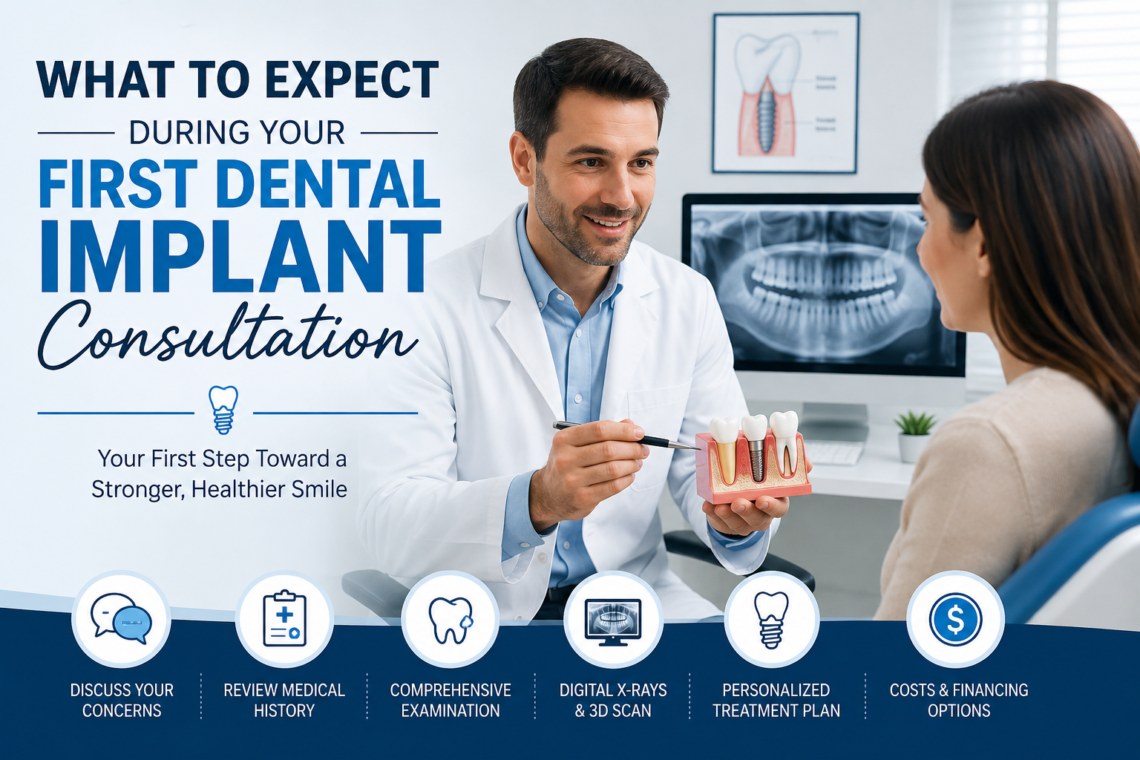
Most consultations include a detailed discussion of your dental concerns, a comprehensive oral examination, diagnostic imaging (such as digital X-rays or a CBCT scan when indicated), and an opportunity to ask questions about the procedure, timeline, expected outcomes, and costs. Many appointments last approximately 30 to 90 minutes, depending on the complexity of your case and whether additional imaging is required.
Why Your First Dental Implant Consultation Is Important
A successful dental implant begins long before the implant is placed. The consultation provides your dentist with the information needed to create a treatment plan tailored to your needs.
During this appointment, your dentist evaluates factors such as:
- Your overall oral health
- The condition of your gums
- Jawbone quantity and quality
- Existing restorations
- Missing teeth
- Bite alignment
- Medical conditions that may affect healing
- Lifestyle factors such as smoking
This comprehensive assessment helps determine not only whether you’re a candidate for implants or , but also whether additional procedures—such as periodontal treatment, tooth extraction, or bone grafting—may be recommended before implant placement.
If you are considering extraction before implant treatment, understanding the differences between preservation and removal can also be helpful. Read our guide to Root Canal vs Tooth Extraction: Which Is Better for Your Oral Health?.
Step-by-Step: What Happens During Your First Dental Implant Consultation?
Your first dental implant consultation is designed to help your dentist determine whether dental implants are the right solution for you. It is also your opportunity to learn about the procedure, discuss your goals, and ask questions before committing to treatment.
Every dental practice has its own workflow, but most implant consultations follow a similar process.
Step 1 – Discuss Your Dental Concerns and Goals
The appointment usually begins with a conversation about your oral health and what you hope to achieve with dental implants.
Your dentist may ask questions such as:
- Which tooth or teeth are missing?
- How long have they been missing?
- Are you experiencing pain or difficulty chewing?
- Have you previously worn a bridge or denture?
- What concerns do you have about your smile?
- What are your expectations from treatment?
Understanding your goals helps your dentist recommend the most appropriate treatment options.
Step 2 – Review Your Medical and Dental History
Your overall health plays an important role in implant success.
Your dentist will review:
Medical History
- Current medications
- Allergies
- Diabetes
- Heart conditions
- Osteoporosis
- Autoimmune disorders
- Previous surgeries
- Smoking or tobacco use
- Pregnancy (if applicable)
Dental History
- Previous root canals
- Gum disease
- Tooth extractions
- Dental implants
- Orthodontic treatment
- Teeth grinding (bruxism)
Some medical conditions do not prevent implant treatment, but they may require additional planning or coordination with your physician.
If you grind or clench your teeth, you may also benefit from understanding Bruxism (Teeth Grinding): Why It Happens and How to Stop It before discussing your implant treatment plan.
Step 3 – Comprehensive Oral Examination
Next, your dentist performs a detailed examination of your mouth.
The evaluation may include:
✔ Remaining teeth
✔ Gum health
✔ Signs of periodontal disease
✔ Tooth mobility
✔ Existing restorations
✔ Bite alignment
✔ Jaw movement
✔ Soft tissues
✔ Bone condition
The goal is to identify any issues that should be treated before implant placement.
Step 4 – Digital X-Rays and 3D CBCT Scan
Diagnostic imaging provides detailed information about your jawbone and surrounding structures.
Digital X-Rays Help Evaluate
- Remaining tooth roots
- Bone levels
- Tooth positioning
- Existing restorations
- Signs of infection
3D CBCT Scan May Be Used To Assess
- Bone height and width
- Bone density
- Nerve locations
- Maxillary sinus position
- Implant placement planning
- Anatomical structures
Three-dimensional imaging allows the dental team to evaluate implant placement with greater precision in appropriate cases.
Step 5 – Determine If You’re a Good Candidate
After reviewing your examination and imaging, your dentist will determine whether dental implants are likely to be an appropriate treatment option.
Good Candidates Often Have
- One or more missing teeth
- Healthy gums or treatable gum conditions
- Adequate jawbone to support an implant (or suitability for bone augmentation if needed)
- Good oral hygiene habits
- Overall health that supports healing
Additional Treatment May Be Recommended Before Implants
- Periodontal (gum) therapy
- Tooth extraction
- Bone grafting
- Sinus augmentation (when indicated)
- Treatment of dental infections
- Restorative care for other teeth
Step 6 – Bone Graft Assessment
One of the most important parts of implant planning is evaluating the quantity and quality of the jawbone.
If there is not enough bone to securely support an implant, your dentist may recommend procedures such as:
- Bone grafting
- Socket preservation
- Guided bone regeneration
- Sinus lift (for certain upper back teeth)
Not every implant patient needs bone grafting. The recommendation depends on your individual anatomy and treatment plan.
Step 7 – Discuss Your Personalized Treatment Plan
Once the evaluation is complete, your dentist will explain your treatment options.
The discussion typically includes:
- Number of implants recommended
- Implant locations
- Need for additional procedures
- Estimated treatment timeline
- Healing stages
- Final restoration (crown, bridge, or denture)
- Expected outcomes
- Benefits and potential risks
This is an excellent time to ask questions and ensure you understand each stage of the process.
If a dental crown will be used as the final restoration, you can also review How Long Do Dental Crowns Last? to understand factors that can affect crown longevity.
Step 8 – Review Costs and Financing Options
Dental implant treatment is individualized, so costs vary based on several factors.
Your treatment estimate may include:
- Consultation and diagnostic imaging
- Tooth extraction (if needed)
- Bone grafting (if recommended)
- Implant placement
- Healing abutment
- Abutment
- Implant crown, bridge, or denture
- Follow-up visits
Many dental practices also discuss financing options, payment plans, or insurance benefits where applicable.
Important Note: Dental insurance coverage for implants varies significantly between plans. Ask your provider and dental office for a detailed explanation of benefits before beginning treatment.
Questions You Should Ask During Your Consultation
Preparing questions in advance can help you make an informed decision.
Consider asking:
- Am I a good candidate for dental implants?
- Will I need bone grafting or other preparatory treatment?
- How many implants do I need?
- What are the risks and benefits in my case?
- How long will the entire treatment process take?
- What type of implant restoration is recommended?
- What is the estimated total cost?
- Does my insurance cover any part of the treatment?
- What happens if I delay treatment?
- How should I care for my implant after placement?
How to Prepare Before Your Dental Implant Consultation
A little preparation can make your appointment more productive and help your dentist create a more accurate treatment plan.
Bring the Following Items
✔ Government-issued identification (if required)
✔ Dental insurance information (if applicable)
✔ List of current medications
✔ Medical history and recent health updates
✔ Previous dental X-rays or CBCT scans (if available)
✔ Referral letter (if referred by another dentist)
✔ List of questions about treatment
✔ Payment or financing information (if you plan to discuss costs)
Who Is a Good Candidate for Dental Implants?
While many adults are eligible for dental implants, candidacy depends on several factors.
Ideal Candidates Usually Have
- One or more missing teeth
- Healthy gums or gum disease that can be treated
- Sufficient jawbone to support an implant (or suitability for bone grafting)
- Good oral hygiene habits
- Overall health that supports healing
- Commitment to regular dental checkups
Reasons Treatment May Be Delayed
Not every patient is ready for implant surgery immediately.
Your dentist may recommend additional treatment if you have:
- Active gum disease
- Untreated tooth decay
- Insufficient jawbone volume
- Certain uncontrolled medical conditions
- Poor oral hygiene
- Heavy smoking or tobacco use
- Active oral infection
These issues don’t always prevent implants, but addressing them first can improve the chances of long-term success.
Choosing the Right Implant Dentist
Selecting an experienced provider is just as important as choosing the treatment itself.
Look For
✔ Experience with implant procedures
✔ Advanced diagnostic technology (such as CBCT imaging)
✔ Clear communication
✔ Transparent treatment planning
✔ Detailed cost estimates
✔ Positive patient reviews
✔ Comprehensive follow-up care
✔ Emergency support if needed
Latest Trends in Dental Implant Consultations
Modern implant dentistry continues to evolve with digital technologies that improve planning and communication.
Current Trends
- 3D CBCT imaging for detailed assessment of bone and anatomy
- Digital treatment planning for more precise implant positioning
- Intraoral scanning to reduce the need for traditional impressions in many cases
- Guided implant surgery using digitally planned surgical guides where appropriate
- Virtual smile previews in selected restorative cases
- Improved patient education through digital imaging and treatment simulations
These advancements can improve diagnostic accuracy and help patients better understand their treatment options.
Pros and Cons of Dental Implants
| Pros | Cons |
| Closely mimic the look and function of natural teeth | Higher initial cost than some replacement options |
| Help preserve jawbone after tooth loss | Treatment often takes several months from start to finish |
| Do not rely on adjacent teeth for support | Some patients require bone grafting or additional procedures |
| Stable and comfortable for eating and speaking | Minor surgical procedure is required |
| Can provide long-term function with proper care | Success depends on healing and good oral hygiene |
Myths vs. Facts About Your First Dental Implant Consultation
| Myth | Fact |
| You’ll receive your dental implant during the first appointment. | Most first consultations focus on evaluation, diagnostic imaging, and treatment planning. Implant surgery is usually scheduled for a later visit. |
| If I’m missing a bone, I can’t get dental implants. | Not necessarily. Many patients with reduced bone volume may still qualify after procedures such as bone grafting or other preparatory treatments, depending on their individual case. |
| Dental implant consultations are only about cost. | While costs are discussed, the consultation primarily evaluates your oral health, medical history, bone structure, and treatment options. |
| Anyone missing a tooth is automatically a candidate for implants. | Suitability depends on factors such as gum health, bone quality, medical history, and overall oral health. |
| Dental implant treatment is the same for every patient. | Every treatment plan is customized based on the patient’s clinical findings, goals, and overall health. |
Frequently Asked Questions (FAQs)
1. What happens during the first dental implant consultation?
Your dentist reviews your medical and dental history, performs an oral examination, may take diagnostic images such as digital X-rays or a CBCT scan (when indicated), evaluates your suitability for implants, and discusses a personalized treatment plan.
2. Will I get my dental implant on the first visit?
In most cases, no. The first appointment focuses on diagnosis and planning. Implant placement is typically scheduled for a later appointment after the evaluation is complete.
3. How long does a dental implant consultation take?
Many consultations last 30 to 90 minutes, depending on the complexity of the case, whether imaging is required, and the amount of treatment planning involved.
4. What should I bring to my consultation?
Bring your medical history, a list of medications, dental insurance information (if applicable), previous dental records or X-rays (if available), and a list of questions you’d like to discuss.
5. Will I need a CBCT scan?
Not every patient requires a CBCT scan. Your dentist will determine whether three-dimensional imaging is appropriate based on your anatomy, treatment complexity, and planning needs.
Conclusion
Knowing what to expect during your first dental implant consultation can help you approach your appointment with confidence and realistic expectations. Rather than focusing solely on the implant procedure itself, this visit is designed to evaluate your oral health, identify the best treatment options, and create a personalized plan that supports long-term success.
By preparing for the consultation, sharing your complete medical history, asking thoughtful questions, and understanding each stage of the treatment process, you’ll be better equipped to make informed decisions about replacing missing teeth. A successful dental implant journey begins with careful planning—and your consultation is the first and most important step.
Call to Action
Missing one or more teeth and wondering if dental implants are right for you?
Our experienced dental team provides comprehensive implant consultations using modern diagnostic technology and personalized treatment planning. We’ll evaluate your oral health, answer your questions, explain every stage of the process, and help you determine the best tooth replacement option for your needs.