Quick Answer
Dental fillings repair decayed or damaged tooth structure and prevent further destruction. In 2026, composite resin dominates for visible teeth due to aesthetic matching, while amalgam persists for posterior teeth where durability and cost matter. Gold and ceramic inlays offer premium longevity for large restorations. A single filling costs $150–$450 depending on size, location, and material. The procedure is routine, typically completed in one visit under local anesthesia, with immediate return to normal activities.
What This Article Covers
-
How dentists decide filling versus crown
-
Filling materials compared honestly
-
The complete procedure from numbing to polishing
-
True costs and insurance coverage in 2026
-
Lifespan and when replacement is needed
-
Preventing the next cavity
When a Filling Suffices and When It Does Not
Not every decayed tooth gets a filling. The extent of damage determines the appropriate restoration.
Fillings work when decay is confined to enamel and dentin without compromising structural integrity. The remaining tooth structure can support normal chewing forces. The cavity is accessible for complete removal and restoration. No cracks extend below the restoration margin.
Crowns become necessary when decay or fracture removes so much tooth structure that filling material cannot withstand chewing forces. Cracks extend through the tooth. Previous large fillings have failed repeatedly. Root canal treatment leaves the tooth brittle and prone to fracture.
Dr. Chan: “I see patients frustrated when I recommend a crown instead of a filling. They think I’m upselling. The reality is that a filling in a compromised tooth is a temporary fix that will fail, often catastrophically. I’d rather explain the crown now than extract the tooth later because a large filling cracked the root.”
Filling Materials: Honest Comparison
Composite Resin
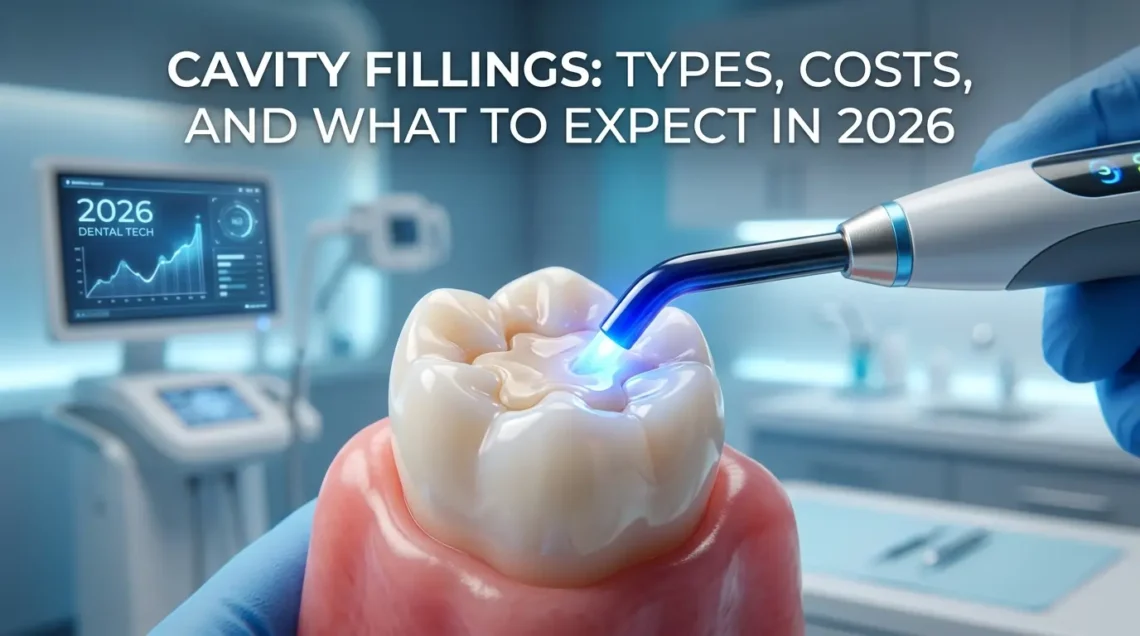
Tooth-colored material made of plastic resin and glass filler particles. Applied in layers, cured with blue light, and polished to match surrounding enamel.
Advantages: Aesthetic matching to natural tooth color. Bonds directly to tooth structure, requiring less removal of healthy enamel. Versatile for anterior and posterior teeth. Repairable if chipped.
Disadvantages: Wears faster than amalgam under heavy grinding. More technique-sensitive placement requires dry field control. Higher cost. May stain over time at margins. Requires replacement sooner in high-stress areas.
Lifespan: 5–7 years for posterior teeth, 7–10 years for anterior teeth with lighter forces.
Cost: $150–$300 per filling for small to moderate cavities. Large composites approach $400.
Amalgam
Silver-colored alloy containing mercury, silver, tin, and copper. Mixed immediately before placement, packed into prepared cavity, and carved to anatomy before hardening.
Advantages: Exceptional durability under chewing forces. Easier placement in wet environments. Lower cost. Proven track record spanning over 150 years. Self-sealing margins improve over time as corrosion products deposit.
Disadvantages: Metallic appearance unsuitable for visible teeth. Requires more tooth removal for mechanical retention. Environmental concerns about mercury disposal. Controversy over mercury safety despite overwhelming evidence of stability once set. Thermal conductivity may cause sensitivity.
Lifespan: 10–15 years, often longer in low-stress areas.
Cost: $100–$250 per filling.
Safety note: The mercury in amalgam is bound chemically and released in minuscule amounts far below any health threshold. Major health organizations including the FDA, ADA, and WHO confirm amalgam safety for most patients. It is contraindicated only for those with mercury allergy or specific genetic conditions affecting mercury metabolism.
Gold
Cast gold alloy restorations fabricated in a laboratory and cemented into prepared cavities. Rare for direct fillings, more common for inlays and onlays.
Advantages: Unmatched durability and wear compatibility with natural enamel. Biocompatibility excellent. Marginal integrity superior to any other material. Some patients prefer gold for posterior teeth.
Disadvantages: Cost prohibitive for most. Multiple visits required. Metallic appearance. Declining patient preference and dentist training in placement.
Lifespan: 20–30+ years.
Cost: $800–$1,500 per restoration.
Ceramic (Porcelain)
Laboratory-fabricated or milled in-office from ceramic blocks. Used for inlays, onlays, and some direct applications.
Advantages: Excellent aesthetics. Biocompatibility. Wear properties similar to enamel. Stain resistance.
Disadvantages: Brittleness under point forces. Requires more tooth reduction. Higher cost. Technique-sensitive cementation.
Lifespan: 10–15 years.
Cost: $500–$1,200 per restoration.
Glass Ionomer
Tooth-colored material releasing fluoride. Used for specific indications rather than general cavities.
Advantages: Fluoride release inhibits recurrent decay. Chemical adhesion to tooth. Minimal preparation. Useful for root caries, pediatric dentistry, and temporary restorations.
Disadvantages: Poor wear resistance. Lower strength. Aesthetics inferior to composite. Limited to low-stress situations.
Lifespan: 3–5 years.
Cost: $100–$200.
The Complete Filling Procedure
Diagnosis and Anesthesia
Your dentist examines the tooth visually, probes suspicious areas, and reviews bitewing X-rays to determine decay extent. Local anesthetic numbs the tooth and surrounding tissue. Modern articaine and lidocaine formulations work within minutes and provide profound anesthesia for the duration.
Decay Removal
The dentist removes decayed tooth structure using a high-speed handpiece with diamond or carbide burs. Slow-speed instruments complete excavation near the pulp. The goal is complete bacteria removal while preserving maximum healthy structure.
Cavity Preparation
The cavity is shaped to retain the filling material. For amalgam, undercuts provide mechanical lock. For composite, bonding agents eliminate the need for aggressive tooth reduction. The dentist applies cavity liner or base near the pulp if decay approached the nerve, protecting against sensitivity and providing therapeutic benefit.
Material Placement and Finishing
Composite: Acid etching roughens enamel microscopically. Bonding agent penetrates and cures. Composite is placed in thin layers, each cured with LED light. The final layer is sculpted to match tooth anatomy. Polishing creates smooth, stain-resistant surface.
Amalgam: The mixed material is packed into the cavity in increments, condensed to eliminate voids, and carved to functional anatomy. The patient is instructed not to chew on that side for several hours while hardening completes.
Bite Adjustment and Polish
You bite on articulating paper to identify high spots. The dentist adjusts until contact feels natural. Final polishing ensures smooth margins that resist plaque accumulation and staining.
Total appointment time: 30 minutes to 1 hour for single-surface fillings. Multi-surface or multiple fillings extend accordingly.
True Costs in 2026
Filling costs vary by material, cavity size, geographic location, and dentist experience.
| Filling Type | Small Cavity | Medium Cavity | Large Cavity |
|---|---|---|---|
| Amalgam | $100–$150 | $150–$200 | $200–$250 |
| Composite | $150–$200 | $200–$300 | $300–$450 |
| Ceramic inlay/onlay | — | $500–$800 | $800–$1,200 |
| Gold inlay/onlay | — | $600–$1,000 | $1,000–$1,500 |
Insurance coverage: Most dental plans cover 70–80% of amalgam costs for posterior teeth. Composite coverage on posterior teeth is often downgraded to amalgam reimbursement, leaving patients responsible for the difference. Anterior composite fillings are typically covered at standard rates. Annual maximums limit total payout.
Hidden costs to consider:
-
Diagnostic X-rays: $25–$75
-
Anesthesia: usually included
-
Core buildup if decay was extensive: $150–$300
-
Crown if tooth is too compromised: $1,000–$2,000
-
Replacement when filling fails: full cost again
Lifespan and Replacement Reality
No filling lasts forever. Material properties, oral habits, and decay risk determine longevity.
Why fillings fail:
-
Recurrent decay at margins where bacteria penetrate microscopic gaps
-
Fracture from grinding, hard foods, or inadequate remaining tooth structure
-
Wear from opposing teeth, particularly in grinders
-
Leakage as bonding degrades or thermal cycling stresses margins
-
Tooth structure breakdown around large fillings, requiring crown conversion
Replacement considerations:
Each replacement cycle removes additional tooth structure. A filling that becomes a larger filling eventually becomes a crown. Preserving tooth structure initially by choosing appropriate restoration size and material delays this progression.
Preventing the Next Cavity
Fillings treat decay. Prevention stops it from starting or recurring.
Daily habits:
-
Brush twice daily with fluoride toothpaste for two minutes
-
Floss or use interdental brushes daily
-
Limit between-meal snacking, especially sugary or acidic foods
-
Drink water throughout the day; rinse after acidic consumption
-
Chew sugar-free gum to stimulate saliva flow
Professional care:
-
Dental examinations and cleanings every six months
-
Bitewing X-rays annually to catch interproximal decay early
-
Fluoride varnish applications if decay risk is elevated
-
Sealants for deep grooves in molars, particularly in children and adolescents
Risk factor management:
-
Dry mouth from medications requires saliva substitutes and more frequent dental visits
-
GERD or frequent vomiting exposes teeth to acid; treat the underlying condition
-
Diabetes control improves oral health outcomes
-
Smoking cessation reduces decay risk and improves healing
Dr. Chan: “I can place perfect fillings all day, but I’d rather never see you for decay again. The patients who stop getting cavities change their daily habits, not just their dental visit frequency. Small behavioral shifts compound into dramatic oral health improvements over years.”
The Bottom Line
Cavity fillings are among dentistry’s most common and successful procedures. Material choice matters but is secondary to proper diagnosis, complete decay removal, and meticulous technique. Composite dominates modern practice for aesthetics, amalgam persists for durability and value, and premium options serve specific indications.
The real goal is not choosing the perfect filling. It is preventing the next cavity from forming. Every filling represents a failure of prevention somewhere upstream. Use that knowledge as motivation to improve daily habits, maintain professional care, and address risk factors that put you in the chair repeatedly.
Your teeth are not disposable. Each restoration is a patch on a structure that cannot be replaced once lost. Protect what remains.
Sources
-
American Dental Association. “Restorative Materials: Clinical Recommendations and Evidence Review.” JADA, 2025;156(5):345-358.
-
Chan A. “Composite Resin Longevity in Posterior Teeth: A 10-Year Practice-Based Cohort Study.” General Dentistry, 2025;73(4):312-318.
-
Opdam NJM, et al. “Amalgam and Composite Restorations: 25-Year Survival and Failure Modes.” Journal of Dentistry, 2024;142:104-112.
-
FDA. “Dental Amalgam: Safety and Regulatory Update.” FDA Consumer Update, 2025.
-
Tyas MJ, et al. “Minimal Intervention Dentistry: Evidence-Based Clinical Guidelines.” Australian Dental Journal, 2024;69(Suppl 1):S45-S58.