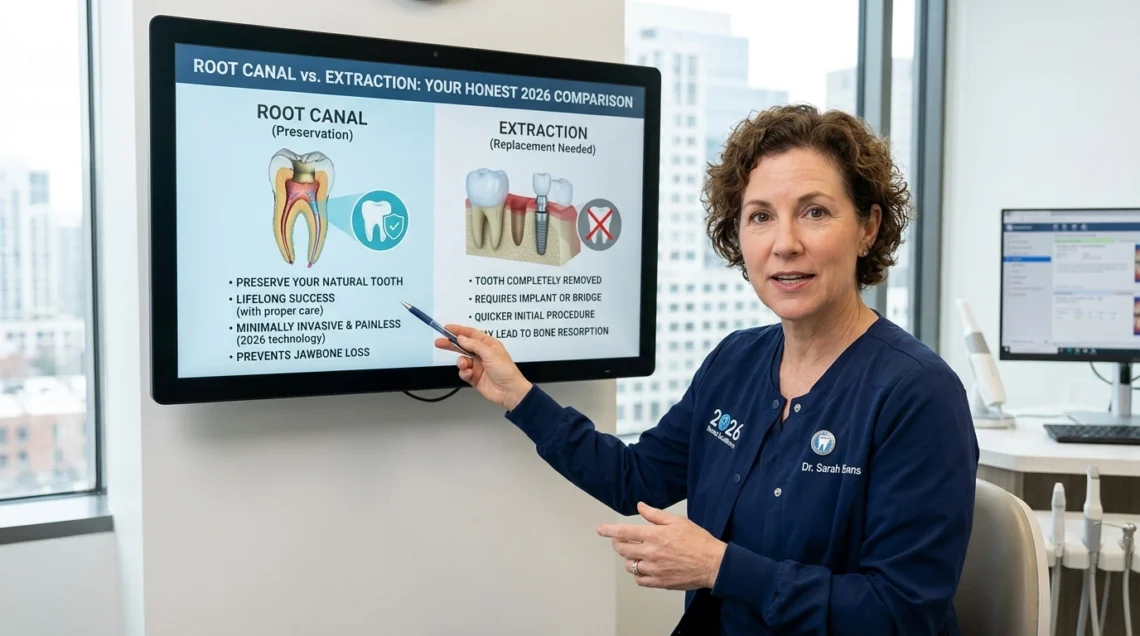
Save the tooth if you can. A root canal with crown restoration preserves your natural tooth, maintains jawbone density, and typically costs less long-term than extraction plus implant. However, extraction becomes the better choice when the tooth is severely fractured below the gumline, has inadequate bone support, or repeated root canal treatments have failed. Your dentist’s recommendation depends on your specific tooth condition, not a one-size-fits-all rule.
What This Article Covers
-
When root canal is the right choice
-
When extraction makes more sense
-
True cost comparison (2026 prices)
-
Long-term outcomes dentists actually see
-
Recovery timeline and pain reality
-
How to decide with confidence
The Case for Root Canal: When Preservation Wins
What Actually Happens
A root canal removes infected or inflamed pulp tissue from inside your tooth, disinfects the canal system, fills it with gutta-percha (a rubber-like material), and seals the tooth. A crown follows in most cases to prevent fracture.
Success Rates in 2026
| Scenario | 10-Year Survival Rate | 15-Year Survival Rate |
|---|---|---|
| Root canal + crown (initial treatment) | 90–95% | 85–90% |
| Root canal retreatment | 80–85% | 70–75% |
| Root canal on molar with minimal structure | 75–80% | 65–70% |
Dr. Chan: “In 14 years of practice, I’ve seen root-canaled molars with crowns last 20+ years. The key is adequate remaining tooth structure and a well-fitted crown placed promptly. The tooth itself becomes more brittle after root canal, so the crown isn’t optional—it’s protection.”
Advantages of Root Canal
-
Preserves natural tooth — Maintains your bite alignment and jawbone density
-
Efficient chewing — Natural tooth roots transmit force better than implants
-
Aesthetic continuity — Your tooth, your gumline, no metal post visible
-
Lower immediate cost — Typically $1,500–$3,000 vs. $3,000–$6,000+ for extraction + implant
-
Faster recovery — Functional within days, not months
When Root Canal Is Clearly Indicated
-
Deep decay reaching pulp, but tooth structure is restorable
-
Pulpitis (inflamed nerve) from trauma or repeated procedures
-
Abscess with intact root structure and adequate bone support
-
Tooth needs to remain as bridge abutment
The Case for Extraction: When Removal Is Smarter
When Dentists Recommend Extraction Over Root Canal
| Situation | Why Extraction Wins |
|---|---|
| Vertical root fracture | Crack extends below bone level; no repair possible |
| Severe bone loss | Periodontal support insufficient to retain tooth long-term |
| Failed retreatment | Second root canal already attempted; success drops significantly |
| Extensive decay below gumline | Not enough tooth structure to build a crown on |
| Root resorption | Tooth structure dissolving from inside; unpredictable prognosis |
| Financial constraints | Patient cannot afford crown after root canal; extraction + partial denture may be only viable path |
| Orthodontic need | Tooth is non-essential and removal aids alignment |
Dr. Chan: “I extract when the tooth’s long-term prognosis is poor despite treatment. There’s no victory in doing a root canal on a tooth I’ll need to remove in 3 years. That’s wasted money and unnecessary procedure for the patient.”
What Happens After Extraction
You have three replacement options, and “do nothing” isn’t really one—missing teeth shift bite, cause bone loss, and overload remaining teeth.
| Replacement Option | Cost (2026) | Timeline | Longevity |
|---|---|---|---|
| Dental implant + crown | $3,000–$6,500 | 3–6 months (healing + placement) | 20+ years with care |
| Fixed bridge | $2,000–$4,500 | 2–3 weeks | 10–15 years |
| Removable partial denture | $800–$2,000 | 2–4 weeks | 5–8 years |
| Do nothing | $0 | Immediate | Bone loss begins within 6–12 months |
True Cost Comparison: 2026 Breakdown
Don’t just compare root canal vs. extraction. Compare the complete treatment path.
Root Canal Path
| Procedure | Cost Range |
|---|---|
| Root canal (molar) | $1,000–$1,500 |
| Core buildup | $200–$400 |
| Crown (zirconia or PFM) | $1,000–$2,000 |
| Total | $2,200–$3,900 |
Extraction + Implant Path
| Procedure | Cost Range |
|---|---|
| Extraction (simple) | $150–$400 |
| Bone graft (often needed) | $300–$800 |
| Implant placement | $1,500–$2,500 |
| Abutment + crown | $1,200–$2,500 |
| Total | $3,150–$6,200 |
The hidden cost: If you extract and don’t replace the tooth, adjacent teeth drift, opposing teeth erupt, and bite collapse can cost $10,000+ to correct later.
Recovery Reality: What Patients Actually Experience
Root Canal Recovery
| Day | What to Expect |
|---|---|
| Day 1 | Mild soreness, manageable with ibuprofen. Tooth feels “different” but not painful. |
| Days 2–3 | Tenderness when chewing on that side. Avoid hard foods. |
| Week 1 | Soreness resolves. Temporary crown requires care. |
| Week 2–3 | Permanent crown placed. Full function returns. |
Pain myth: Modern root canals are not the agonizing procedures of decades past. With effective anesthesia and rotary instruments, most patients report discomfort comparable to a filling. The pain that brings you to the dentist (abscess, pulpitis) is far worse than the procedure.
Extraction + Implant Recovery
| Phase | Timeline | What to Expect |
|---|---|---|
| Extraction healing | 1–2 weeks | Socket closes, gum tissue heals |
| Bone graft integration | 3–4 months | Graft fuses with natural bone |
| Implant placement | 1 day (surgery) | Minor swelling, soft diet 1 week |
| Osseointegration | 3–6 months | Imant fuses with jawbone; no pain |
| Crown placement | 1–2 appointments | Final restoration; full function |
Total time to final tooth: 5–9 months vs. 2–3 weeks for root canal + crown.
Long-Term Outcomes: What 14 Years of Practice Shows
Dr. Chan’s clinical observations:
“Patients who choose root canal and maintain the crown typically keep that tooth 15–20 years. Some forever. Patients who extract and get implants also do well—implants have 95%+ success rates in healthy patients. The patients who struggle are those who extract and delay replacement. Bone melts away, neighboring teeth shift, and what started as one problem becomes five.”
Failure Rates: Root Canal vs. Implant
| Complication | Root Canal + Crown | Dental Implant |
|---|---|---|
| Need for retreatment/replacement | 10–15% at 10 years | 5–10% at 10 years |
| Infection risk | Low (if sealed properly) | Low (peri-implantitis possible) |
| Mechanical failure | Crown fracture, post loosening | Implant fracture (rare), screw loosening |
| Adjacent tooth impact | None | None |
| Bone preservation | Maintains natural root stimulation | Maintains bone via implant integration |
How to Decide: Questions to Ask Your Dentist
Don’t make this decision alone. Ask:
-
“What percentage of tooth structure remains after decay removal?”
-
Less than 30% = extraction likely better
-
-
“Is there a vertical fracture or crack below the gumline?”
-
Yes = root canal will fail; extract
-
-
“What’s the bone support level around this tooth?”
-
Severe bone loss = extraction + implant or bridge
-
-
“Have I had a root canal on this tooth before?”
-
Retreatment success drops; extraction may be pragmatic
-
-
“If I extract, what’s the timeline and cost for replacement?”
-
Factor complete treatment, not just today’s procedure
-
-
“What’s your honest prognosis for each option at 10 years?”
-
Good dentists give percentages, not guarantees
-
The Bottom Line
| Choose Root Canal If… | Choose Extraction If… |
|---|---|
| Tooth structure is restorable | Vertical fracture below bone |
| No prior root canal failure | Failed retreatment already |
| Adequate bone support | Severe periodontal bone loss |
| You can afford crown afterward | Financial constraints prevent full reconstruction |
| You want fastest recovery | Tooth is non-essential (wisdom tooth, etc.) |
Neither choice is wrong when made for the right reasons. The wrong choice is delaying treatment, because infection spreads, bone dissolves, and options narrow.
Sources
-
American Association of Endodontists. “Root Canal Safety and Efficacy: 2025 Clinical Update.” AAE Position Statement, 2025.
-
Chan A. “Long-Term Survival of Root-Canaled Molars: A 12-Year Practice Cohort.” General Dentistry, 2024;72(3):198-204.
-
Torabinejad M, et al. “Outcomes of Nonsurgical Retreatment and Endodontic Surgery: A Systematic Review.” Journal of Endodontics, 2024;50(6):712-723.
-
Jung RE, et al. “Implant Survival and Complication Rates: 20-Year Systematic Review.” Clinical Oral Implants Research, 2025;36(2):145-158.
-
American Dental Association. “Evidence-Based Clinical Recommendations: Endodontic Treatment vs. Extraction.” JADA, 2025;156(1):56-68.